Starting a personalized gift business is a rewarding venture that combines creativity with business savvy. The industry is worth billions of dollars, with steady demand for unique items for weddings, birthdays, and corporate events.
This guide will take you through the practical steps of validating your business concept, acquiring the right equipment, building supplier relationships, and obtaining necessary permits to help you launch a successful personalized gift business in the U.S.
Step 1: Validate your business idea and plan your budget
First, find your niche. Use Google Trends to compare search interest for terms like “personalized baby gift” versus “custom corporate award.” Also, browse social media hashtags and Etsy categories to see what products are currently popular and have high engagement.
Analyze your competition
Identify 3-5 direct competitors on platforms like Etsy or Amazon Handmade. Create a simple spreadsheet to track their product range, pricing, and shipping policies. Read their customer reviews to find gaps in their service or product quality that you can fill.
Estimate your startup costs
Your initial investment will vary. A common mistake is to purchase expensive equipment too early. You might consider starting with a versatile vinyl cutter like a Cricut or Silhouette ($300-$500) before you commit to a laser engraver, which can cost over $4,000.
In addition to equipment, budget for initial inventory of blank items like mugs or shirts ($500-$1,500). Factor in design software like Canva Pro (around $13/month) and business formation fees, which typically run from $100 to $500 depending on your state.
Here are 3 immediate steps to take:
- Research five potential gift niches using Google Trends and Etsy.
- Create a spreadsheet to compare three competitors’ pricing for a product you want to offer.
- Draft a startup budget that lists your top five expected expenses.
Step 2: Set up your legal structure and get licensed
You might want to form a Limited Liability Company (LLC) through your state’s Secretary of State website. An LLC protects your personal assets if your business faces legal issues. Many new owners skip this, but a sole proprietorship leaves your personal finances exposed.
Next, get a free Employer Identification Number (EIN) from the IRS website. You will need this number to open a business bank account and file federal taxes, even if you have no employees.
Handle state and local requirements
Apply for a seller’s permit, also called a resale certificate, from your state’s Department of Revenue. This permit allows you to buy wholesale goods without paying sales tax and is required for you to collect sales tax from customers. Processing can take 2-3 weeks.
Check with your city or county clerk for a general business license, which can cost between $50 and $150 annually. If you operate from home, you may also need a Home-Based Business Permit to ensure you comply with local zoning laws.
Here are 4 immediate steps to take:
- Research your state's LLC formation fees and processing times.
- Apply for a free EIN directly on the IRS website.
- Find the seller’s permit application on your state’s Department of Revenue site.
- Check your local city government’s website for business license information.
Step 3: Secure your business with the right insurance
You will want to start with General Liability insurance. This policy covers claims like bodily injury or property damage. For a home-based operation, annual premiums often range from $400 to $600 for $1 million in coverage.
Also consider Product Liability insurance, which protects you if a gift causes harm, like a misspelled wedding favor or a baby item with a defect. This coverage is frequently bundled with a general liability policy.
Now, let's talk about your gear. Business Property insurance covers your expensive equipment, like a laser engraver, against theft or fire. Many new owners assume their homeowner's policy protects business assets, but it typically does not.
When you look for coverage, providers like Hiscox, The Hartford, and Next Insurance are known for working with small businesses. You can often get a quote online in minutes. If you hire help, you will need Workers' Compensation insurance.
Here are 4 immediate steps to take:
- Get online quotes for a $1 million General Liability policy.
- Ask if Product Liability can be bundled with your general liability policy.
- Review your homeowner's insurance to confirm its coverage limit for business property.
- List your equipment and its value to prepare for a property insurance quote.
Step 4: Choose your workspace and buy equipment
Most personalized gift businesses start from home. You will need a dedicated area of about 100-150 square feet. A spare bedroom or a clean corner of a garage works well. Before you set up, check your local zoning laws for any restrictions on home-based businesses.
Select your starting equipment
Your equipment choices depend on the products you want to sell. A 15x15 inch heat press is a versatile starting point for apparel and flat items, costing between $200 and $400. Many new owners make the mistake of buying too much specialized gear at once.
For full-color designs on mugs and phone cases, a sublimation printer like the Sawgrass SG500 is a popular option at around $600. If you plan to engrave wood or acrylic, a desktop laser like an xTool starts near $500, while a Glowforge is a larger investment.
Find your wholesale suppliers
Now that you have equipment in mind, find suppliers for your blank products. Companies like JDS Industries and Johnson Plastics Plus offer a wide range of items for engraving and sublimation. For vinyl and presses, Heat Press Nation is a common choice.
A benefit of this industry is that many suppliers have no minimum order quantity. This allows you to buy just a few items to test a new product idea. Avoid the urge to buy in bulk until you have confirmed sales for a specific design.
Here are 4 immediate steps to take:
- Measure a 100-square-foot area in your home for your workspace.
- Compare prices for a 15x15 inch heat press on Heat Press Nation.
- Create a free account on Johnson Plastics Plus to browse their sublimation blanks.
- Check your city’s website for home-based business zoning rules.
Step 5: Set up your payment processing
Establish your payment terms
For custom orders, you might want to require a 50% non-refundable deposit. This protects your investment in materials if a client cancels. For smaller, off-the-shelf items, it is standard to collect the full payment upfront before you begin any personalization work.
Choose a payment solution
When you select a payment processor, pay attention to transaction fees and how quickly you get your money. Some new owners find their cash flow tight because of high monthly fees or processors that hold funds for several days before a bank transfer.
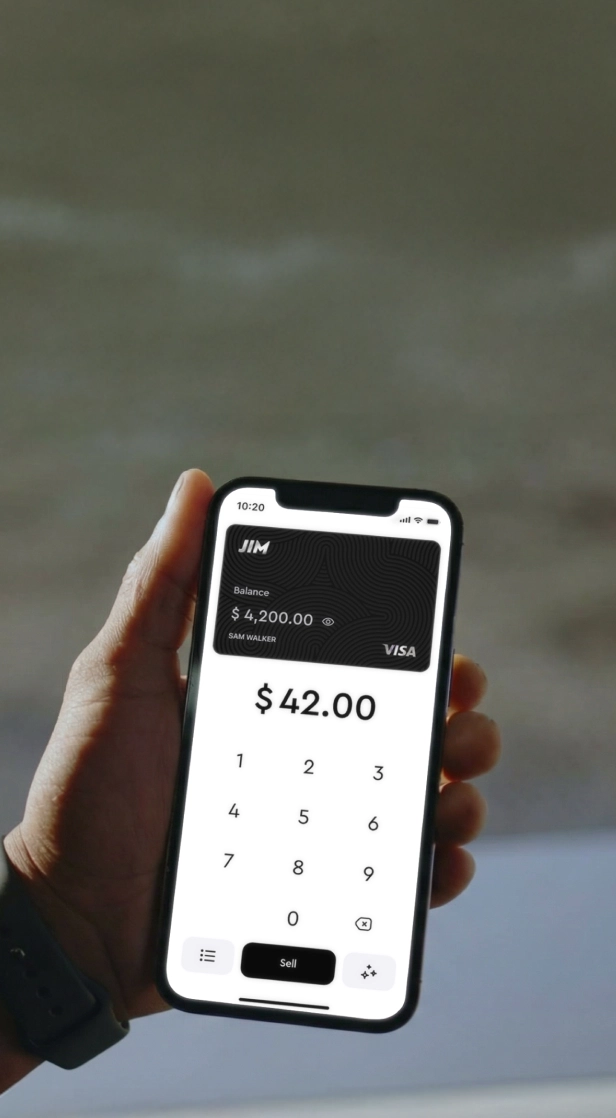
For selling at craft fairs or local markets, JIM offers a streamlined solution. With JIM, you can accept debit, credit, and digital wallets directly through your smartphone. Just tap and done. There is no need for extra hardware.
At just 1.99% per transaction with no hidden costs, the rate is very competitive. Other providers often charge between 2.5% and 3.5%. This difference adds up, especially when you sell many items at a pop-up event.
Getting started is straightforward.
- Get Started Download the JIM app for iOS.
- Make a Sale Type the sales amount, hit sell, and ask your customer to tap their card or device on your phone.
- Access Funds Your money is available on your JIM card as soon as the sale is done. No waiting for bank transfers.
Here are 3 immediate steps to take:
- Define your deposit policy for custom orders.
- Compare JIM’s 1.99% rate to one other payment processor.
- Calculate the fee difference between 1.99% and 2.9% on a typical $50 sale.
Step 6: Fund your business and manage finances
You might not need a large bank loan. Consider an SBA Microloan, which offers up to $50,000 from nonprofit lenders. Interest rates typically fall between 8% and 13%. Another option is a 0% interest loan from Kiva, which can provide up to $15,000 for U.S. businesses.
Estimate your working capital
Your first six months will require cash for more than just equipment. Budget for inventory, shipping supplies, and marketing. Many new owners focus on big purchases and forget these daily costs. A safe estimate for working capital is between $3,000 and $7,000.
From your very first sale, track every dollar. Use accounting software like QuickBooks Self-Employed or the free option from Wave. This makes tax time much simpler and shows you where your money actually goes. It helps you see your real profit margins on each product.
Here are 3 immediate steps to take:
- Research SBA Microloan lenders in your state.
- Draft a six-month budget for your working capital needs.
- Compare features on QuickBooks Self-Employed and Wave.
Step 7: Hire your team and set up operations
Your first hire will likely be a Production Assistant. Their duties include operating equipment, preparing items for personalization, and packing orders for shipment. Expect to pay between $15 and $20 per hour depending on your location. No special certifications are needed for this role.
Many owners hire too quickly without checking for skill. Before you make an offer, give candidates a small, paid test project. Have them weed a simple vinyl design or pack a fragile item. This shows you their attention to detail firsthand.
Streamline your order management
Once you handle more than 10-15 orders a week, manual tracking becomes difficult. Use a free project management app like Trello or Asana. You can create a simple board with columns for each stage of your process, from design to shipping.
As for when to hire, a good benchmark is to bring on part-time help when you consistently reach $3,000 to $5,000 in monthly revenue. This ensures your sales can comfortably cover the additional payroll expense without straining your cash flow.
Here are 3 immediate steps to take:
- Write a job description for a part-time Production Assistant.
- Set up a free Trello board with columns for “New Order,” “In Production,” and “Shipped.”
- Calculate the monthly revenue you need to support a 10-hour-per-week employee.
Step 8: Market your business and get customers
Start with visual platforms like Instagram and Pinterest to showcase your gifts. Post clear, well-lit photos of your products in a real-world setting. For example, show a personalized cutting board in a kitchen rather than just on a white background.
Many new owners only post finished product photos. You can set yourself apart by sharing your process. A short video of a laser engraver at work or a time-lapse of you weeding vinyl builds customer trust and engagement.
Expand to marketplaces and local events
On a platform like Etsy, your product titles and tags are your best friends. Use specific phrases like “custom wedding favor” instead of just “gift.” A healthy conversion rate on Etsy hovers around 2-3%. If you fall below 1%, revisit your photos and pricing.
When you sell at craft fairs, your booth is your storefront. Create an attractive display and consider a live demonstration. Personalizing a small item like a luggage tag on the spot can draw a crowd and lead to larger orders.
Here are 4 immediate steps to take:
- Brainstorm 10 specific keywords for one of your products on Etsy.
- Plan a 30-second video showing your personalization process.
- Find one upcoming craft fair or local market in your area.
- Take three new lifestyle photos of your most popular item.
Step 9: Price your products for profit
A common way to price your items is the cost-plus model. Calculate your total cost per item, which includes materials and your labor. Then, multiply that cost by a markup of 2.5 to 4 to find your retail price. This ensures you cover expenses and make a profit.
For example, if a custom mug costs you $4 in materials and takes 15 minutes of your time at a $20 hourly rate ($5 labor), your total cost is $9. A 3x markup would set your price at $27. This yields a gross profit margin of about 66%.
Check what the market will bear
With a baseline price in mind, research your competition. Look up similar items on Etsy or Amazon Handmade. Many new sellers make the mistake of only looking at the list price and forget to account for shipping costs, which customers see as part of the total cost.
Your price sends a message about quality. If your photos are professional and your designs are unique, you can often charge 10-20% more than competitors who use stock photos or simple templates. Do not fall into the trap of trying to be the cheapest option.
Here are 4 immediate steps to take:
- Calculate the total cost (materials and labor) for one of your main products.
- Apply a 3x markup to determine your initial list price.
- Find three similar items on Etsy and compare their final prices, including shipping.
- Adjust your price based on your product’s unique quality or design complexity.
Step 10: Implement quality control and scale your operations
Establish your quality standards
Create a simple quality control checklist for every order. This should include double-checking spelling on custom text, confirming design placement, and inspecting the item for flaws before you pack it. Many new owners rush this step, only to face costly remakes and negative reviews.
Your goal should be an Order Accuracy Rate of 99% or higher. You can track this by dividing the number of flawless orders by the total number of orders each month. This simple metric gives you a clear view of your performance.
Know when to scale
Once you consistently process 40-50 orders per week, production often becomes a bottleneck. This is a good signal to hire your first part-time production assistant. Do not wait until you are completely overwhelmed and order quality starts to slip.
The same logic applies to equipment. If your primary machine, like a heat press or laser, runs for more than four hours a day, it might be time to upgrade. A faster machine or a second unit can double your capacity and reduce lead times.
As you grow, managing inventory becomes complex. Software like Craftybase is designed for makers and helps track material costs and stock levels. This prevents you from running out of popular blank items during busy seasons.
Here are 4 immediate steps to take:
- Create a three-point quality checklist for your most popular product.
- Calculate your Order Accuracy Rate from last month’s sales.
- Set a weekly order volume that will trigger your search for a part-time hire.
- Sign up for a free trial of an inventory app like Craftybase to see its features.
You have a clear path to start your personalized gift business. In this niche, your creative vision is what sets you apart. Follow these steps with confidence, and you are ready to turn your ideas into a real business.
When you are ready to sell, a simple payment process helps. JIM lets you accept cards on your phone for a flat 1.99% fee, no extra hardware needed. Your funds are available instantly. Download JIM to get started.
.avif)