Starting a pretzel business is a rewarding venture that combines culinary skill with business savvy. The soft pretzel market is a multi-billion dollar industry, driven by consistent demand at sporting events, breweries, and shopping centers.
This guide will take you through the practical steps of validating your business concept, securing funding, obtaining necessary licenses, and selecting the right location to help you launch a successful pretzel business in the U.S.
Step 1: Plan your business and validate your concept
Conduct market research
Start by visiting locations where pretzels sell well, like breweries, sports venues, and farmers' markets. Observe the foot traffic and customer demographics. Talk to event managers about vendor fees and requirements to understand the operational landscape before you commit to a location.
Analyze your competition
Use Google Maps to find local pretzel vendors. Visit them to note their menu, prices, and busiest hours. For deeper data, check business databases like ReferenceUSA, often free through your local library, to see a list of registered food businesses in your area.
Estimate your startup costs
Your initial investment depends on your model. A mobile cart is less expensive than a full storefront. Many new owners focus on equipment and forget to budget for insurance, marketing, or the 5-10% of product lost to waste. Account for these from day one.
Here is a typical cost breakdown:
- Equipment: A commercial oven and mixer can range from $5,000 to $15,000.
- Initial Inventory: Expect to spend $1,000 to $2,500 on flour, yeast, and toppings.
- Licenses and Permits: Set aside $500 to $1,500 for health permits and business registration.
- Kiosk or Cart: A basic setup can cost between $3,000 and $7,000.
Here are 3 immediate steps to take:
- Visit three potential competitor locations and note their pricing and product quality.
- Create a spreadsheet to track estimated startup costs against your available capital.
- Research your city’s health department requirements for mobile food vendors.
Step 2: Form your legal entity and get licensed
Most new pretzel businesses register as a Limited Liability Company (LLC). This structure separates your personal assets from business debts. It also allows profits to pass through to your personal tax return, avoiding the double taxation that corporations face.
You will need an Employer Identification Number (EIN) from the IRS. Think of it as a Social Security number for your business. You can apply for one for free on the IRS website, and it's required for hiring employees and opening a business bank account.
Secure your state and local permits
Now, let's talk about local rules. Your city or county health department is the main agency you'll work with. The specific permits you need depend on your setup, but a few are standard across the board.
- Food Facility Health Permit: This is your main operating license from the health department. Expect costs from $200 to $1,000 and a processing time of 4-8 weeks. Many owners underestimate this timeline, so apply early.
- Food Handler's Permit: Anyone who touches food needs this. Programs like ServSafe offer certification for around $15-$25 per person.
- Business License: A general license from your city or county to operate legally.
These documents are your ticket to operating legally. Keep copies of everything, both digital and physical, as inspectors can ask to see them at any time.
Here are 3 immediate steps to take:
- File for an LLC with your state’s Secretary of State office.
- Apply for a free EIN directly from the IRS website.
- Schedule a preliminary meeting with your local health department to review their food vendor application packet.
Step 3: Secure your insurance and manage risk
Understand your insurance needs
Insurance protects your business from unexpected events. Start with general liability, which covers customer slips and falls. Most event organizers require proof of at least $1 million in coverage. Product liability, for claims of illness, is often bundled with it.
Premiums for a combined policy typically run between $500 and $1,200 annually. Beyond that, here are the main policies to consider:
- General Liability: Covers third-party injuries and property damage.
- Commercial Property: Protects your cart, oven, and other equipment from theft or damage.
- Workers’ Compensation: Required in most states if you hire even one employee.
- Commercial Auto: A frequent oversight is to rely on personal auto insurance. If you use a vehicle for business, you need a separate commercial policy.
When you look for providers, consider companies that specialize in food businesses. You might want to get quotes from the Food Liability Insurance Program (FLIP), Hiscox, or The Hartford. They understand the risks specific to mobile food vendors.
Here are 3 immediate steps to take:
- Request quotes from three insurance providers that cover food businesses.
- Review your target venue's vendor agreement for their minimum insurance requirements.
- Ask an agent about a bundle for general liability and commercial property insurance.
Step 4: Select your location and buy equipment
Your location depends on your business model. For a food cart or kiosk, you need a 10x10 foot space at a minimum. For a small storefront, look for 500-800 square feet in an area with commercial zoning, often labeled C-1 or C-2.
When you talk to venue managers about your cart, ask about their fee structure. Some charge a flat daily rate, while others take 10-15% of your sales. You can often negotiate a lower rate if you commit to multiple dates upfront.
Find your equipment and suppliers
You will need commercial-grade equipment. Health departments require NSF-certified items, so residential appliances are not an option. Many new owners overlook this and have to repurchase equipment, a costly mistake.
Here are some typical costs for new gear:
- Commercial Convection Oven: $3,000 - $8,000
- 20-Quart Spiral Mixer: $2,000 - $7,000
- Heated Display Case: $500 - $2,000
For supplies, you can start with a membership to Restaurant Depot, which has no minimum order. As you grow, you can move to a broadline distributor like Sysco, but expect minimum orders around $500.
Here are 3 immediate steps to take:
- Contact your city’s planning department to confirm approved areas for mobile vending.
- Price out a commercial convection oven and a 20-quart mixer from a supplier like WebstaurantStore.
- Ask a potential venue manager about their vendor fee structure.
Step 5: Set up your payment processing
Most of your sales will be immediate, so you need a fast and reliable way to accept payments. Customers expect to pay with debit, credit, and digital wallets. Many new owners get locked into processors with high monthly fees, which eats into profits on a high-volume, low-margin product like pretzels.
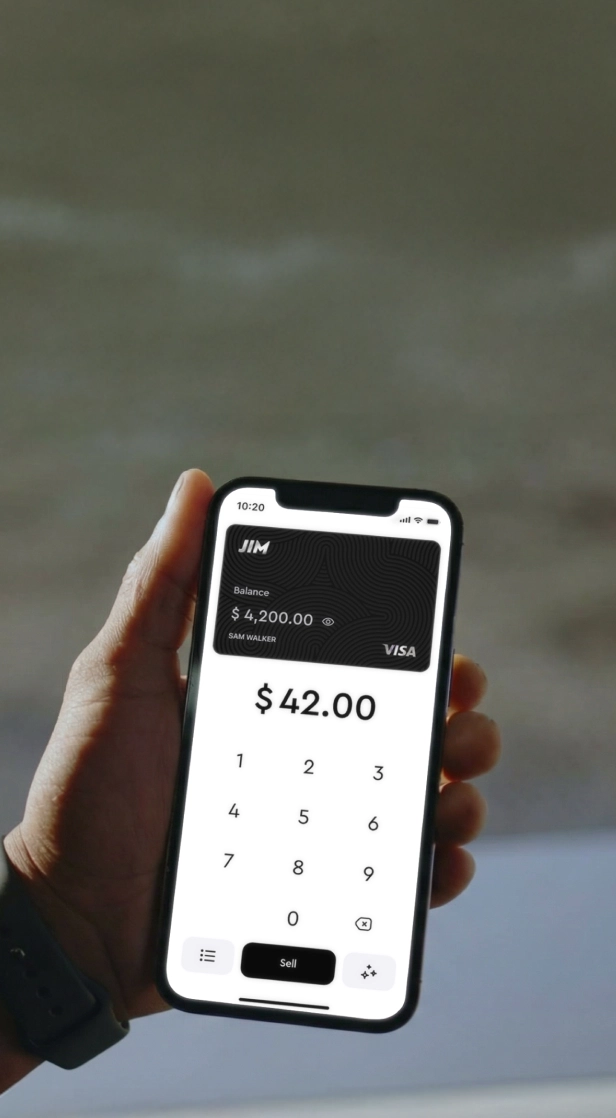
When you look for a payment solution, compare transaction rates. Many providers charge between 2.5% and 3.5% per sale. For a mobile business that needs to accept payments on-site, JIM offers a streamlined solution. You can accept debit, credit, and digital wallets directly through your smartphone.
With JIM, it is just a tap and you are done. At just 1.99% per transaction with no hidden costs or extra hardware needed, it is particularly useful for busy farmers' markets or events where transaction speed matters. Getting started is straightforward.
- Get Started: Download the JIM app for iOS.
- Make a Sale: Type the sales amount, hit sell, and ask your customer to tap their card or device on your phone.
- Access Funds: Your money is available right on your JIM card as soon as the sale is done, with no wait for bank transfers.
Here are 3 immediate steps to take:
- Compare JIM's 1.99% rate to two other payment processors.
- Download the JIM app to explore its interface before you commit.
- Estimate your weekly sales to calculate how different transaction fees impact your profit.
Step 6: Fund your business and manage finances
With your cost estimates ready, you can pursue funding. The Small Business Administration (SBA) is a good starting point. Their Microloan program offers up to $50,000 and is well-suited for food startups. Expect interest rates between 8% and 13%, and a personal credit score over 680 will help your application.
Plan your working capital
Many new owners focus on startup costs but forget day-to-day cash flow. You should have six months of operating expenses saved. For a pretzel cart, this is typically $5,000 to $10,000. This fund covers inventory, event fees, and slow sales periods without stress.
You might also consider equipment financing. This is a loan specifically for your oven or cart, where the equipment itself acts as collateral. This can make it easier to get an approval compared to an unsecured loan. Suppliers often have financing partners they can recommend.
Here are 3 immediate steps to take:
- Research two SBA Microloan lenders in your state.
- Calculate your estimated operating expenses for the first six months.
- Ask an equipment vendor if they offer or partner with financing companies.
Step 7: Hire your team and set up operations
Build your team
For a cart or kiosk, you will likely need two key roles to start. A Pretzel Maker handles dough preparation and baking, while a Sales Associate manages customer orders and payments. Clearly defining these roles from day one prevents confusion.
Expect to pay a Pretzel Maker between $15 and $18 per hour, depending on experience. A Sales Associate typically earns $14 to $16 per hour. Remember, every employee who handles food must have a Food Handler's Permit, which you can get through programs like ServSafe.
Streamline your daily operations
With your team in place, you need to manage schedules. Many new owners rely on texts, but this can lead to missed shifts and confusion. You might want to consider a scheduling app like Homebase or 7shifts. They often have free plans for small teams.
A frequent misstep is understaffing during a festival rush, which costs you sales and frustrates customers. Use your sales data to identify your busiest times and schedule accordingly. As a general guide, aim to keep your total labor costs between 25% and 35% of your revenue.
Here are 3 immediate steps to take:
- Draft simple job descriptions for a Pretzel Maker and a Sales Associate.
- Look up the cost and process for ServSafe Food Handler certification in your state.
- Explore the free version of a scheduling app like Homebase to understand its features.
Step 8: Market your business and get customers
Build your online presence
Focus your efforts on visual platforms like Instagram. High-quality photos of your pretzels are your best asset. Also, claim your free Google Business Profile. This action puts you on Google Maps and allows customers to leave reviews, which builds trust with new patrons.
Use partnerships and promotions
Contact local breweries or event spaces to propose a pop-up. This gives you direct access to an established customer base. You can also run a simple social media giveaway, like "tag a friend to win a free pretzel," to quickly expand your local reach.
Many new owners spend money on ads that are too broad. You should instead use Facebook ads to target users within a 3-5 mile radius of your location or event. With this approach, your cost to acquire a customer can often be under $5.
Here are 3 immediate steps to take:
- Claim your Google Business Profile and upload five high-quality photos.
- Draft an email to a local brewery to propose a weekend pop-up event.
- Outline a simple Instagram giveaway to run before your next market day.
Step 9: Price your pretzels and manage your menu
Calculate your cost per pretzel
First, figure out your cost of goods sold (COGS) for a single pretzel. Add up the price of the flour, yeast, salt, and butter for one unit. Many new owners forget to include the cost of the paper sleeve, napkins, and dipping sauces, which can quietly shrink your profit margin.
A plain pretzel should cost you between $0.40 and $0.75 to make. Once you have this number, you can confidently set prices that ensure profitability from your very first sale.
Set your menu prices
A good target food cost percentage for a pretzel business is 25-35%. To find your price, divide your COGS by your target percentage. If a pretzel costs you $0.60 to make, a 30% food cost suggests a price of $2.00 ($0.60 / 0.30).
You should also look at what competitors charge. If nearby vendors sell plain pretzels for $3.00, pricing yours at $2.00 might signal lower quality. Consider a tiered menu to encourage upsells.
- Plain Salted Pretzel: $3.00
- Cinnamon Sugar Pretzel: $3.50
- Specialty (e.g., Jalapeño Cheddar): $4.50
Here are 3 immediate steps to take:
- Calculate the exact cost to produce one plain pretzel, including its packaging.
- Visit two local events or markets to document competitor pretzel prices.
- Draft a simple menu with prices for three pretzel varieties using a 30% food cost target.
Step 10: Maintain quality and scale your operations
Establish your quality standards
Your pretzel's consistency is your reputation. Aim for a uniform golden-brown color and a weight of 4-5 ounces per pretzel. Use a digital scale and timer for every batch to ensure customers get the same great product every time.
Create a simple quality checklist. It should include dough proofing time, final baked color, and texture. Many new owners have issues with inconsistent proofing, which leads to a dense or overly airy product. A temperature log for your proofing area can solve this.
Know when to grow
With quality under control, you can plan for growth. A good benchmark to hire your first full-time employee is when you personally work over 60 hours a week for a month straight. This prevents burnout and service decline.
Consider expanding production when you consistently sell out two hours before an event ends for three consecutive events. This signals unmet demand. You might also look into inventory software like MarketMan to track ingredient usage and automate reorders as your volume increases.
Here are 3 immediate steps to take:
- Create a quality checklist for each batch that includes weight, color, and bake time.
- Set a sales trigger for hiring your next employee, like selling 200+ pretzels per event.
- Research an inventory management app to track your cost of goods sold.
You now have a roadmap for your pretzel business. Remember, success in this niche comes down to consistency. A perfect pretzel, every single time, is what builds a loyal customer base. You have the plan, now it is time to execute.
And when you make that first sale, a simple payment solution helps. JIM turns your phone into a card reader, so you can accept payments without extra hardware for a flat 1.99% fee. Download JIM and get ready for your first customer.
.avif)