Starting a robotics company is a rewarding venture that merges technical skills like engineering and software development with sharp business savvy. The global robotics market is a multi-billion dollar industry, and there is steady demand for mobile POS solutions in sectors like retail, hospitality, and event management.
This guide will take you through the practical steps of validating your concept, securing funding, building supplier relationships, and developing a prototype to help you launch a successful robotics company in the U.S.
Step 1: Validate your concept and plan your business
First, define your specific niche. Instead of a general approach, focus on a narrow problem. For example, target mobile POS for pop-up retail or food trucks. Use reports from the International Federation of Robotics (IFR) to find underserved segments and growth projections.
Next, analyze your competition. Go beyond just their products. Use databases like Crunchbase or PitchBook to see their funding, size, and market trajectory. A common oversight is to ignore indirect competitors who solve the same customer problem with a different technology.
Understand startup costs
Your initial financial plan is a map for your first 12-18 months. The capital needed can be significant, so a detailed budget helps you set realistic funding goals and manage your cash flow effectively from day one. It shows investors you are serious.
Here is a typical breakdown for a small-scale robotics venture:
- Research & Development: $50,000 - $150,000 for components, materials, and initial prototype fabrication.
- Software Development: $30,000 - $100,000. Many founders underestimate the complexity of integrating hardware with reliable, user-friendly software.
- Legal & Business Registration: $2,000 - $5,000 for incorporation and patent filings.
- Initial Marketing: $10,000 - $25,000 to build a website and reach your first customers.
Here are 4 immediate steps to take:
- Draft a one-page concept document that defines your target niche.
- Analyze three competitors using a database like Crunchbase.
- Create a preliminary budget based on the cost categories above.
- Download and review the latest market report from the IFR.
Step 2: Set up your legal structure and get licensed
Choose your business structure
You might want to consider a Limited Liability Company (LLC). It offers liability protection and pass-through taxation, meaning profits are taxed on your personal return. This structure is flexible and a strong choice for new founders.
Alternatively, a C Corporation (C-Corp) is the standard for companies that plan to seek venture capital. Investors prefer this structure. Be aware it involves corporate taxes, and then dividends are taxed again on a personal level.
A frequent misstep is forming a C-Corp too early due to its complexity if you are not seeking VC funding immediately. Expect legal setup costs from $500 to $2,000. Once registered, get a free Employer Identification Number (EIN) from the IRS.
Navigate federal and local requirements
Your hardware must comply with Federal Communications Commission (FCC) rules, specifically Part 15 for devices with wireless components. You should also look into Underwriters Laboratories (UL) certification for electrical safety to build credibility and ensure product safety.
State and local licensing depends on your location. You will need a general business license from your city, which typically costs between $50 and $400 annually. If you sell physical robots, you will also need a seller's permit from your state's tax agency.
Here are 4 immediate steps to take:
- Decide between an LLC and a C-Corp for your business structure.
- File for a free Employer Identification Number (EIN) on the IRS website.
- Research FCC Part 15 compliance requirements for your prototype.
- Visit your city’s business license department website to find application forms.
Step 3: Secure insurance and manage risk
You will need several insurance policies. General Liability protects against third-party injury or property damage. For a $1 million policy, expect annual premiums of $400 to $1,500. Professional Liability (E&O) is also vital. It covers financial losses from your product’s failure or errors.
Many founders underestimate the risk of a software bug or hardware malfunction. Professional Liability insurance, with premiums from $1,000 to $3,000 for $1 million in coverage, addresses this specific exposure. It protects you if your robot causes a client’s operational or financial loss.
Additional coverage to consider
Once you have physical assets, you should add Commercial Property insurance to protect your lab equipment and prototypes. If you hire employees, Workers' Compensation is legally required in most states. Also, get Commercial Auto insurance if you use a vehicle for business errands.
When you look for providers, focus on those with technology expertise. You might want to consider companies like The Hartford, Hiscox, or Embroker. They understand the unique risks of a robotics venture better than a general agent and can help you find appropriate coverage.
Here are 4 immediate steps to take:
- Get a quote for a $1 million General Liability policy.
- Evaluate Professional Liability coverage for software and hardware failure risks.
- Research tech-focused insurance providers like The Hartford or Hiscox.
- Check your state’s requirements for Workers' Compensation insurance.
Step 4: Set up your location and get equipment
For your first workspace, target 500 to 1,000 square feet. This provides enough room for a small lab and assembly area. Before you sign anything, check your city’s zoning map for areas classified as light industrial or commercial, as these typically permit research and development.
When you negotiate a lease, you might want to ask for a shorter 1-2 year term with an option to extend. This gives you flexibility if you outgrow the space. Some founders forget to check for adequate power and face costly electrical upgrades later. Confirm the space has 240V outlets.
Find your core equipment
Once your space is secured, you can equip it. Your initial setup will likely include a professional 3D printer, which can range from $2,000 to $7,000. A desktop CNC machine for custom parts will run between $3,000 and $10,000. These two items are your workhorses for rapid prototyping.
You will also need an electronics workbench. Budget $1,500 to $5,000 for a quality soldering station, oscilloscope, and power supply. For components, use suppliers like Digi-Key and Mouser. They have no minimum order quantities on most parts, which is perfect for development stage orders.
Here are 4 immediate steps to take:
- Identify three potential locations between 500 and 1,000 square feet.
- Check the zoning regulations for your top location choice on your city’s website.
- Price out a professional 3D printer and a desktop CNC machine from online retailers.
- Create an account with an electronics supplier like Digi-Key or Mouser.
Step 5: Set up your payment processing
First, establish your payment terms. For custom robotics projects, a common structure is a 50% upfront deposit and 50% upon final delivery. For standard products, you will likely require full payment upfront. Your payment solution should handle both one-time and recurring payments easily.
Many founders get caught by high transaction fees that eat into profits. While many providers charge between 2.5% and 3.5%, you should look for lower rates. For robotics companies that need to accept payments on-site or on-the-go, JIM offers a streamlined solution.
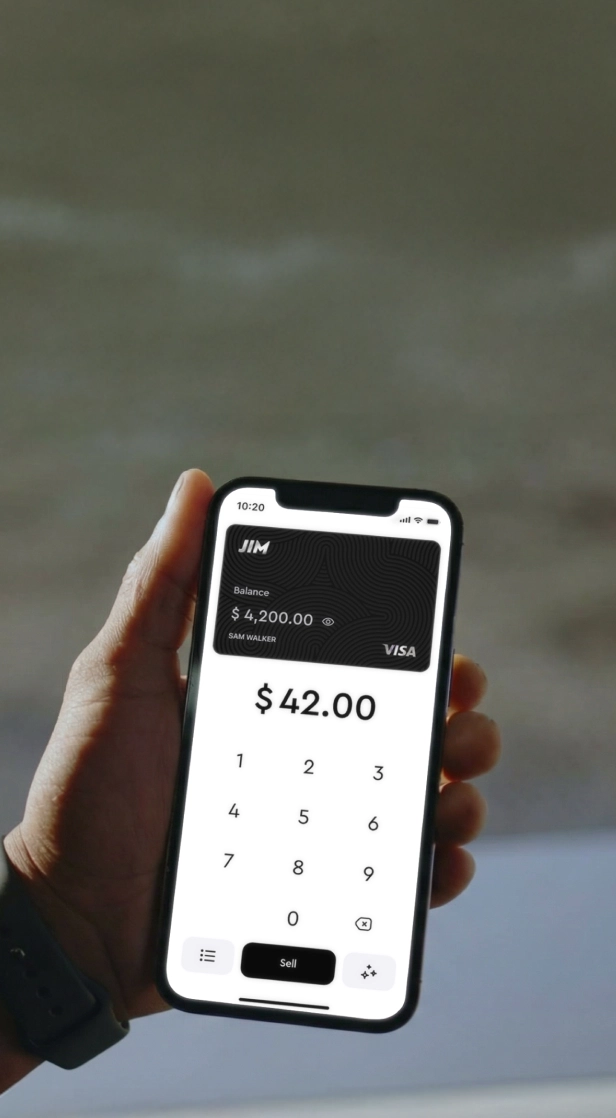
With JIM, you can accept debit, credit, and digital wallets directly through your smartphone. At just 1.99% per transaction with no hidden costs or extra hardware, it is useful for collecting deposits at trade shows or client meetings. Getting started is straightforward:
- Get Started: Download the JIM app for iOS.
- Make a Sale: Type the sales amount, hit sell, and ask your customer to tap their card or device on your phone.
- Access Funds: Your money is available on your JIM card as soon as the sale is done, with no waiting for bank transfers.
Here are 4 immediate steps to take:
- Define your payment terms for both custom projects and standard products.
- Draft a basic sales contract that outlines your payment terms.
- Compare transaction fees from at least two different payment solutions.
- Download the JIM app to see how it works for mobile payments.
Step 6: Secure funding and manage your finances
Find the right funding source
Venture capital is a common path for robotics, but investors will expect you to be a C-Corp with a highly scalable model. You might want to first look at Small Business Administration (SBA) loans. The 7(a) loan program offers up to $250,000 with interest rates typically around Prime + 3%.
In addition to loans, you should explore non-dilutive grants. The Small Business Innovation Research (SBIR) program is a federal grant that funds R&D without you giving up equity. This is a great way to finance your technology development without diluting your ownership early on.
Plan your first six months of cash flow
You will need enough working capital to operate for at least six months before revenue starts. For a small robotics company, this often means having $100,000 to $200,000 set aside. This covers salaries, components, and marketing costs while you build and test.
A frequent oversight is to underestimate R&D expenses in this initial budget. An unexpected design flaw or component shortage can increase costs. Build a 15-20% contingency into your R&D budget to avoid a cash crunch that could stall your progress before you even launch.
Here are 4 immediate steps to take:
- Research the SBA 7(a) loan application process on the SBA website.
- Check the current deadlines and eligibility for the SBIR program.
- Calculate your 6-month working capital needs with a 20% contingency.
- Identify two venture capital firms that invest in hardware or deep-tech startups.
Step 7: Hire your team and set up operations
Your first hires
Start with two key roles: a Mechanical Engineer and a Robotics Software Engineer. The mechanical engineer handles CAD design and physical prototyping. The software engineer will focus on firmware, control systems, and how to integrate the hardware.
Many founders try to save money with junior talent. You might find it more effective to bring on experienced engineers who can work independently. Offer a mix of salary and equity to attract the right people, as you will compete for talent.
For salary, budget around $80,000 to $120,000 for each role, depending on your location and their experience. You can use sites like Glassdoor to check local market rates. A compelling equity offer can help offset a lower base salary.
Once your team is in place, you need a system to manage workflow. Set up a project management board using a platform like Asana or Jira. This helps track tasks and deadlines. Also, establish a version control system with Git and GitHub for all your code from day one.
As you grow, keep an eye on your efficiency. A good target for a scaling robotics company is to aim for a revenue-per-employee of $150,000 to $250,000. This metric helps you decide when it is financially sound to expand the team further.
Here are 4 immediate steps to take:
- Draft job descriptions for a Mechanical Engineer and a Robotics Software Engineer.
- Research salary benchmarks for these roles in your city on Glassdoor.
- Create a project board for your team on a platform like Asana or Jira.
- Outline a simple equity compensation plan for your first two hires.
Step 8: Market your product and acquire customers
Start with content and direct outreach
Begin with content that demonstrates your expertise. You could write a detailed white paper that explains the specific problem your robot solves. This builds credibility with technical buyers. Also, identify three industry publications or blogs where you can contribute a guest post.
Once you have content, use LinkedIn Sales Navigator to find decision-makers in your target niche. A frequent oversight is to rely on broad digital ads early on. Direct outreach is often more effective for high-value robotics sales and helps you build relationships.
Leverage in-person demonstrations
For robotics, nothing sells like a live demo. You should budget $5,000 to $15,000 for a booth at a targeted industry trade show, such as the Automate Show. Your goal should be to collect 20-30 qualified leads from the event.
Your Customer Acquisition Cost (CAC) for these first enterprise clients might seem high, perhaps $5,000 to $10,000. However, the long-term contract value usually justifies this initial investment. Focus on the quality of leads, not just the quantity.
Here are 4 immediate steps to take:
- Draft a one-page white paper on the problem your robot solves.
- Identify three industry blogs to pitch a guest article to.
- Build a target list of 50 potential clients on LinkedIn Sales Navigator.
- Research the cost and dates for one relevant industry trade show.
Step 9: Price your product and define your strategy
Choose your pricing model
You have two main options. With cost-plus pricing, you calculate your total production cost per unit and add a markup. A typical markup in robotics is between 50% and 100%. This approach ensures you cover expenses and generate a healthy profit on each sale.
Alternatively, you might consider value-based pricing. This model sets the price based on the economic value your robot provides to the customer, such as labor savings. If your robot saves a client $50,000 annually, a price of $25,000 is easily justified.
Many new founders simply copy a competitor's price without a full analysis. This approach ignores your unique cost structure and the specific value you offer. You must understand your own numbers before you look at what others are doing.
Conduct competitive research
Once you know your costs, analyze your competitors. Review their public price lists or look for pricing information in industry reports. Your goal is to position your product effectively. You can price higher if you offer superior features or better support.
Here are 4 immediate steps to take:
- Calculate your total cost of goods sold (COGS) for one robot unit.
- Analyze the pricing models of two direct competitors.
- Decide if a cost-plus or value-based model fits your product best.
- Draft a preliminary price sheet based on your chosen model.
Step 10: Implement quality control and scale your operations
You should establish a basic Quality Management System (QMS) from day one. You do not need full certification yet, but use the ISO 9001 framework as your guide. For safety, review the principles in ISO 10218, which covers robots, to inform your design and testing protocols.
Measure what matters
To track quality, focus on key metrics. A good starting point is Mean Time Between Failures (MTBF). For a new robot, you might want to aim for an MTBF of over 2,000 hours. This shows investors and customers that your product is reliable.
Some founders only track failures after a product ships, which creates expensive problems. Instead, monitor your defect rate during assembly from the very first unit. Aim for a rate below 2% for initial production runs to keep rework costs low and maintain momentum.
With quality data in hand, you can plan your growth. Once you sell 50 units, you might want to invest in a Product Lifecycle Management (PLM) system like Arena or Upchain. This helps manage component revisions and supplier information as you scale your manufacturing.
Use the revenue-per-employee metric from Step 7 to guide hiring. If your team is stretched and the metric is well above $250,000, it is time to hire. If it dips below $150,000, focus on process improvements before you expand the team further.
Here are 4 immediate steps to take:
- Draft a one-page QMS document based on ISO 9001 principles.
- Define three quality metrics for your robot, including a target MTBF.
- Set a production milestone, like 50 units, for when you will adopt a PLM system.
- Review your revenue-per-employee target to decide your next hiring trigger.
Launching a robotics company is a marathon, not a sprint. Remember that your first prototype is a learning device, not a final product. Embrace feedback from early tests and iterate quickly. You have the roadmap, now it is time to build.
As you meet clients, a simple payment process helps. JIM turns your phone into a card reader for a flat 1.99% fee, with no extra hardware. It makes getting paid easy from day one. Download JIM to get started.
.avif)