How to start a side hustle business in 2026

See article summary
- Validate your idea with a 5-question survey to at least 20 strangers, not friends or family.
- File an LLC if your side hustle carries liability risk, then get a free EIN from the IRS.
- Budget $300 to $700 for startup costs, including registration, a website, and basic supplies.
- Track every expense from day one to manage cash flow and simplify Schedule C tax filing.
- Accept on-site payments with JIM at a flat 1.99% per Tap to Pay transaction, no hardware needed.
Americans filed 5.62 million new business applications in 2025, and a large share of those are side hustles started by people who already hold a full-time job. The barrier to entry is low, but the failure rate is high: the difference between a hobby that earns $200 and a venture that earns $2,000 a month comes down to validation, legal structure, and disciplined cash management.
Nine steps take a side hustle from idea to first sale: validation, legal structure, licensing, insurance, payment processing, taxes, funding, marketing, and pricing.
How do you validate a side hustle idea?
Validation means strangers, not friends, confirm they will pay for your offer before you spend on registration or inventory. Build a 5-question survey in Google Forms, share it in relevant Reddit forums or Facebook Groups, and aim for at least 20 responses from people who match your ideal customer profile.
Friends and family give supportive but biased feedback. Input from strangers who fit your target customer reveals whether the problem is real and whether your price point is credible. Once you have positive signal, search for 3 to 5 direct competitors and review their pricing, services, and customer reviews to find your unique angle.
A service-based side hustle typically launches for $300 to $700 in initial costs: business registration ($50 to $150), a simple website ($200 to $500), and basic software or supplies ($50 to $100). The same steps to start a small business apply to side hustles, so draft a startup budget covering your first three months before spending a dollar.
Do you need an LLC for a side hustle?
An LLC is worth the paperwork when your side hustle carries liability risk, such as consulting, physical labor, or selling products. A Limited Liability Company separates your personal assets from business debts and lawsuits. Without one, your side hustle defaults to a sole proprietorship, which offers no personal asset protection.
You file for an LLC through your state's Secretary of State, with filing fees that range from about $50 to $500 depending on the state. Once approved, apply for a free Employer Identification Number (EIN) from the IRS. An EIN functions like a Social Security number for your business and is required to open a business bank account and file taxes.
A separate business bank account is required the moment you form an LLC. Mixing personal and business funds can pierce the corporate veil and remove the liability protection you paid for. The table below compares the two most common structures for side hustles.
| Structure | Setup cost | Liability protection | Tax filing |
|---|---|---|---|
| Sole proprietorship | $0 to $50 | None | Personal return (Schedule C) |
| LLC | $50 to $500 | Personal assets protected | Personal return, plus state filing |
What licenses and permits do you need?
Most cities or counties require a general business license, which costs between $50 and $100 annually depending on the jurisdiction. For example, Los Angeles charges a tiered fee based on gross receipts, while a small-town clerk's office may charge a flat $50. Check your city or county clerk's website, or use the SBA guide to business licenses and permits, for the application and fee schedule.
If you sell physical products, you also need a seller's permit from your state's department of revenue or taxation. This permit allows you to collect sales tax from customers. There is usually no fee for the permit itself.
How much does business insurance cost?
General liability insurance is the first policy to buy. It covers property damage and customer injury, and a $1 million policy typically costs $300 to $600 per year, according to Insureon's small business insurance cost data. Premiums vary by industry, location, and coverage limits, so request quotes from at least two providers to compare.
If you offer professional advice or services, add professional liability insurance, often called errors and omissions. This policy protects you if a client claims your work was faulty, with premiums typically ranging from $500 to $1,500 annually.
A common mistake is assuming a homeowner's or renter's policy covers a home-based side business. Business-related claims are usually excluded. Review your policy's business exclusions before you launch.
How do you set up payment processing?
Decide your payment terms before your first sale. For services, a 50% deposit upfront with the balance due on completion is standard. For products, require full payment before shipping. State these terms on every invoice.
Transaction fees eat into margins if you ignore them. Most processors charge 2.5% to 3.5% plus a fixed amount per sale. Compare two processors for a hypothetical $100 sale to see the real cost.
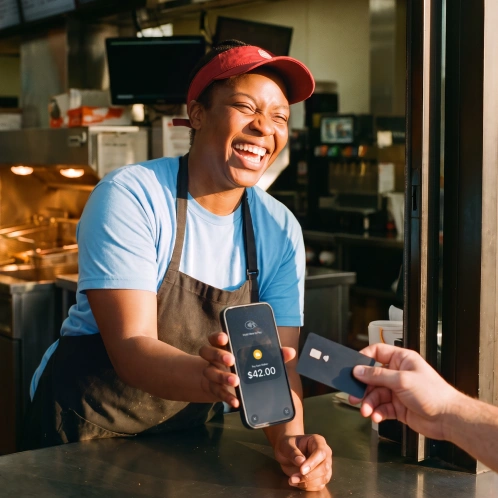
For on-site or on-the-go payments, JIM lets you accept debit, credit, and digital wallets directly through your smartphone with no extra hardware. JIM charges a flat 1.99% per Tap to Pay transaction. The JIM app is free to download for iOS: type the sales amount, ask your customer to tap their card or device on your phone, and funds are available on your JIM card immediately after the sale.
Disclosure: JIM is the product we make. The 1.99% rate applies to Tap to Pay transactions with no monthly fees or hardware rental.
How are side hustle earnings taxed?
Side hustle net earnings are subject to self-employment tax, which is 15.3% for 2026, covering Social Security (12.4%) and Medicare (2.9%). You owe this tax if your net self-employment income reaches $400 or more.
You report side hustle income and expenses on Schedule C (Form 1040), which flows to your personal tax return. Track every business expense from day one, including software subscriptions, supplies, and mileage, because each deduction lowers your taxable net income.
A working capital cushion of $1,000 to $2,000 covers your first six months of marketing, subscriptions, and slow periods. Track expenses in a spreadsheet or a free platform like Wave to simplify tax preparation.
How do you fund a side hustle?
Most side hustles are self-funded through personal savings. For early capital beyond savings, the SBA Microloan program provides loans up to $50,000 through intermediary lenders, with interest rates generally between 8% and 13%. Find a microlender through the SBA's Lender Match service, which connects you with approved lenders within two business days.
Avoid racking up high-interest credit card debt early on. The interest erodes profits and adds pressure before revenue stabilizes.
How do you market a side hustle locally?
Your first customers are usually in your own neighborhood. Post about your business on Nextdoor or in local Facebook groups with a photo and a clear offer. Aim for 2 to 3 posts per week to stay visible, and respond to comments promptly to build trust.
Set up a free Google Business Profile to appear on Google Maps. Ask happy customers for reviews after each completed job. A profile with 5 to 10 positive reviews boosts visibility over competitors who have none.
Track your Customer Acquisition Cost (CAC) once you start spending on ads. For a local service business, a CAC under $100 is a solid benchmark. If you spend $50 on ads and land one client, your CAC is $50.
How do you price your side hustle?
Start with cost-plus pricing for products. Add up your material and labor costs, then apply a markup. Suppose a candle costs $15 to make: a 100% markup sets the price at $30, giving a 50% gross margin before other expenses. Check Etsy or Google Shopping to confirm the market rate falls in a credible range.
For services, research local rates for your skill. A freelance graphic designer might charge $60 to $85 per hour, or offer project packages like $400 for a logo design. Factor payment processing fees (around 3%) and shipping into your total cost to protect your margin.
Consistent effort matters more than a perfect launch. Your first few sales build the momentum you need to refine pricing and grow. As those sales come in, getting paid should be simple. JIM lets you accept payments on your smartphone with no extra hardware and a flat 1.99% fee per Tap to Pay transaction. Download JIM to get started.
Frequently Asked Questions
How much does it cost to start a side hustle?
Do I need an LLC for a side hustle?
How long does it take to start a side hustle?
Do I need to pay taxes on side hustle income?
What are the best side hustles to start in 2026?




Sell and get paid in seconds with Jim