How to start a soft serve ice cream business: a simple plan
See article summary
- Startup costs range from $12,000 to over $40,000 depending on cart, kiosk, or storefront setup.
- Core requirements: LLC, food service permit, commercial soft serve machine, and a payment method.
- Target a 20 to 25% food cost and 70 to 80% gross margin per serving.
- Health department permits take 30 to 90 days, so start applications two months before opening.
- Accept cards at a cart or counter with JIM at a flat 1.99% per transaction, no extra hardware.
Soft serve is a high-margin frozen dessert with low ingredient costs and steady demand from families, tourists, and local communities. Most U.S. operators open a cart, kiosk, or small shop and run it seasonally, which keeps the footprint small and the startup capital manageable.
Startup costs range from $12,000 to over $40,000 depending on your setup, with the soft serve machine as the largest single expense. The core requirements are an LLC, a food service permit from your local health department, a commercial-grade machine, and a payment method that works at a cart or counter. This plan covers cost ranges, permits, insurance, equipment, pricing, and payments so you can launch a soft serve ice cream business in the U.S.
How do you plan and validate a soft serve business idea?
Validate demand and costs before you spend on equipment. Research your local market, study competitors, and map your startup budget so you know what you are committing to before you file for an LLC.
Start by researching your local market. Spend a few hours at potential locations like parks or busy shopping streets to count foot traffic. You can also use U.S. Census Bureau data to understand neighborhood demographics and find your target customers.
Next, analyze your competition. Use Google Maps to find other ice cream shops in your target area. Read their online reviews to see what customers love and what they complain about. For broader industry trends, reports from databases like IBISWorld can offer valuable insights.
Estimate your startup costs
Startup costs for a soft serve business can range from $12,000 to over $40,000, depending on your setup. Underestimating these initial expenses is the fastest way to run out of cash before opening day. Here is a typical breakdown:
| Item | Low | High | Notes |
|---|---|---|---|
| Soft serve machine | $5,000 | $20,000 | Gravity-fed countertop to floor model |
| Licenses and permits | $500 | $2,000 | Varies by state and city |
| Initial inventory | $2,000 | $5,000 | Mix, cones, cups, toppings |
| Cart, kiosk, or lease deposit | $3,000 | $10,000+ | Cart is cheapest, storefront is highest |
| Marketing and point of sale | $1,000 | $3,000 | Signage, branding, payments |
A low-capacity machine bought to save money will fail during a weekend rush. Invest in a model that can handle your projected peak volume from day one. It prevents lost sales and unhappy customers.
Here are 3 immediate steps to take:
- Scout two potential locations and observe foot traffic during peak hours.
- Create a simple spreadsheet to draft your initial budget using the cost ranges above.
- Research one local competitor and list three strengths and three weaknesses based on their reviews.
How profitable is a soft serve business, and how does it compare to hard-scoop?
Soft serve is more profitable than hard-scoop ice cream per serving because the mix is cheaper, serving is faster, and equipment does the work. Gross margins typically land between 70% and 80%, with food costs around 20% to 25% per serving.
Soft serve differs from hard-scoop in equipment and workflow. Soft serve machines whip air into the mix (called overrun) and freeze it on demand, so you buy liquid or powder mix and serve directly. Hard-scoop requires batch freezing and storage. The tradeoff is machine cost and cleaning: soft serve machines need daily sanitation to meet health codes.
Seasonality is the biggest profit variable. In cold-climate states, outdoor cart revenue drops from November through March. Year-round operators manage this by moving indoors, adding hot beverages, or booking indoor events like school functions and corporate parties. If you are weighing a related frozen treat concept, our water ice business startup guide covers a similar cart and kiosk model.
What licenses and permits do you need?
You need an LLC, an EIN from the IRS, a food service permit from your local health department, a seller's permit, and a local business license. Costs run from $100 to $1,000 and processing can take 30 to 90 days.
First, protect your personal assets by forming a Limited Liability Company (LLC). An LLC separates your business and personal finances. It also offers simpler tax filing than a corporation, as profits pass directly to your personal tax return.
Once your LLC is registered with your state, get an Employer Identification Number (EIN) from the IRS. You will need this for taxes and hiring employees. Applying for an EIN is free on the IRS website and takes only a few minutes.
Navigate state and local permits
Your business will be regulated by several agencies. You will need a food handler's permit for every employee, a seller's permit to collect sales tax, and a business license from your city. Expect costs from $100 to $1,000 and processing times of 30 to 90 days.
The health department permit is the most involved. Owners routinely underestimate the time for inspections and approval. You should contact your local health department at least two months before you plan to open to get their specific requirements and application forms. If you want a closer look at how mobile dessert vendors handle permitting, see our guide to starting an ice cream truck business.
Also, check with your city's planning department about zoning laws for mobile food vendors. Some areas have restrictions on where and when you can operate. Securing the right spot often requires a separate mobile food vendor permit, which can have its own application process. If you operate a cart or truck, your state may classify it as a mobile food unit under a frozen dessert license, which carries its own inspection requirements.
Here are 3 immediate steps to take:
- File for an LLC with your state's Secretary of State office.
- Apply for a free EIN directly on the official IRS website.
- Contact your local health department for a food service permit application packet.
What insurance do you need to manage risk?
You need general liability, commercial property, and workers' compensation insurance. General liability for a small food business runs roughly $500 to $1,500 per year for $1 million in coverage, according to Insureon's published food business rate data.
Protect your business with the right insurance policies. This is an area where a small upfront investment prevents major financial trouble later. You will need a few key policies to operate safely, and some may be required by your health department or event organizers.
Key insurance policies
| Policy | What it covers | Typical annual cost |
|---|---|---|
| General liability | Customer injuries, property damage | $500 to $1,500 |
| Commercial property | Equipment like machine and cart | $500 to $2,000 |
| Commercial auto | Business truck or van | Varies by vehicle |
| Workers' compensation | Employee on-the-job injuries | Required by law when you hire |
Aim for at least $1 million in general liability coverage. Source: Insureon food and beverage business insurance cost data.
If you use a dedicated truck or van for your business, you will need commercial auto insurance. Personal auto insurance will not cover business activities.
Workers' compensation is mandatory for most employers in every state except Texas, according to the National Association of Insurance Commissioners. Requirements vary by state, so check your state's labor department rules before you hire.
One gap many owners leave is coverage for the soft serve machine against mechanical failure. An equipment breakdown endorsement can be added to your property policy. It covers repair or replacement costs if your machine fails, which saves you from a huge unexpected expense.
When you look for policies, consider providers that specialize in food businesses. Get quotes from The Hartford, Hiscox, or the Food Liability Insurance Program (FLIP). They understand specific risks, like claims of foodborne illness, and can offer tailored coverage.
Here are 3 immediate steps to take:
- Request a quote for a $1 million general liability policy.
- Ask insurers about adding an equipment breakdown endorsement for your soft serve machine.
- Contact a specialized provider like FLIP to compare their rates against a general insurer.
How do you choose a location and buy equipment?
A cart or kiosk needs 50 to 100 square feet. A small shop requires 400 to 800 square feet. Your soft serve machine will cost $5,000 to $15,000 for a commercial gravity-fed model from brands like Taylor or Stoelting.
Here is a decision matrix to help you pick the right format:
| Format | Space needed | Startup cost | Best for |
|---|---|---|---|
| Cart | 50 to 100 sq ft | $12,000 to $25,000 | Testing a market, events, parks |
| Kiosk | 100 to 300 sq ft | $20,000 to $35,000 | Malls, food courts, fixed seasonal spots |
| Storefront | 400 to 800 sq ft | $35,000 to $40,000+ | Year-round sales, dine-in, brand building |
Choose your location
For a cart or kiosk, you need about 50 to 100 square feet. A small shop requires more space, around 400 to 800 square feet. Check with your city's planning department for commercial zoning codes, like C-1, and any specific rules for mobile food vendors.
If you pursue a storefront, try to negotiate a short-term lease of 1 to 2 years with an option to renew. This gives you flexibility. You can also ask the landlord for a tenant improvement allowance to help pay for plumbing or electrical upgrades.
Locking into a five-year lease on day one is a risky move. Test your market with a cart first. It is a lower-risk way to confirm foot traffic before you commit to a long-term physical location.
Purchase your equipment
With a location in mind, you can focus on equipment. Your soft serve machine is the heart of the operation. A gravity-fed machine from a brand like Taylor or Stoelting is a reliable start and can cost between $5,000 and $15,000.
You will also need a refrigerated topping bar ($500 to $2,000) and a commercial freezer ($1,000 to $3,000). Do not be tempted by a residential freezer; you need a commercial one that holds temperature with frequent opening to meet health codes.
For supplies, you can use online retailers like WebstaurantStore or local distributors. When you order soft serve mix from a supplier like US Foods or Sysco, expect to buy it by the case, which usually contains 4 to 6 one-gallon cartons.
Here are 3 immediate steps to take:
- Contact your city's planning department to confirm zoning for two potential locations.
- Get quotes for a commercial-grade, gravity-fed soft serve machine.
- Research lease terms for a 100-square-foot kiosk space in a local mall.
How do you set up your payment system?
You need a payment processor with low transaction fees and no monthly charges, especially since sales can be seasonal. For a cart or truck, mobility matters because you sell wherever foot traffic is. Our guide to the best credit card readers for small businesses breaks down how flat-rate pricing compares across providers.
Getting locked into a system with high monthly fees or clunky hardware hurts your profits during slower months. You want a solution that costs you money only when you make money.
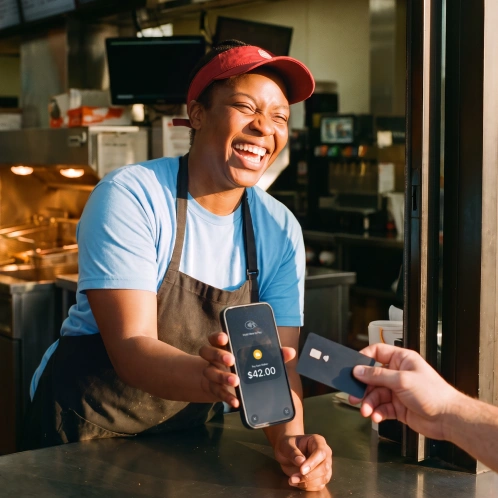
For a business that is often on the move, a streamlined solution is best. JIM turns your iPhone into a contactless card reader with no extra hardware. Customers tap their card or device on your phone to pay.
The rate is a flat 1.99% per transaction with no hidden costs or extra hardware. Many other providers charge over 2.5% plus other fees. This makes JIM useful for quick lines at parks or events.
Getting started is simple. Here is how it works:
- Get Started: Download the JIM app for iOS.
- Make a Sale: Type the sales amount, hit sell, and ask your customer to tap their card or device on your phone.
- Access Funds: Your money is available right on your JIM card as soon as the sale is done, with no waiting for bank transfers.
This instant access to funds means you can restock daily supplies without delay.
Here are 3 immediate steps to take:
- Compare transaction fees from two different payment processors.
- Download the JIM app to explore its interface.
- Calculate your potential daily transaction costs using both a flat 1.99% rate and a 2.6% plus $0.10 rate.
How do you secure funding and manage your finances?
The SBA Microloan program covers up to $50,000 at 8% to 13% interest, and you need a 3 to 6 month cash buffer of $5,000 to $10,000 on top of your startup costs.
Find the right funding
The SBA Microloan program is a solid choice for a soft serve business. It provides loans up to $50,000, with interest rates generally between 8% and 13%. Source: SBA Microloan program.
You could also explore equipment financing specifically for your soft serve machine. This loan is secured by the machine itself, which can make it easier to qualify for. Companies like Accion Opportunity Fund sometimes work with food startups and are worth a look.
Plan your operating cash
Founders who focus only on startup costs often forget day-to-day expenses. You should have enough working capital to cover your first 3 to 6 months. This includes inventory, rent, and marketing before your sales are steady. A buffer of $5,000 to $10,000 is a safe target.
This cash reserve prevents you from running out of money for supplies or unexpected repairs during your critical first season. It is the difference between scrambling for funds and operating with confidence.
Here are 3 immediate steps to take:
- Check your credit score to see where you stand with lenders.
- Research the SBA Microloan program requirements on the SBA website.
- Create a 6-month budget to calculate your working capital needs.
How do you hire your team and set up operations?
Start with one or two employees at $11 to $18 per hour, each holding a food handler's permit, and schedule lean with one staffer per $75 to $100 in hourly sales.
Hire your first team members
Start by hiring one or two team members. Their duties will include serving customers, restocking supplies, and basic cleaning. Pay for food preparation and serving workers typically ranges from about $11 to $18 per hour, depending on your location. Source: BLS Occupational Employment and Wages, Food Preparation and Serving Related Occupations.
Every employee you hire must have a food handler's permit. These certifications are often available online for under $15 and usually take only a few hours to complete. Check your state's health department website for approved courses.
Streamline your daily operations
Once you have your team, you can focus on scheduling. Use a system like 7shifts or Homebase. Many offer free plans for small businesses and simplify managing shift changes and employee availability.
Overstaffing at the beginning strains the budget. A good benchmark is to aim for one employee per $75 to $100 in hourly sales. It is often better to start lean and add more help as your customer traffic grows.
Here are 3 immediate steps to take:
- Draft a job description for a team member role with pay and responsibilities.
- Research state-approved food handler's permit courses for your new hires.
- Explore the free plans offered by scheduling software like 7shifts or Homebase.
How do you market your business and get customers?
Start with Instagram and a free Google Business Profile, then add an A-frame sign and a loyalty punch card to drive repeat visits.
Build an online and local presence
Start with social media. Create an Instagram account to showcase your soft serve with colorful toppings. A "coming soon" campaign can build excitement before you open. Post high-quality photos and short videos to attract followers.
Next, claim your free Google Business Profile. Add your hours, address, and menu photos. This ensures you appear in local search results when people look for "ice cream near me," which is a primary way new customers will find you.
Relying only on digital marketing leaves foot traffic on the table. Use an A-frame sign with a daily special to boost walk-ins. Also, consider partnering with a local school for a fundraiser night where you donate 15 to 20% of sales.
Encourage repeat business
Launch a simple loyalty program. A physical "buy nine, get the tenth free" punch card is inexpensive and effective. This encourages repeat visits and increases customer lifetime value without the need for complex software or systems.
You can also run promotions during slower times. For example, offer a "two for one" deal on Tuesdays. This helps smooth out your revenue across the week and introduces new customers to your business during off-peak hours.
Here are 3 immediate steps to take:
- Create an Instagram account and post three photos of your potential menu items.
- Claim and complete your Google Business Profile listing.
- Design a simple punch card for a "buy 9, get 10th free" loyalty program.
How do you develop your pricing strategy?
A good target food cost for soft serve is 20 to 25%, which aligns with standard quick-service restaurant benchmarks. This means if your ingredients, cone, and napkin cost $0.80, you should price the item around $3.20 to $4.00. Source: National Restaurant Association State of the Industry. This is a common cost-plus pricing model that ensures profitability on every sale.
With that baseline, look at your competitors. Use Google Maps or visit their shops to see their menu prices. Note what they charge for a small vanilla cone. This gives you a sense of the local market rate and what customers are accustomed to paying.
Pricing 10% lower than everyone else backfires. It starts a price-war and signals lower quality. Price similarly but offer better service or unique toppings to justify your value instead.
Soft serve is a high-margin product, so your gross profit margin should land between 70% and 80%. For example, a premium waffle cone with two toppings might cost you $1.50 in supplies. To hit a 75% profit margin, you would need to charge $6.00.
Here are 3 immediate steps to take:
- Calculate the total cost for one small vanilla cone, including the mix, cone, and napkin.
- Research the price of a small cone at three nearby ice cream shops.
- Set a menu price for your small cone that targets a 20 to 25% food cost.
How do you maintain quality and scale your business?
Serve at 18°F with 35 to 50% overrun, calibrate your machine daily, and scale only after 6 to 12 months of sustained profitability above $800 in daily sales.
Maintain consistent quality
Your product's consistency is everything. Aim for a serving temperature of 18°F, which falls within the typical soft serve range of 18 to 22°F noted in dairy science references. You should also measure overrun, which is the amount of air in your mix. A good target is 35 to 50%, consistent with the 30 to 60% range cited across soft serve production guides. Too low and it is dense, too high and it is icy. The FDA Food Code sets the model food safety standards that state and local health departments enforce for frozen dessert operations.
Neglecting daily machine calibration causes texture and taste to drift. Run a quick calibration each morning before you open. It ensures every cone is as good as the last.
Know when to scale
Growth should be data-driven. When you consistently see daily sales over $800 or customer lines that last more than 10 minutes, it is time to consider hiring another employee. This keeps service fast and customers happy.
When you think about a second location or truck, look for sustained profitability over 6 to 12 months. You can use inventory management software like MarketMan to track your costs and sales velocity. This data will show if you can support expansion.
Here are 3 immediate steps to take:
- Use a food thermometer to check your soft serve temperature during a peak hour.
- Calculate your machine's overrun by weighing a cup of liquid mix versus a cup of finished product.
- Set a daily sales goal that will trigger a review of your staffing needs.
What to remember before you launch
Your soft serve business comes down to a few numbers and decisions: total minimum spend of $12,000 to $40,000, 30 to 90 days to open once permits are filed, and a first revenue milestone of $800 in daily sales to justify added staffing.
Keep your product consistent at 18°F with 35 to 50% overrun, hold a $1 million general liability policy, and target a 20 to 25% food cost. Consistency in your product and service is what builds a loyal following.
As you serve customers, keep your payments simple. With JIM, your smartphone becomes a card reader to accept cards for a flat 1.99% fee, with no extra hardware. Download JIM and you are ready for your first sale.
Frequently Asked Questions
How profitable is a soft serve ice cream business?
What licenses do you need to start a soft serve business?
What is the best soft serve machine brand?
How much does it cost to start a soft serve business?
Can you run a soft serve business year-round in a cold climate?



Sell and get paid in seconds with Jim