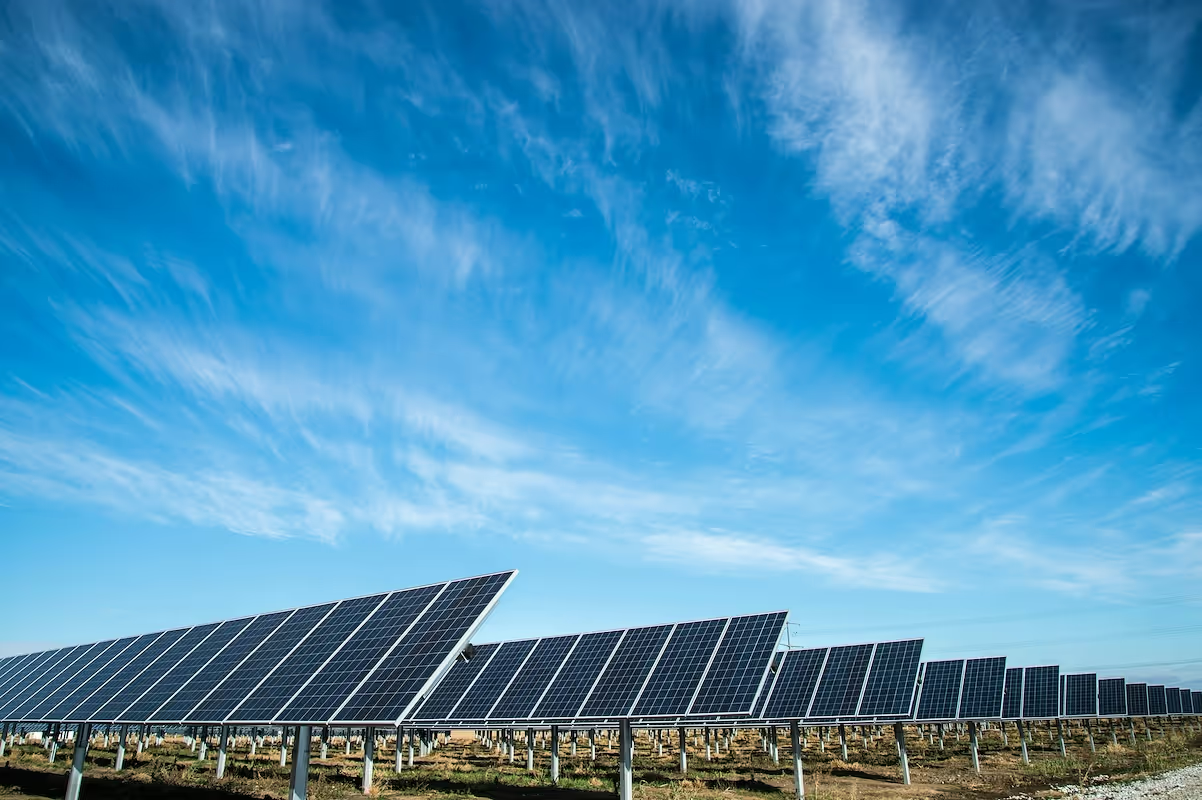
Starting a solar farm is a rewarding venture that combines skills in project management and environmental planning with sharp business sense. The solar energy market is a multi-billion dollar industry, and there is steady demand for clean power from utility companies, community projects, and large corporations.
This guide will take you through the practical steps of validating your business concept, securing funding, selecting the right location, and obtaining necessary permits to help you launch a successful solar farm business in the U.S.
Step 1: Validate your concept and plan your business
Begin by researching your state's Renewable Portfolio Standard (RPS). This policy dictates the demand for clean energy from utilities. Also, investigate the Power Purchase Agreement (PPA) rates offered by local utility companies. These rates will define your project's revenue stream and overall financial viability.
Analyze competition and project costs
To understand the competitive landscape, use the U.S. Energy Information Administration (EIA) database to map existing and planned solar projects in your target area. You can also review public records from your local county planning commission for more localized insight into upcoming developments.
A frequent oversight is choosing land without confirming its proximity to a substation with capacity. The cost to build new transmission lines can derail a project, so consult utility grid maps early. This single factor often determines a site's feasibility before any other work begins.
Speaking of costs, a 1-megawatt solar farm, which typically requires 5 to 7 acres, involves a significant investment. Expect to budget for land acquisition or leasing, solar panels and inverters ($500k-$1M), and soft costs like interconnection studies and permits ($100k-$350k+).
Here are 4 immediate steps to take:
- Identify your state's RPS and local utility PPA rates.
- Use the EIA database to map competing solar farms in your region.
- Draft a preliminary budget that includes land, equipment, and soft costs.
- Check local utility grid maps for substation proximity to potential sites.
Step 2: Establish your legal structure and secure licenses
Choose your business entity
Most solar developers form a Limited Liability Company (LLC). This structure protects your personal assets from business debts. You might also consider an S Corp election for your LLC, which can offer tax advantages once your farm generates consistent revenue.
A frequent misstep is to delay this decision. Set up your legal entity before you sign any leases or contracts. This ensures all agreements are in the business's name, not yours personally, which is a cleaner approach for liability and financing.
Navigate permits and regulatory bodies
Your project will answer to several agencies. At the federal level, the Federal Energy Regulatory Commission (FERC) governs wholesale electricity sales. Your state's Public Utility Commission (PUC) will also have its own set of rules and interconnection standards.
Locally, you will need a Conditional Use Permit (CUP) from the county planning department. This permit can cost between $5,000 and $20,000 and often takes 6 to 12 months to approve. You will also need standard building and electrical permits.
Here are 4 immediate steps to take:
- File for an LLC with your Secretary of State.
- Consult a tax professional about an S Corp election.
- Contact your county planning department to start the CUP application.
- Review your state PUC's interconnection application requirements.
Step 3: Secure insurance and manage risk
Key insurance policies
You will need several layers of protection. General Liability insurance, with at least $1M to $2M in coverage, is standard. Annual premiums often range from $5,000 to $15,000. Property insurance is another major item, covering your panels and equipment against physical damage.
Many developers overlook the need for Professional Liability (E&O) insurance. This policy protects you from claims of negligence in your project's design or management. Also, plan for Workers' Compensation if you hire staff and Commercial Auto if you own company vehicles.
A frequent misstep is to work with a general insurance agent. You might want to contact brokers who specialize in renewable energy. Consider providers like GCube, McGriff, or Beecher Carlson, as they understand the unique risks, from equipment failure to catastrophic weather damage like hailstorms.
Here are 4 immediate steps to take:
- Request quotes for a General Liability policy with at least $1M in coverage.
- Obtain a property insurance proposal that covers the full replacement cost of your equipment.
- Contact an insurance broker who specializes in renewable energy projects.
- Review policy exclusions to ensure you have coverage for severe weather events.
Step 4: Select your site and procure equipment
Secure your location
Plan for 5 to 7 acres of flat, unshaded land per megawatt of capacity. Parcels zoned for agriculture or industry are often ideal, but you should always verify solar is a permitted use in your county’s specific land use ordinance before you proceed.
When you negotiate a lease, aim for a 25 to 30-year term with options to extend. A detail that often gets missed is decommissioning. Your lease agreement must clearly define who is financially responsible for removing the equipment at the end of the project’s life.
Source major equipment
Your largest hardware expense will be solar panels. Tier 1 panels from manufacturers like Jinko Solar or Canadian Solar typically cost between $0.25 and $0.40 per watt. For a 1 MW farm, this can easily amount to over $250,000.
You will also need inverters. Central inverters cost around $0.08 per watt, while string inverters are closer to $0.12 per watt. String inverters can improve output if parts of your site experience shading, but they come with a higher upfront price tag.
Here are 4 immediate steps to take:
- Review county zoning maps for suitable agricultural or industrial parcels.
- Draft a Letter of Intent (LOI) for a 25-year land lease that includes decommissioning terms.
- Request quotes for Tier 1 solar panels from at least two suppliers.
- Compare pricing for central versus string inverters based on your site's layout.
Step 5: Set up your payment processing
Your primary revenue will come from utility companies through your Power Purchase Agreement (PPA). These payments are typically made via monthly or quarterly wire transfers. The payment structure is straightforward, but you should confirm the exact net metering credit and payment schedule in your contract.
However, if you explore a community solar model, you will need to accept payments from individual subscribers. This brings us to payment solutions. Many providers charge rates between 2.5% and 3.5% per transaction, which can add up significantly across dozens or hundreds of subscribers.
For accepting payments on-site or on-the-go, JIM offers a streamlined solution. With JIM, you can accept debit, credit, and digital wallets directly through your smartphone. At just 1.99% per transaction with no hidden costs, it's useful for signing up new community solar members at local events.
Getting started is simple:
- Get Started: Download the JIM app for iOS.
- Make a Sale: Type the sales amount, hit sell, and ask your customer to tap their card or device on your phone.
- Access Funds: Your money is available on your JIM card as soon as the sale is done.
Here are 3 immediate steps to take:
- Confirm the payment schedule and terms in your PPA draft.
- Evaluate if a community solar model is a viable part of your business plan.
- Compare JIM's 1.99% transaction rate against other payment solutions.
Step 6: Secure funding and manage your finances
For debt financing, you might want to explore SBA 7(a) or 504 loans. A 7(a) loan can provide up to $5 million with interest rates typically between Prime + 2.75% and 4.75%. Lenders will expect a detailed business plan and a solid credit history.
A frequent misstep is to present a budget that only covers hardware. Your loan application must also account for all soft costs, from permit fees to interconnection studies, or lenders may not consider it complete. This shows you have a realistic grasp of the total project investment.
Explore grants and tax equity
Look into the USDA's Rural Energy for America Program (REAP). This program offers grants that can cover up to 50% of total project costs if your farm is in a qualifying rural area. In addition, you can explore tax equity financing.
With tax equity, you partner with an investor who can use the federal tax credits your project generates. This can fund a significant portion of your upfront costs in exchange for a share of the project's financial benefits. This is a standard practice in the solar industry.
Here are 4 immediate steps to take:
- Research your eligibility for a USDA REAP grant.
- Contact an SBA-preferred lender to discuss 7(a) and 504 loan options.
- Calculate at least six months of operating expenses for your working capital needs.
- Find a financial consultant who specializes in renewable energy tax equity.
Step 7: Hire your team and manage operations
Build your operations team
For a 1-megawatt farm, your team will be lean. You will likely need a Solar Farm Technician responsible for panel cleaning, vegetation control, and basic repairs. Expect to budget a salary between $55,000 and $75,000 for this role.
You might want to look for candidates with a NABCEP certification. This credential shows they have a solid grasp of solar installation and maintenance standards. An Operations Manager role, which you could fill yourself initially, handles performance monitoring and reporting.
Streamline daily management
Your farm's performance is tracked through a SCADA system, which provides real-time output data. To manage maintenance tasks, consider using a CMMS software like UpKeep or MaintainX. These platforms help schedule and log all repair work.
A frequent misstep is to underestimate vegetation management. Uncontrolled grass and weeds can shade panels and reduce output by 10% or more. Your maintenance plan must include regular mowing or even grazing animals to keep the site clear.
Many small farms outsource Operations & Maintenance (O&M) to a third-party provider. This can be more cost-effective than hiring full-time staff, as the industry standard is roughly one technician per 10-20 megawatts of capacity.
Here are 4 immediate steps to take:
- Draft a job description for a Solar Farm Technician, including NABCEP certification as a preferred qualification.
- Request quotes from at least two third-party O&M service providers.
- Schedule demos for CMMS software like UpKeep or MaintainX.
- Create a detailed vegetation management plan for your specific site.
Step 8: Market your project and acquire customers
Target utility off-takers
Your primary marketing focus will be on securing a Power Purchase Agreement (PPA). Create a professional website and a detailed project prospectus. This document should outline your project’s capacity, interconnection status, and expected output for potential utility or corporate buyers.
Networking is your main channel. You might want to attend industry conferences like RE+ to meet utility procurement managers. The sales cycle for a PPA is long, often 12 to 24 months, so relationship-building is a priority. A frequent oversight is not having a polished online presence, which can signal a lack of professionalism.
Engage community solar subscribers
If you pursue a community solar model, your marketing shifts to direct customer acquisition. Develop a simple website with a clear call-to-action for subscriber sign-ups. Local digital ads and partnerships with homeowner associations or environmental groups can be effective outreach methods.
Budget for a Customer Acquisition Cost (CAC) between $400 and $800 per subscriber. You can also host local informational webinars to explain the benefits of community solar. This direct engagement helps build trust and accelerates sign-ups within your target service area.
Here are 4 immediate steps to take:
- Create a professional one-page project summary for potential PPA off-takers.
- Identify two key renewable energy conferences to attend in the next year.
- If pursuing community solar, outline a marketing budget based on a target CAC.
- Develop a list of local organizations to partner with for community outreach.
Step 9: Develop your pricing strategy
Set your Power Purchase Agreement (PPA) price
Your PPA price is your core revenue driver. This rate, priced per megawatt-hour (MWh), typically falls between $35 and $55 in today's market. You must calculate your project's Levelized Cost of Energy (LCOE) to determine your break-even point before you negotiate any contract.
A frequent misstep is to set a PPA price below your LCOE, which locks in a loss for decades. Your price must cover all costs and deliver your target Internal Rate of Return (IRR), which is often between 8% and 12% for solar projects.
You can propose a fixed-price PPA for its simplicity or one with a 1-2% annual price escalator. An escalator helps your revenue keep pace with inflation. Utilities in some markets prefer one over the other, so it helps to model projections for both structures.
Price your community solar subscriptions
If you pursue a community solar model, your pricing shifts from wholesale to retail. You will offer subscribers a guaranteed discount on their monthly electricity bills. A common offer is a 10% to 15% reduction, which provides a clear value proposition to potential customers.
Your pricing decision here is a balancing act. A larger discount can help you acquire subscribers more quickly but will reduce your overall profit margin. You might want to analyze competitor subscription rates in your area to find a competitive yet profitable price point.
Here are 4 immediate steps to take:
- Calculate your project's Levelized Cost of Energy (LCOE).
- Review your state's public utility commission database for recent PPA prices.
- Analyze competing community solar offers to benchmark subscription discounts.
- Create financial models for both a fixed-price and an escalating PPA rate.
Step 10: Launch and scale your operations
Monitor performance and quality
Once your farm is operational, you must track its output. The key metric is the Performance Ratio (PR), which compares actual energy production to the theoretical maximum. A well-run farm should target a PR of 80% or higher. Also, track availability, which should exceed 99%.
Many new owners focus on availability but neglect performance degradation. Your farm can be online 99.9% of the time but still lose significant revenue if dirty panels or faulty equipment cause the PR to drop. This detail separates profitable projects from struggling ones.
For documentation and maintenance procedures, you might want to align your practices with IEC 62446 standards. This provides a clear framework for testing, documentation, and maintenance of your PV system, which is valuable for both internal operations and potential buyers if you sell the project.
Plan your growth strategy
Scaling your operations is tied directly to securing new Power Purchase Agreements. As you plan to add more megawatts, your team will need to grow. A good rule of thumb is to hire one full-time O&M technician for every 10 to 20 megawatts of capacity you manage.
When you manage multiple sites, a simple SCADA system is not enough. You might want to look at portfolio management platforms like PowerFactors. These systems consolidate data from all your projects, which helps you manage a larger fleet of assets from a single dashboard.
Here are 4 immediate steps to take:
- Establish a system to calculate your farm's Performance Ratio (PR) monthly.
- Review the IEC 62446 standards for system maintenance and documentation.
- Create a hiring forecast based on the 1 technician per 10-20 MW benchmark.
- Research portfolio management software for when you expand to multiple sites.
You have a clear path to launch your solar farm. Success often comes down to the long-term details, like your PPA rate and decommissioning terms, which define profitability over decades. With this guide, you are well-equipped to begin your project with confidence.
As you build your business, especially with a community solar model, managing payments should be straightforward. JIM turns your phone into a card reader for a flat 1.99% fee, no extra hardware required. Download JIM to handle transactions easily.
.avif)