Starting a sparkling water business is an exciting venture that blends creativity in flavor development and branding with sharp business savvy. The market is already worth billions of dollars, showing a steady demand from health-conscious consumers, people looking for soda alternatives, and even as a popular cocktail mixer.
This guide will take you through the practical steps of validating your business concept, securing funding, obtaining necessary licenses, and building supplier relationships to help you launch a successful sparkling water business in the U.S.
Step 1: Validate your business idea and map out your plan
Conduct market research and competitor analysis
First, confirm people actually want your flavors. You can run simple taste tests at local farmers' markets or create online surveys. Aim to get feedback from 50-100 potential customers before committing to a flavor profile. Many new owners make flavors they love but forget to check the market.
While you do that, study your competition. Look at what's on the shelves in local grocery stores and cafes. Note their branding, price points, and flavor combinations. For broader industry data, reports from firms like Nielsen or SPINS can offer valuable market insights.
Estimate your startup costs
With your initial research done, it is time to build a preliminary budget. A small-scale launch using a contract packer, or co-packer, is a common starting point. This helps you avoid the high upfront investment in a full canning or bottling line, which can exceed $50,000.
Here is a realistic breakdown of initial expenses:
- Branding and Packaging Design: $3,000 - $10,000. Your can or bottle is your most important marketing piece, so this is a worthwhile investment.
- Co-Packer Setup and First Run: $10,000 - $30,000. This covers your first batch of product.
- Licenses and Permits: $500 - $2,000. This includes FDA registration and local health department requirements.
- Initial Ingredients: $2,000 - $5,000.
In total, you might plan for a startup budget between $20,000 and $50,000 for a professional, small-scale launch.
Here are 3 immediate steps to take:
- Survey at least 50 potential customers on your top three flavor ideas.
- Analyze three direct competitors, noting their pricing, packaging, and where they sell.
- Draft a startup budget with line-item estimates for co-packing, branding, and licensing.
Step 2: Establish your legal structure and secure licenses
Choose your business structure
Most new beverage brands start as a Limited Liability Company (LLC). This structure protects your personal assets if the business faces legal issues. It also offers pass-through taxation, meaning profits are taxed on your personal return, which simplifies things early on.
Some founders start as a sole proprietorship to save money, but this is a mistake. It leaves your personal finances exposed. Filing for an LLC costs between $50 and $500 depending on your state, a small price for major protection.
Navigate food and beverage regulations
Your business is regulated by the Food and Drug Administration (FDA). You must register your production facility with the FDA, even if you use a co-packer. This is free and can be done online through their Food Facility Registration portal.
Next, you will need state and local permits. Look for a 'Food Processor License' or similar permit from your state's Department of Agriculture or Health. These can cost $200-$800 and often take 4-8 weeks to process, so apply early.
Here are 3 immediate steps to take:
- File for an LLC with your state's Secretary of State office.
- Complete the FDA Food Facility Registration online.
- Contact your state's Department of Agriculture to request an application for a food processor license.
Step 3: Secure insurance and manage risk
Key insurance policies for your business
Protecting your business from day one is non-negotiable. You will need several types of insurance. The most important is a combined General and Product Liability policy. This covers claims if someone gets sick from your product or is injured at your facility.
For a small operation, expect to pay between $1,500 and $4,000 annually for a policy with $1 million per occurrence and $2 million aggregate coverage. This is a standard requirement for most distributors and retailers, so you cannot skip it.
In addition, you may need:
- Commercial Property Insurance: To cover your ingredients, finished products, and any equipment you own.
- Workers’ Compensation: This is legally required in most states as soon as you hire your first employee.
- Commercial Auto Insurance: If you use a vehicle for deliveries or business errands.
A mistake some new owners make is using a general insurance agent. You might want to work with a broker who specializes in the food and beverage industry. They understand specific risks like product recalls or contamination and can find policies that actually cover them.
Speaking of brokers, consider getting quotes from providers like the Food Liability Insurance Program (FLIP), Hiscox, or The Hartford. They have experience with beverage startups and can ensure your coverage meets industry standards, a step that prevents major headaches later.
Here are 3 immediate steps to take:
- Request quotes for a $1M/$2M general and product liability policy.
- Contact an insurance broker who specializes in the food and beverage industry.
- Confirm your policy explicitly covers product recalls and contamination risks.
Step 4: Secure your production space and equipment
Find your production space
Look for a 1,000 to 2,500 square foot space. It should be zoned for 'light industrial' or commercial food production. This size gives you enough room for equipment, ingredient storage, and pallets of finished product. Many founders underestimate storage needs, so plan for extra space.
When you review a lease, try to negotiate a 1-2 year term with an option to renew. This gives you flexibility. Before you sign, confirm the space has floor drains and 3-phase electrical service, as most beverage equipment requires it.
Source your equipment and supplies
You can begin with a modest equipment setup. A brite tank for carbonation costs between $3,000 and $7,000. A small, manual canning line from a company like Oktober Can Seamers runs about $5,000. Pumps and hoses will add another $1,000.
For cans, large suppliers like Ball have high minimums. A better start is a distributor like American Canning. They can supply printed cans with a minimum order of one pallet, which is roughly 7,000 cans, a manageable amount for a new brand.
Here are 4 immediate steps to take:
- Identify three potential commercial spaces in your target size range.
- Contact your city's planning department to confirm zoning for a beverage facility.
- Get quotes for a brite tank and a manual canning system.
- Request a pricing sheet from a can distributor like American Canning.
Step 5: Set up your payment processing
Handle wholesale and direct payments
When you sell to distributors or retailers, expect payment terms like Net 30. This means you get paid 30 days after they receive your product. You will need to plan your cash flow for this delay. Most wholesale payments arrive via ACH transfer or a physical check.
For direct sales at farmers' markets or events, you need a way to accept cards. A mistake some new owners make is to focus only on wholesale. They miss high-margin sales because they are not ready to take immediate payment. This is an easy problem to avoid.
Choose a payment solution
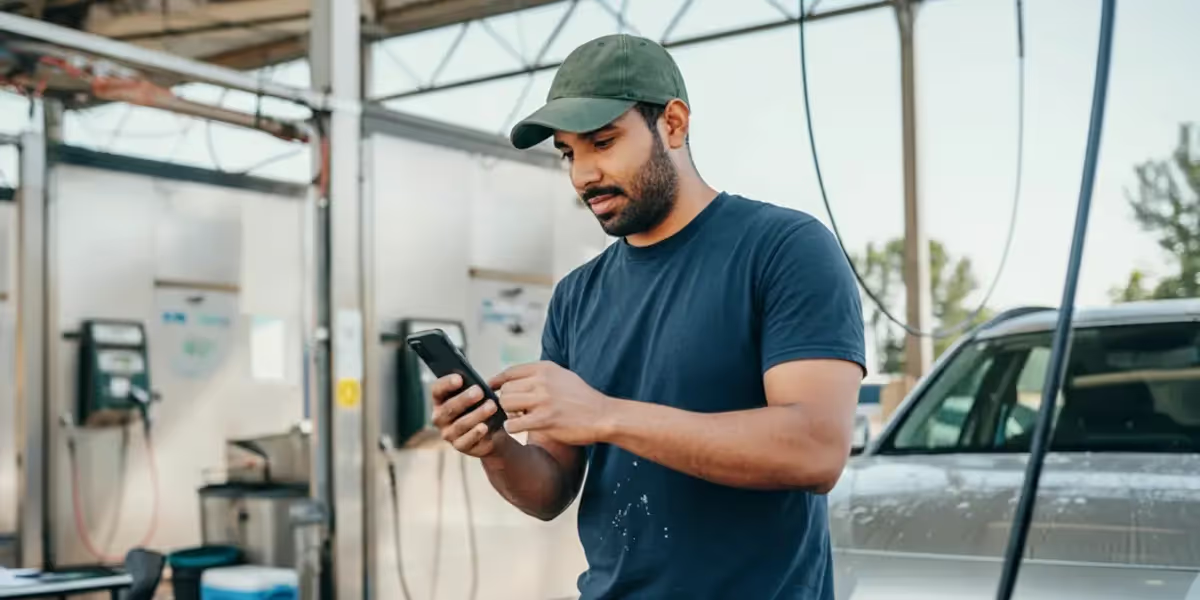
For sales on-site or on-the-go, JIM offers a streamlined solution. With JIM, you can accept debit, credit and digital wallets directly through your smartphone. Just tap and the sale is done. It is particularly useful for sales at farmers' markets or food festivals.
At just 1.99% per transaction with no hidden costs or extra hardware, it is very competitive. Other providers often charge between 2.5% and 3.5% and may require you to buy a card reader. With JIM, your phone is all you need.
Here is how to get started:
- Get Started: Download the JIM app for iOS.
- Make a Sale: Type the sales amount, hit sell, and ask your customer to tap their card or device on your phone.
- Access Funds: Your money is available right on your JIM card as soon as the sale is done, with no wait for bank transfers.
Here are 3 immediate steps to take:
- Decide on your payment terms (e.g., Net 30) for wholesale accounts.
- Set up a business bank account to accept ACH transfers from distributors.
- Download a mobile payment solution like JIM to prepare for direct-to-consumer sales.
Step 6: Secure funding and manage your finances
Explore your funding options
SBA loans are a solid option for beverage startups. The SBA 7(a) program can fund large projects, but a realistic target for a new brand is $50,000 to $150,000. Lenders will want to see a credit score above 680 and a detailed business plan.
For smaller needs, the SBA Microloan program offers up to $50,000. These often have more flexible requirements. In addition to loans, you might look into grants. The USDA’s Value-Added Producer Grant is one to research, as it supports businesses using agricultural products.
Plan your working capital
With funding in mind, map out your cash needs for the first six months. This working capital covers inventory, marketing, and operational costs while you wait for payments from distributors. Many new owners focus on startup costs but forget the cash needed to run the business.
A safe estimate for your first six months is between $40,000 and $75,000. This should cover two production runs, initial marketing pushes, and unforeseen expenses. Having this buffer prevents a cash crunch before your sales gain momentum.
Here are 3 immediate steps to take:
- Draft a 6-month financial projection to estimate your working capital needs.
- Check your credit score and gather documents for an SBA loan application.
- Research the next application window for the USDA Value-Added Producer Grant.
Step 7: Hire your team and set up operations
Your first hire will likely be a Production Assistant. This person handles brewing, canning, and cleaning. Plan for a pay rate between $18 and $25 per hour. Most states require them to have a Food Handler's Permit, which is a simple online course.
Once you have a consistent production schedule, you might want to find a part-time Sales Representative. Their job is to get your product into local stores and cafes. A common pay structure is a small base salary plus a 5-10% commission on new sales.
Many founders try to handle all sales themselves and burn out. Bringing on a sales rep, even for 10-15 hours a week, frees you to focus on running the business. It is a smart move once you have product ready to ship.
For operations, create simple Standard Operating Procedures (SOPs) for key tasks like sanitation and carbonation. For scheduling, apps like Homebase or When I Work have free plans that are perfect for a small team. A good financial benchmark is to keep labor costs under 20% of revenue.
Here are 4 immediate steps to take:
- Draft a job description for a Production Assistant, including pay and responsibilities.
- Check your local health department website for Food Handler's Permit requirements.
- Write a one-page SOP for your most important cleaning process.
- Explore the free version of a scheduling app like Homebase.
Step 8: Market your product and acquire customers
Start with local and digital channels
Your first customers are likely in your community. Offer samples at farmers' markets and local events. Also, partner with independent cafes and grocers to get your product on their shelves. A good initial goal is to secure 5-10 local stockists in your first three months.
For digital marketing, Instagram is your best friend. Post high-quality photos of your cans and share your brand story. You might want to collaborate with local food bloggers for reviews. A common mistake is to pour money into paid ads too soon. Focus on organic reach first.
Track your efforts and build a brand
Set a marketing budget around 10-15% of your projected revenue. As you sell online, aim for a Customer Acquisition Cost (CAC) under $5. This helps you measure if your ad spend is effective. Successful brands like Recess built a following by creating a lifestyle, not just a drink.
Your brand story is what separates you from the competition. Is your water sourced from a unique spring? Do you use exotic fruit infusions? Communicate this clearly on your packaging and website. This narrative gives customers a reason to choose you over established names.
Here are 4 immediate steps to take:
- Identify five local cafes or independent grocers for sales outreach.
- Create a one-month content calendar for your brand's Instagram account.
- Draft a one-paragraph brand story that highlights your unique angle.
- Set an initial marketing budget based on 10% of your projected revenue.
Step 9: Set your pricing and sales strategy
Calculate your pricing
First, determine your cost of goods sold (COGS) per can. This includes ingredients, packaging, and production labor. A realistic COGS for a startup is often between $0.60 and $0.85 per can. This number is your foundation for all pricing decisions.
For wholesale, a standard gross margin is 40-50%. If your COGS is $0.75, your wholesale price per can should be around $1.25 to $1.50. This price allows your retail partners to apply their own markup and still offer a competitive shelf price.
Now, walk the aisles of your target retailers. Note the prices of competitors like Spindrift and other local brands. Many new owners make the mistake of pricing too low to compete. This can signal poor quality and make it impossible to achieve profitability.
If your brand has a unique angle, like using rare ingredients or functional additives, you can use value-based pricing. This allows you to set a price based on perceived value, which might support a retail price of $2.50 to $3.50 per can.
Here are 4 immediate steps to take:
- Calculate your final cost of goods sold (COGS) for a single can.
- Analyze the retail pricing of three direct competitors in local stores.
- Set your wholesale price to achieve a 40-50% gross margin over your COGS.
- Establish a direct-to-consumer (DTC) price for farmers' markets and online sales.
Step 10: Maintain quality control and scale your operations
Maintain consistent quality
Your top priority is a consistent product. Track key metrics for every batch. For sparkling water, this means a target carbonation level between 3.5 and 4.5 volumes of CO2 and a stable pH. Use a log to record these numbers so you can spot deviations early.
Many new owners fail to document their processes. This becomes a problem when you hire help. You should follow Good Manufacturing Practices (GMPs). This provides a framework for sanitation, production, and record-keeping that ensures your product is safe and consistent.
Know when to scale
Once you have a consistent product, you can think about growth. A good signal to expand is when you regularly hit 80% of your production capacity. At this point, you might want to invest in a larger brite tank or a more automated canning line.
As your orders increase, managing inventory becomes complex. You can look into beverage-specific software like Ekos or OrchestratedBEER. These platforms help track raw materials, finished goods, and sales data, which prevents stockouts and simplifies financial planning.
Here are 4 immediate steps to take:
- Document your target pH and carbonation volume for each flavor.
- Create a simple cleaning log to align with Good Manufacturing Practices (GMPs).
- Calculate your current production capacity to see if you are near the 80% mark.
- Request a demo for a beverage management software like Ekos.
You now have the roadmap to launch your sparkling water brand. Remember that success in this space comes from balancing a great flavor with smart, practical business moves. With this plan, you are ready to take the first real step.
As you start selling, you will want an easy way to get paid. JIM turns your phone into a card reader for a flat 1.99% fee, with no extra hardware. Download JIM so you are ready for your first customer.
.avif)