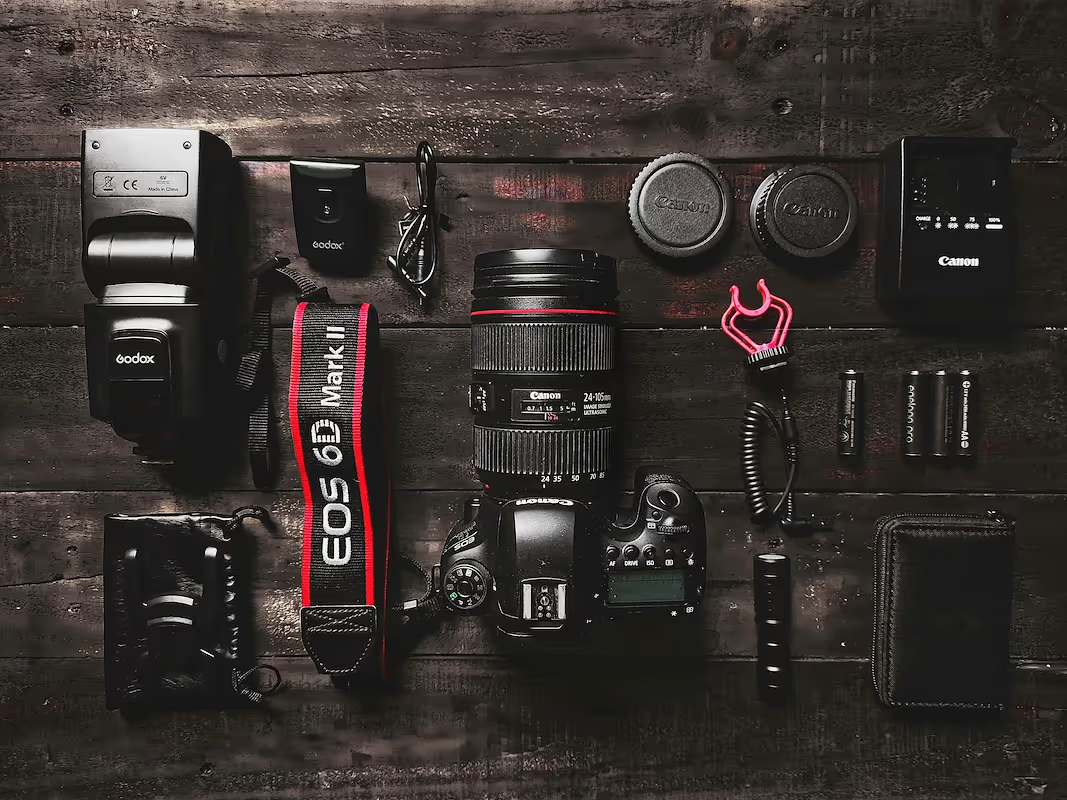
Starting a stock photography business is a rewarding venture that combines artistic vision and technical photography skills with business savvy. The industry is worth billions of dollars, with a steady demand for high-quality images from marketers, web designers, and businesses of all sizes.
This guide will take you through the practical steps of validating your business concept, acquiring the right equipment, obtaining necessary licenses, and marketing your portfolio to help you launch a successful stock photography business in the U.S.
Step 1: Plan your business and validate your idea
Start by researching what images sell. Spend a few hours on sites like Adobe Stock and Getty Images to identify popular categories and aesthetics. Use Google Trends to find emerging visual needs, like "remote work" or "sustainability," to stay ahead of the curve.
Many new photographers shoot what they love, not what buyers need. While passion is important, market demand is what will sustain your business. Find the overlap between your skills and what sells.
Analyze your competition
Look at the portfolios of top-earning photographers on platforms like Shutterstock. Note their most popular images, keywords, and subject matter. For a deeper dive, you can use a platform like SEMrush to see which keywords drive traffic to major stock photo websites.
Estimate your startup costs
Your initial investment will mostly cover equipment. A professional setup can range from $3,000 to $7,000. This includes a full-frame camera ($1,500+), versatile lenses ($800+), and basic lighting ($500+). Also, budget for editing software like Adobe Creative Cloud.
You do not need the best gear on day one. Many successful photographers start with a solid entry-level kit and upgrade as their income grows. Focus on quality lighting and lenses first.
Here are 3 immediate steps to take:
- Create a list of 10 niche photo categories based on your research on Adobe Stock and Google Trends.
- Identify 5 successful stock photographers on Shutterstock and analyze their top 10 images.
- Build a startup budget that separates "must-have" gear from "nice-to-have" upgrades.
Step 2: Set up your legal structure and get licensed
You should consider forming a Limited Liability Company (LLC). Many new photographers operate as sole proprietors, but this mixes personal and business assets. An LLC protects your personal property from business debts. You can file with your state's Secretary of State for around $50 to $150.
Once your LLC is approved, get an Employer Identification Number (EIN) from the IRS. It is free and you can apply online in minutes. You will need this number for tax purposes and to open a business bank account, which keeps your finances separate and clean.
Secure the right releases
For any photo with a recognizable person or private property, you need a signed release. A model release is for people, and a property release is for places like a unique home. Without these, stock agencies will reject your images. Apps like Easy Release can manage this for you.
Also, check with your city or county clerk for a general business license. These usually cost between $50 and $100 per year. This permit allows you to operate legally within your local area.
Here are 4 immediate steps to take:
- File for an LLC with your state's Secretary of State office.
- Apply for a free Employer Identification Number (EIN) on the IRS website.
- Download a model release app like Easy Release to have on your phone.
- Visit your city’s website to find the application for a general business license.
Step 3: Insure your business and manage risk
Protect your assets and operations
General liability insurance is your first line of defense. It covers third-party claims like bodily injury or property damage. A client who trips over your light stand is a perfect example. Expect to pay $400 to $700 annually for a $1 million policy.
You should also get professional liability insurance, often called errors and omissions (E&O). This protects you if a client claims your work caused a financial loss, such as from an alleged copyright issue. This policy adds another layer of security for your business.
Cover your equipment
Your camera gear is a significant asset. A standard homeowner's policy often will not cover equipment used for business purposes, a detail many new photographers miss. You need a separate equipment insurance policy, which costs 1% to 2% of your gear's total value per year.
Providers that specialize in photographer insurance include Hiscox, The Hartford, and Full Frame Insurance. They understand the specific risks you face and offer tailored packages. It is wise to get quotes from a few before you decide on one.
Here are 3 immediate steps to take:
- Create a detailed inventory of all your photography gear with serial numbers and purchase prices.
- Request a quote for a $1 million general liability policy from an insurance provider.
- Compare equipment insurance policies from specialized providers like Hiscox or Full Frame Insurance.
Step 4: Build your home studio and initial portfolio
Set up your workspace
You do not need a commercial studio. A dedicated corner in a spare room, around 100-150 square feet, is plenty of space for product shots and headshots. Check your local city ordinances for home-based business rules, but this is usually a formality for a business with no foot traffic.
Create your first 100 images
Your first goal is to build a portfolio of about 100 diverse, high-quality images. This proves to stock agencies you can deliver consistent quality. Use the niche list you created in step 1 to guide your shot list. Focus on variety, from business concepts to lifestyle moments.
A mistake many photographers make is buying too much gear upfront. Stick to your budget. A reliable full-frame camera ($1,500+), a versatile 24-70mm lens ($800+), and a two-light kit ($500+) will cover most scenarios. Your lighting skills matter more than your camera model.
Keyword your images correctly
Great photos are useless if buyers cannot find them. Keywording is how your images get discovered. Be specific. Instead of just "dog," use "golden retriever puppy playing in grass with red ball." Use 20-40 keywords per image, mixing broad terms with very specific ones.
Most stock agencies have keyword suggestion tools built into their uploader. Use them to find what buyers actually search for. Analyze the keywords on top-selling images in your niche to learn what works. This is not a step you should rush.
Here are 4 immediate steps to take:
- Designate and clear a 10x10 foot space in your home for your studio setup.
- Create a shot list for your first 25 photos based on your niche research.
- Practice keywording by adding 30 keywords to five of your existing favorite photos.
- Finalize your starter gear list and compare prices on sites like B&H Photo or Adorama.
Step 5: Set up your payment and delivery systems
Accepting payments
Most stock agencies like Shutterstock or Adobe Stock handle payments for you. They pay out monthly via PayPal or bank transfer once you hit a minimum threshold, usually $35 to $100. Your main task is to link your preferred payment account to their platform.
Many photographers miss out on higher earnings because they do not understand commission structures. Some agencies offer a flat rate per download, while others give a percentage. You might want to research this before you commit your portfolio to one platform.
For photographers who need to accept payments on-site, JIM offers a streamlined solution. You can accept debit, credit, and digital wallets directly through your smartphone—just tap and you are done. At just 1.99% per transaction with no hidden costs or extra hardware needed, it is useful for selling prints at art fairs.
Here is how it works:
- Get Started: Download the JIM app for iOS.
- Make a Sale: Type the sales amount, hit sell, and ask your customer to tap their card or device on your phone.
- Access Funds: Your money is available on your JIM card as soon as the sale is done. There is no wait for bank transfers.
Delivering your images
When you sell through a stock agency, they manage the file delivery to the buyer. Your job is to upload a high-resolution JPEG that meets their technical standards. For direct sales, you will need to send a download link yourself, often through a service like WeTransfer or Dropbox.
Here are 4 immediate steps to take:
- Compare the commission rates and payment thresholds for Adobe Stock, Shutterstock, and Getty Images.
- Create a PayPal or Payoneer account to receive your earnings from stock agencies.
- Download the JIM app to prepare for any in-person sales opportunities.
- Set up a Dropbox or Google Drive folder to organize and share images for direct sales.
Step 6: Fund your business and manage finances
Find your startup capital
You might want to look into an SBA Microloan. These loans range from $500 to $50,000 and often have interest rates between 8% and 13%. They are a good fit for new businesses that have a solid plan but may lack extensive credit history.
Another path is to seek out grants. While competitive, organizations like PPA Charities offer financial support to photographers. You should also check with your local arts council, as they often have grants for artists in the community.
Manage your working capital
For your first six months, you will need some working capital. Plan for about $1,000 to $2,000. This amount should cover software subscriptions like Adobe Creative Cloud, website hosting, and any small marketing campaigns you decide to run.
A frequent misstep is poor financial tracking from the start, which creates a huge headache during tax season. Use a simple spreadsheet or a program like QuickBooks Self-Employed to log every business expense as it happens. This keeps your records clean and organized.
Here are 4 immediate steps to take:
- Research SBA Microloan requirements on the official SBA website.
- Search for grants offered by your local arts council.
- Create a 6-month operating budget that projects your software and marketing costs.
- Set up a spreadsheet to track all your business-related expenses from day one.
Step 7: Hire help and streamline your operations
Hiring your first help
As a solo operator, you handle everything. Once your income grows, you might want to outsource tasks. A freelance photo retoucher is often the first hire. They handle post-processing, which frees you up to shoot more. Expect to pay $25 to $75 per hour for an experienced editor.
Another role to consider is a keywording assistant. This person can save you hours of tedious work. A good assistant costs around $15 to $30 per hour. Look for freelancers on platforms like Upwork who have experience with stock photo agencies.
Managing your workflow
To keep your projects organized, you can use a workflow management app. A simple Trello or Asana board helps you track shoots from concept to upload. Create columns for "Idea," "Scheduled," "To Edit," "To Keyword," and "Submitted." This visual system prevents images from getting lost.
For keywording specifically, software like Xpiks or Photo Mechanic can speed up the process significantly. These programs help you apply metadata to batches of images at once. Many photographers find this investment pays for itself quickly in time saved.
Here are 4 immediate steps to take:
- Draft a job description for a freelance photo retoucher on Upwork.
- Set up a free Trello board to map out your photography workflow.
- Compare the features of keywording software like Xpiks and Photo Mechanic.
- Track your time for one week to identify tasks you could outsource.
Step 8: Market your portfolio and acquire customers
Leverage stock agency platforms
Your primary marketing channel is the stock agency itself. Success here depends on visibility. A mistake many new photographers make is uploading to only one site. You should submit your portfolio to 3-5 agencies like Adobe Stock, Shutterstock, and Alamy to maximize reach.
Agencies reward consistency. Aim to upload 10-20 new images each week. This signals to their algorithm that you are an active contributor, which can boost your portfolio’s visibility. Track your submission acceptance rate and aim for 80% or higher.
Build your personal brand
Beyond agencies, you should create a personal portfolio website. This is your space to attract direct clients for higher-value projects. Use a platform like Squarespace or Pixpa. You can also use social media, especially visual platforms like Instagram and Behance, to showcase your best work.
Create content that attracts your ideal buyer. If you shoot travel photos, write a blog post on your site titled "Photographing the Italian Coast." This helps you appear in Google searches and establishes your expertise. This is a long-term play that builds your reputation.
Here are 4 immediate steps to take:
- Select three stock agencies to upload your initial portfolio to, instead of just one.
- Create a professional Instagram or Behance profile dedicated to your photography.
- Outline three blog post ideas for a personal portfolio website that target your chosen niches.
- Set a weekly goal to upload 15 new, keyworded images to your chosen agencies.
Step 9: Price your work and understand the market
Understand the pricing models
Most stock photography operates on a Royalty-Free (RF) model. A buyer pays a one-time fee to use your image multiple times. Your earnings come from commission splits with the agency, which typically start around 15-20% and can rise to 40% as you sell more.
A frequent mistake is to ignore the commission structure. Before you upload your portfolio, review the contributor agreements for sites like Shutterstock and Adobe Stock. Understand the different earning tiers and what it takes to move up to a higher percentage.
For direct sales, you set the price. Research what similar independent photographers charge. A web-resolution image for a blog might be $50, while an exclusive commercial license could be $500 or more. This gives you control but also requires more marketing effort.
Research your image value
To gauge an image’s worth, search for similar photos on major stock sites. A standard business photo might sell for $10 to $30, but a highly specific or artistic shot could command more. Also, look at Extended Licenses, which can sell for over $80 for use on merchandise.
Here are 4 immediate steps to take:
- Review the commission tiers for Shutterstock and Adobe Stock to understand how earnings grow.
- Find five photos similar to yours on Getty Images and note their prices.
- Define a price list for three types of direct-sale licenses: personal, web, and commercial.
- Identify three images in your portfolio that could be candidates for an Extended License.
Step 10: Maintain quality and scale your business
Establish your quality benchmarks
Stock agencies have strict technical standards. Your images must be sharp, correctly exposed, and free of digital noise. Most require a minimum resolution of 4 megapixels, but you should submit files that are 12 megapixels or larger to meet buyer needs for big prints.
A key metric to watch is your acceptance rate. If it drops below 80% on sites like Adobe Stock, their algorithms may show your portfolio less often. A common mistake is to sacrifice quality for speed. It is better to upload 15 great images a week than 50 that get rejected.
Know when to grow
Once your portfolio reaches 500 images, it is time to analyze your sales data. Use a service like Stock Performer to identify your top-selling 10% of photos. This information is your roadmap for what to shoot next. Double down on what already works.
When you consistently earn over $500 per month, you might want to outsource post-processing. A good freelance retoucher costs $25 to $75 per hour. This frees you up to shoot more, which is where you provide the most value. This is how you scale from a hobby to a business.
Here are 4 immediate steps to take:
- Review the technical image guidelines for one of your main stock agencies.
- Calculate your current acceptance rate and set a goal to keep it above 85%.
- Analyze your top 20 selling images to find a pattern in subject matter or style.
- Set a monthly income goal that will trigger your search for a freelance retoucher.
Building a stock photography business is a marathon, not a sprint. Success comes from consistently creating quality images that buyers need, not just photos you love to shoot. Your portfolio is your engine, so keep it running with fresh content. Good luck out there.
And when you make direct sales at fairs or events, a simple payment solution helps. JIM turns your smartphone into a card reader for a flat 1.99% fee, with no extra hardware. Download JIM to get paid on the spot.
.avif)