How to start a traffic control business: 2026 costs, licenses, and steps
See article summary
- A traffic control business supplies certified flaggers, signage, and lane-closure equipment to construction, utility, and event clients under MUTCD standards.
- Startup costs run $50,000 to $150,000, driven by used work trucks and compliant traffic control gear.
- You need an LLC, ATSSA Flagger and Traffic Control Technician certifications, and a $1 million general liability policy.
- SBA 7(a) loans up to $5 million fund most launches, with rates capped at Prime plus a set spread.
- Price crew labor at $65 to $110 per hour and target a 20 to 30 percent net profit margin per job.
A traffic control business supplies certified flaggers, signage, and lane-closure equipment to construction, utility, and event clients under federal safety standards. Demand stays consistent because roadwork, utility projects, and public events require traffic management year-round, which makes it a reliable industry if you have construction or field-operations experience.
The 10 steps below cover business planning, licensing, insurance, equipment, funding, and pricing so you can launch a compliant operation in the U.S. without costly first-year mistakes.
How much does it cost to start a traffic control business?
Startup costs typically range from $50,000 to over $150,000, driven by used work trucks and compliant traffic control gear. The figure is not arbitrary; it reflects the minimum inventory you need to run a safe, contract-ready operation. Underestimating equipment needs is a common misstep, because you need a full inventory beyond a few cones and signs.
A sample cost breakdown looks like this:
- Used Work Trucks (2): $40,000 to $60,000
- Traffic Control Equipment (signs, cones, barricades): $15,000 to $25,000
- Insurance and Licensing: $5,000 to $10,000
- Safety Gear and Radios: $3,000 to $5,000
These ranges reflect typical market pricing for used trucks and compliant gear sourced from suppliers like Traffix Devices and Royal Truck & Equipment. Equipment financing or leasing helps you manage the initial cash requirement without tying up your working capital.
Your next moves:
- Identify three major construction projects planned in your area for the next year.
- List five local competitors and note the types of jobs they manage.
- Build a preliminary budget using the cost ranges above.
How do you set up your legal structure and get licensed?
Form a Limited Liability Company (LLC) to separate your personal assets from business debts, then obtain a federal Employer Identification Number. An LLC protects your home and savings if the business faces a lawsuit, and profits pass through to your personal tax return, which simplifies filing compared to a C corporation.
As you grow, you might consider an S corporation election using IRS Form 2553, which can lower self-employment taxes once your profits justify the extra paperwork. An S-corp election is a tax decision that depends on your revenue and ownership, so consult a licensed tax professional before you file.
Regulations and certifications
Your operations are governed by your state's Department of Transportation (DOT) and the federal Manual on Uniform Traffic Control Devices (MUTCD), 11th Edition, which became effective January 18, 2024. States had two years to adopt the 11th Edition or publish a substantially conforming state supplement, with a state adoption deadline of January 18, 2026. Check your state DOT's supplement before you bid, because state-specific addendums can change sign placement and work-zone layout requirements.
Your crew will need certifications from the American Traffic Safety Services Association (ATSSA), such as Flagger and Traffic Control Technician (TCT). Budget $200 to $400 per person for these courses. Job-specific permits from local public works departments can cost $100 to $500 and take 5 to 15 business days to process.
Your next moves:
- File for your LLC with your state's Secretary of State.
- Download your state DOT's supplement to the MUTCD.
- Find local ATSSA-certified training providers and check their schedules.
What insurance does a traffic control business need?
Carry General Liability with at least a $1 million per-occurrence limit and a $2 million aggregate, which is the standard requirement for state DOT contractor prequalification and prime contractor contracts. Add Commercial Auto insurance with a $1 million combined single limit for your work trucks. Specific insurance minimums are set by state DOT contract requirements, which vary by jurisdiction, so confirm the limits your target clients demand before you buy.
Workers' Compensation is mandatory once you hire employees. Professional Liability, or Errors and Omissions (E&O), protects you if a mistake in your traffic plan leads to an incident. Annual premiums for a full package can range from $15,000 to $30,000 or more, depending on your payroll and claims history.
Avoid a general insurance agent. Seek out brokers who specialize in construction or traffic control, because they understand risks like liability for accidents caused by improper sign placement. Consider providers like The Hartford, Tivly, or local brokers with construction expertise, and always confirm coverage amounts against your contract requirements before you commit.
Your next moves:
- Request quotes from three insurance brokers who specialize in construction.
- Confirm your state DOT's minimum requirements for Commercial Auto liability.
- Ask for a sample Certificate of Insurance (COI) to see what clients will receive.
Where do you set up and what equipment do you need?
You need a yard, not just an office. Look for a property with 2,000 to 5,000 square feet of outdoor space for trucks and equipment. Check for light industrial (I-1) or similar commercial zoning with your local planning department to confirm outdoor storage is permitted.
When you negotiate a lease, aim for a 1 to 2 year initial term with an option to renew. Ask the landlord to cover minor office improvements during negotiations, because tenant improvement allowances are common for light industrial spaces.
Your core equipment package
Non-compliant equipment can get a job site shut down, so make sure every item meets federal MUTCD and your state's DOT standards. Here is what you might spend on initial gear:
- Arrow Boards (2, used): $6,000 to $10,000
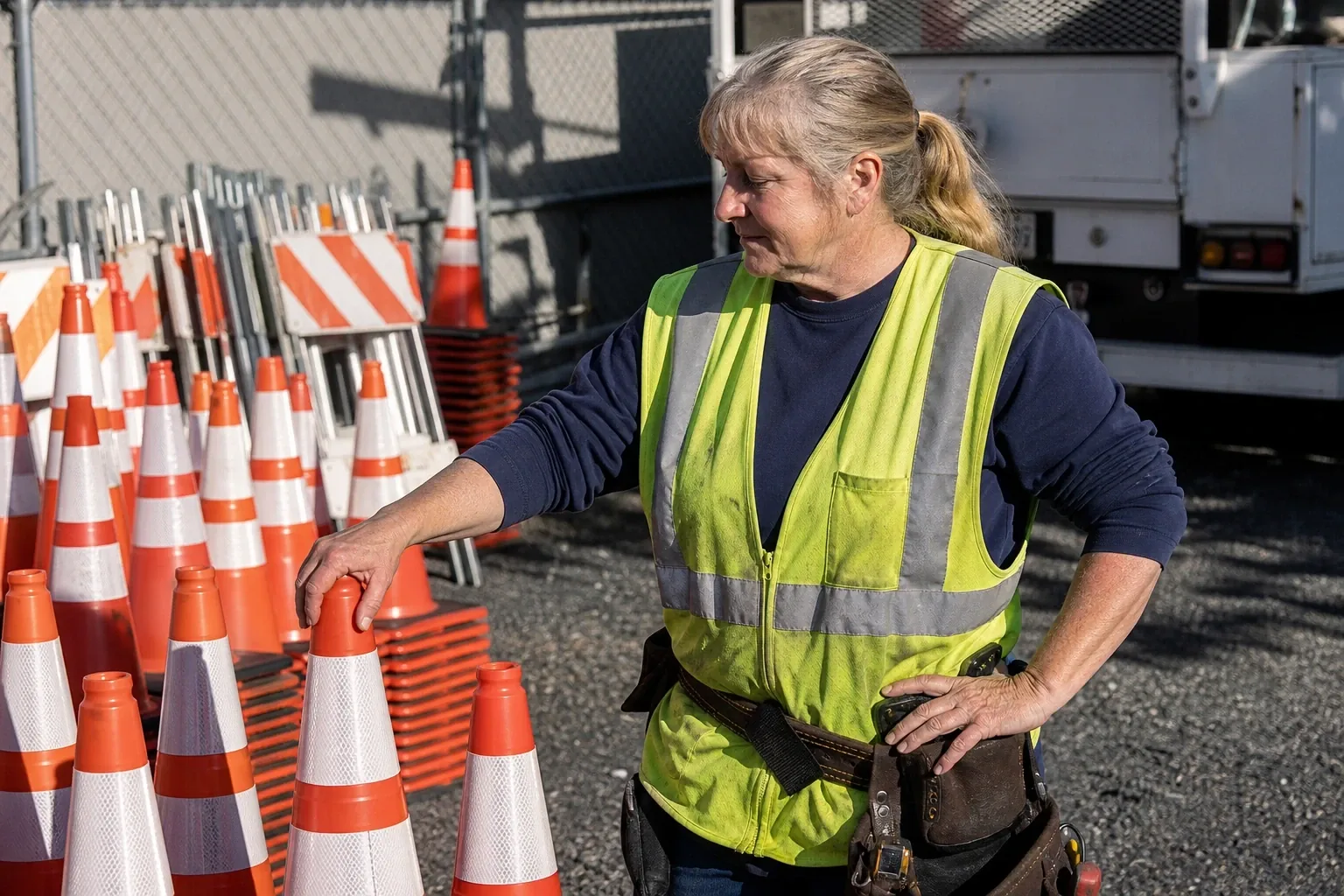
- Traffic Cones (100, 28-inch): $1,500 to $2,500
- Barricades (Type I/II, 20 units): $1,000 to $2,000
- Stop/Slow Paddles and Vests: $500 to $1,000
Contact suppliers like Traffix Devices or Royal Truck & Equipment, and ask about starter packages for new businesses to avoid high minimum order quantities on individual items.
Your next moves:
- Research three local properties with light industrial zoning.
- Request starter package quotes from two equipment suppliers.
- Confirm the MUTCD compliance for all items on your purchase list.
How do you set up payment processing?
Most of your clients will be businesses, so Net 30 payment terms are standard. You send an invoice after the job is complete, and they have 30 days to pay. For larger contracts, require a deposit or set up progress payments to maintain healthy cash flow.
Many payment solutions charge upwards of 2.5% plus other fees, which eats into your profit on smaller jobs. For on-site or last-minute event flagging work, you need a system that is both cost-effective and flexible enough to accept credit card payments on the go.
JIM lets you accept debit, credit, and digital wallets directly through your smartphone with Tap to Pay at a flat 1.99% per transaction, with no hidden costs or extra hardware. That rate is lower than the 2.5% to 3.5% many processors charge, which matters on small deposit collections or event jobs. Getting started takes minutes: download the JIM app for iOS, enter the sale amount, and ask your customer to tap their card or device on your phone. Funds are available on your JIM card as soon as the sale completes, with no waiting for bank transfers.
Your next moves:
- Draft your standard client contract with Net 30 payment terms.
- Compare JIM's 1.99% flat rate with at least one other payment processor.
- Choose invoicing software to send professional bills to your clients.
How do you fund your business and manage finances?
Most traffic control businesses secure funding through an SBA 7(a) loan or equipment financing. The SBA 7(a) program offers loans up to $5 million, which is far more than the $50,000 to $150,000 most new operators need to launch. Interest rates are negotiated between you and the lender but cannot exceed SBA-set maximums, which are based on the Wall Street Journal Prime Rate plus a spread that ranges from 3.0% on loans over $350,000 up to 6.5% on loans of $50,000 or less. Grants are rare for this industry, though you can check for local programs for veteran or minority-owned businesses.
The SBA sets no fixed minimum credit score for 7(a) loans, but individual lenders set their own standards and many look for a FICO score of 680 or higher. Treat that number as a lender preference, not an SBA requirement, and bring a detailed business plan and clean cash-flow projections to your application.
Equipment financing is another route. It lets you finance just your gear, often with the equipment itself as collateral, which can be easier to secure than a general business loan.
Plan your working capital
Beyond startup costs, you need working capital to cover day-to-day expenses for the first six months, including payroll, fuel, and insurance payments. Many new owners get caught by slow-paying clients, so a cash reserve is critical for survival.
Aim to have at least $30,000 to $60,000 set aside. This buffer ensures you can make payroll and pay bills while you wait for your Net 30 invoices to be paid, and it keeps your operations smooth during the initial ramp-up period.
Your next moves:
- Finalize the financial projections in your business plan.
- Contact your local Small Business Development Center (SBDC) for free loan application help.
- Calculate your operating expenses for the first six months to set your working capital goal.
How do you hire your team and set up operations?
Your first hires will be Traffic Control Technicians who handle the on-site setup of cones and signs. The Bureau of Labor Statistics reports a median hourly wage of $17.48 for Crossing Guards and Flaggers (SOC 33-9091) and $22.77 for Highway Maintenance Workers (SOC 47-4051) as of May 2023, though pay varies by metro and experience. Expect to pay between $18 and $25 per hour for technicians and $25 to $35 per hour for a Traffic Control Supervisor who manages the crew and client communication.
All crew members must hold an ATSSA Flagger certification before they step onto a job site. Cutting costs with uncertified labor leads to contract violations and fines. Your supervisor should also hold a Traffic Control Technician (TCT) certification.
Manage your daily operations
A typical crew consists of two to three technicians per supervisor. As you take on more jobs, manual scheduling becomes difficult. Software like Assignar or CrewTracks manages your dispatch, prevents costly overtime or missed shifts, and tracks employee certifications and job site reports from a single dashboard.
Your next moves:
- Draft job descriptions for Traffic Control Technicians and Supervisors.
- Set your initial pay rates based on local wage data.
- Request a demo from a scheduling software provider like Assignar.
Is a traffic control business profitable?
A traffic control business is profitable once you keep equipment utilization high and price your all-in labor cost correctly. A single two- to three-person crew billed at $65 to $110 per hour per technician, plus equipment rentals, can generate steady revenue once you land recurring DOT and contractor work. Most operators reach break-even in 12 to 18 months when they hold a 20 to 30 percent net profit margin per job and keep equipment utilization above 70 percent.
The main profitability risks are slow-paying Net 30 clients and underpricing your labor. Track these five KPIs from day one to spot problems early:
- Equipment utilization: target above 70%. Below that, your gear is sitting idle and your financing costs eat your margin.
- Incident rate: target zero. Every work-zone incident triggers insurance claims and puts contracts at risk.
- Revenue per crew-day: divide total monthly revenue by crew work-days. A healthy two- to three-person crew generates $1,500 to $3,000 per day.
- Days sales outstanding (DSO): track how long clients take to pay. Anything above 35 days on Net 30 terms signals a collection problem.
- Net profit margin per job: target 20 to 30%. If a job falls below 20%, your markup or all-in labor cost is off.
Build relationships with contractors
Your first clients come from direct outreach, because this is a relationship business. Identify general contractors who manage roadwork or large commercial projects, and target their project managers and estimators as your key contacts. A persistent series of cold calls yields results.
Relying only on a website is a mistake. Get on the bid list for your local municipality and state DOT, which puts your company in front of prime contractors. Contractors will vet you online, so create a simple, professional website that lists your services, service area, and certifications, and set up a Google Business Profile with photos of your trucks and gear. Join local construction groups on Facebook or LinkedIn to stay visible between bids.
Your next moves:
- Compile a list of 10 general contractors in your area and find their main contact.
- Set up your Google Business Profile with high-quality photos.
- Join your state's Associated General Contractors (AGC) chapter to access their member directory.
How do you set your pricing and win bids?
Your pricing strategy combines labor rates and equipment rentals. Bill Traffic Control Technicians at $65 to $85 per hour and Supervisors at $85 to $110 per hour. These rates must cover their wages, your overhead like insurance and fuel, and your profit. For equipment, set daily or weekly rental fees, such as $150 to $250 per day for an arrow board or $50 per day for a set of 20 cones.
A frequent mistake is to only mark up the direct labor wage. Calculate your all-in cost per employee hour, which includes payroll taxes, workers' comp, and general liability costs, before you add your profit margin.
How to bid on jobs
When a contractor sends a bid request, break it into labor hours, equipment needs, and permit fees, then add your markup. Here is a worked example for a one-day, two-flagger job:
- Labor: 2 flaggers x 8 hours at $65/hour blended all-in cost = $1,040
- Equipment: 1 arrow board at $200/day + 20 cones at $50/day = $250
- Permit fees: $75
- Total direct cost: $1,365
- Bid at 1.75x markup: $2,389
- Net profit at 20% target: roughly $478
A markup of 1.5x to 2x on your direct costs is a solid starting point. To check if your prices are in the right ballpark, call a few local competitors and ask for their standard rates, which gives you a real-world benchmark. Your bid should be competitive, but never sacrifice your profit margin just to win the work.
Your next moves:
- Create a rate sheet with hourly prices for your crew and daily rates for all your equipment.
- Calculate your all-in cost per hour for a flagger, including wages, taxes, and insurance.
- Call two competitors to request their standard pricing for a one-day, two-flagger job.
How do you maintain quality and scale?
As your crews work, quality control becomes your focus. Conduct random site audits using a simple checklist to verify MUTCD compliance, because a proactive audit is better than waiting for a client complaint or an incident report. Track your incident rate with a target of zero, and send a simple client feedback survey after each project. For your team, pursue advanced ATSSA certifications like Traffic Control Design Specialist (TCDS) for your key supervisors to elevate your service level.
Growth should be deliberate. A reliable benchmark for hiring another supervisor is when you consistently run more than three crews at once, which prevents your lead from being spread too thin and ensures proper oversight on every job site. When your equipment utilization hits 80% for a full quarter, it is time to invest in more gear. Software like Assignar provides analytics on this, which helps you make data-backed decisions instead of guessing when to expand your fleet.
Your next moves:
- Create a one-page job site audit checklist based on MUTCD standards.
- Set a revenue or crew utilization trigger for hiring your next supervisor.
- Review the analytics features in your scheduling software to track equipment usage.
Your reputation with contractors is your most valuable asset, built one safe work zone at a time. When you need to collect a deposit or take a payment on site, JIM lets you accept cards right on your phone for a flat 1.99% fee, with no extra hardware, which keeps your cash flow healthy from day one. Download JIM to get started.
Frequently Asked Questions
Is a traffic control business profitable?
What licenses and certifications do you need?
How much does it cost to start a traffic control business?
How much does ATSSA certification cost?
Is a traffic control business a good business to start?




Sell and get paid in seconds with Jim