Starting a voice over business is a rewarding venture that combines vocal talent with smart business sense. The voice-over market is a multi-billion dollar industry, with steady demand for skilled voices in commercials, audiobooks, video games, and corporate training.
This guide will take you through the practical steps of acquiring the right equipment, finding your niche, and building a client base to help you launch a successful voice over business in the U.S.
Step 1: Plan your business and validate your idea
Research your market
Start by exploring platforms like Voices.com and Backstage. Listen to demos from established talent to understand current vocal styles and production quality. This helps you identify potential niches, such as commercials, e-learning, or audiobooks, and see where your voice might fit best.
A common misstep is trying to appeal to everyone. Instead, focus on one or two niches where your voice has a natural advantage. Analyze the rates for those specific job types to get a sense of potential income. This focus will guide your demo creation and marketing later.
Calculate your startup costs
Your initial investment will primarily be for a home studio. A quality large-diaphragm condenser microphone like a Rode NT1 costs around $250. You will also need an audio interface, such as a Focusrite Scarlett 2i2, for about $150, and acoustic treatment, which can range from $50 to $200.
For software, you can start with a free Digital Audio Workstation (DAW) like Audacity. All in, a solid entry-level setup can be built for $450 to $600. You can always upgrade your gear as your business grows and generates revenue.
Here are 3 immediate steps to take:
- Listen to 20 voice-over demos in a niche that interests you.
- Create a simple spreadsheet to budget for a microphone, audio interface, and acoustic treatment.
- Compare the features of a free DAW like Audacity with a paid option like Adobe Audition.
Step 2: Establish your legal and financial framework
Choose your business structure
For most, starting as a sole proprietorship is the simplest path. This structure means you and your business are the same legal entity, which simplifies tax filing. You just report business income on your personal tax return using a Schedule C form.
Once you start earning consistently, you might consider forming a Limited Liability Company (LLC). An LLC separates your personal assets from business debts, offering protection. The process costs between $50 and $500 depending on your state and takes a few weeks.
Handle your licenses and taxes
You will want to get a free Employer Identification Number (EIN) from the IRS website. It works like a Social Security number for your business and is needed to open a business bank account. The application is online and takes about 15 minutes.
Next, check with your city or county clerk’s office for a home-based business permit. Many people overlook this step. These permits often cost between $50 and $150 annually. Also, note that SAG-AFTRA is a union that governs work on union projects, not a government licensing body.
Here are 3 immediate steps to take:
- Decide if a sole proprietorship or an LLC is right for you at this stage.
- Apply for a free EIN on the official IRS website.
- Search your city’s government website for “home occupation permit” or “business license.”
Step 3: Protect your business with insurance
Find the right coverage
General liability insurance is your first line of defense. It covers claims of injury or property damage. A standard $1 million policy typically runs between $300 and $600 per year. This protects you if a client, for example, trips over a cable in your home studio.
Next, consider professional liability, also known as Errors and Omissions (E&O). This covers financial losses to a client due to a mistake in your work, like a misread script that forces a project delay. A policy with $250,000 in coverage might cost $400 to $750 annually.
Many new voice actors assume their homeowner's policy covers their studio gear. This is rarely the case. You will want to add business property insurance to protect your microphones and audio interfaces from theft or damage. This coverage can often be bundled with your liability policy.
With this in mind, you can look at providers who understand freelancers. Companies like Hiscox, The Hartford, and Insureon specialize in small business policies and allow you to get quotes online in minutes. They can help you bundle the right coverage for your specific needs.
Here are 3 immediate steps to take:
- Get an online quote for a $1 million general liability policy.
- Review your homeowner's insurance to confirm it excludes business equipment.
- Compare professional liability coverage from providers like Hiscox or The Hartford.
Step 4: Set up your studio and equipment
Create your recording space
Find the quietest, smallest room in your home. A walk-in closet works well, as the clothes help absorb sound. You only need about 25 square feet. Your home occupation permit, mentioned in Step 2, should cover any local zoning requirements for this simple setup.
Select your core equipment
A large-diaphragm condenser mic like an Audio-Technica AT2020 (~$100) is a solid start. You will connect it to your computer with an audio interface like a Focusrite Scarlett Solo (~$120). Also, get a pair of closed-back headphones, such as the Sony MDR-7506, for monitoring.
Treat your room for sound
Many new voice actors buy a great mic but record in a bad room. Your focus should be acoustic treatment, not soundproofing. Use heavy blankets, pillows, or professional foam panels from a supplier like Auralex to stop echoes. This makes a bigger difference than an expensive microphone.
Learn your software
Your Digital Audio Workstation (DAW) is where you will record and edit. You can start with the free software Audacity. As you grow, you might explore a one-time purchase like Reaper (~$60) or a subscription to Adobe Audition. Master the basics of noise reduction and editing.
Here are 3 immediate steps to take:
- Identify a small, quiet closet or corner to serve as your recording booth.
- Price out a starter package: an AT2020 mic, a Scarlett Solo interface, and headphones.
- Download Audacity and watch a tutorial on its basic recording and noise removal functions.
Step 5: Set up your payment processing
Establish your payment terms
Standard industry payment terms are often Net 30. For new clients, you might want to request 50% upfront and 50% on delivery. This secures your time and confirms the client's commitment. Always send a clear invoice with a due date and your payment details.
A mistake some make is waiting to invoice until the project is complete, which can delay your cash flow. Instead, invoice for the deposit before you start recording. This establishes a professional boundary and protects your work. Use a simple invoice template for this.
Choose a payment solution
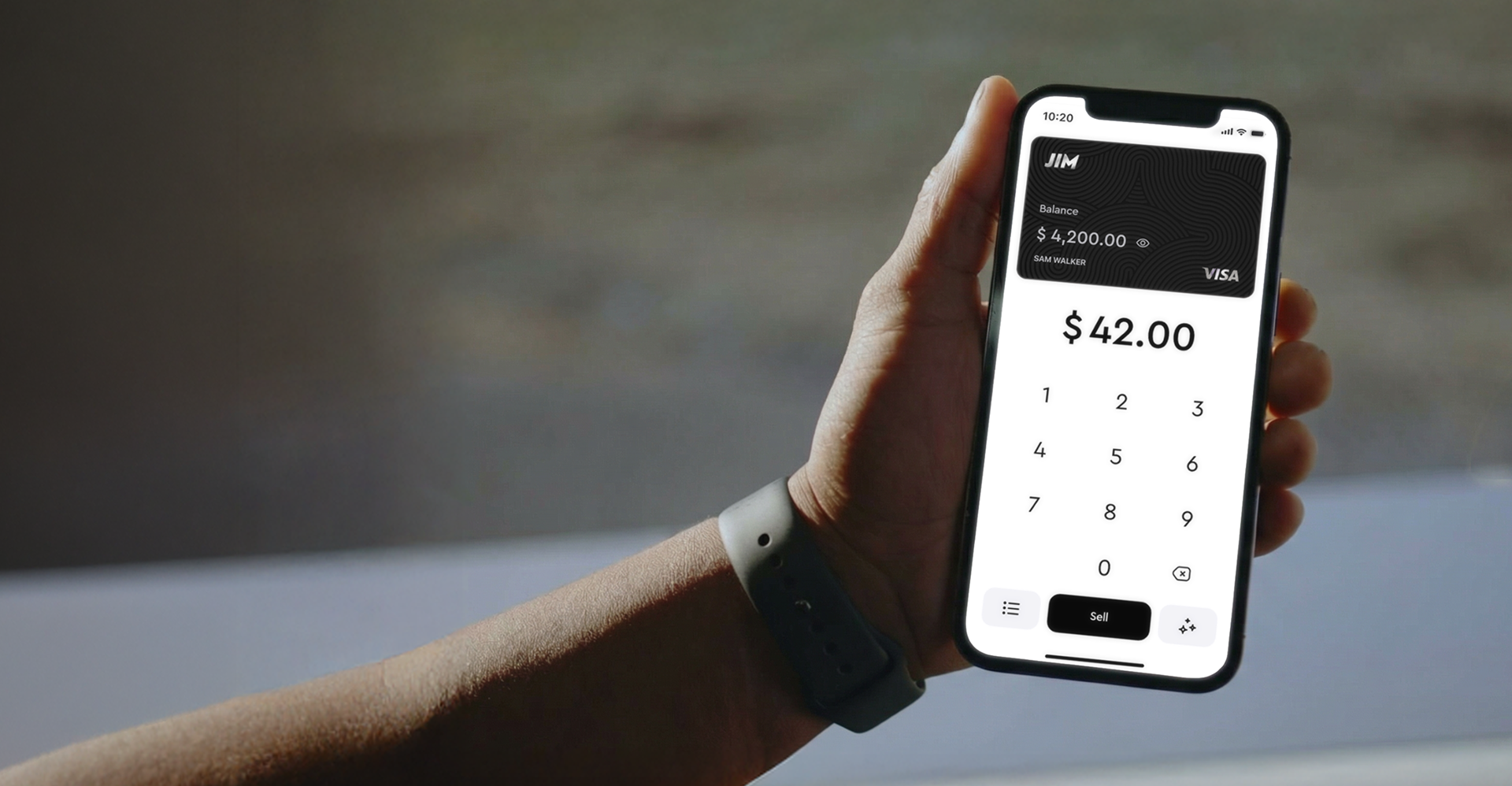
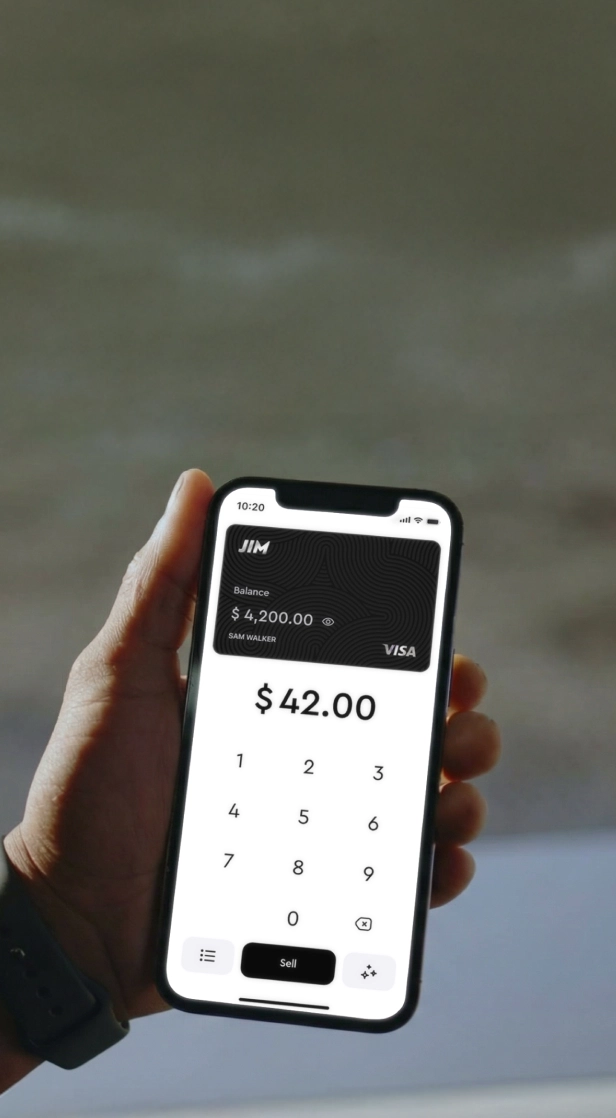
For voice over business that need to accept payments on-site or on-the-go, JIM offers a streamlined solution. With JIM, you can accept debit, credit and digital wallets directly through your smartphone - just tap and done.
At just 1.99% per transaction with no hidden costs or extra hardware needed, it's a strong offer. Other providers can charge between 2.5% and 3.5%. It's particularly useful to collect payment after an in-person coaching session or a local studio recording.
- Get Started: Download JIM app for iOS
- Make a Sale: Type the sales amount, hit sell, and ask your customer to tap their card or device on your phone
- Access Funds: Your money is available right on your JIM card as soon as the sale is done - no waiting for bank transfers
Here are 3 immediate steps to take:
- Create an invoice template with your business details and payment terms.
- Decide on your policy for new clients, such as a 50% upfront deposit.
- Download the JIM app to review its features for in-person payments.
Step 6: Fund your business and manage your finances
Secure your startup funding
Most voice actors self-fund their business since startup costs are low. If you need a small boost, an SBA Microloan is a good option to explore. These loans range from $500 to $50,000 and are designed for new businesses with interest rates typically between 8% and 13%.
You could also look into grants. The National Association for the Self-Employed (NASE) offers Growth Grants up to $4,000. These are competitive, but they are worth applying for if you have a clear business plan and can show how the funds will help you grow.
Plan your working capital
Beyond your initial gear, you will need money to operate. For the first six months, a good target for working capital is around $1,500. This covers marketing costs, platform subscriptions like Backstage or Voices.com, and perhaps some initial coaching sessions to refine your skills.
One thing that trips people up is not tracking finances from day one. This makes tax season much harder than it needs to be. You can use a simple spreadsheet or free accounting software like Wave to log every expense and payment as it happens.
Here are 4 immediate steps to take:
- Calculate your 6-month working capital budget, including marketing and subscriptions.
- Review the eligibility for an SBA Microloan on the official SBA website.
- Check the next application window for a NASE Growth Grant.
- Create a simple expense tracking spreadsheet for your business.
Step 7: Build your team and workflow
Hire help as you grow
Most voice actors start as a one-person operation. Once you have consistent work, you can hire freelancers to free up your time. An audio editor is often the first hire. They can clean up and master your recordings for about $30 to $75 per hour.
A mistake many make is hiring an editor without a trial. Before you commit to a large project, pay for a short, 5-minute test edit. This ensures their quality matches your standards and avoids costly re-records down the line.
When your annual income approaches $50,000, you might consider an agent. They find and negotiate jobs for a 10-20% commission. An agent can get you access to auditions you would not find on your own, often at higher rates.
Streamline your operations
To manage your projects, you can use a client relationship manager (CRM) like HoneyBook or Dubsado. These platforms help you track leads, send contracts, and manage invoices in one place, saving you from endless email chains and spreadsheets.
You can also automate your booking process. A scheduling app like Calendly lets clients see your availability and book a session directly. This eliminates the back-and-forth of finding a meeting time and makes you look more professional.
Here are 3 immediate steps to take:
- Research freelance audio editors on a platform like Upwork and review their portfolios.
- Look up the contact information for three voice-over agents who represent talent in your niche.
- Sign up for a free trial of a scheduling app like Calendly to test its features.
Step 8: Market your business and find clients
Build your online presence
Your demo reel is your most important marketing asset. Create a simple one-page website using a builder like Squarespace to host your demos and contact information. This site acts as your professional hub. Also, create profiles on platforms like Voices.com and Backstage to access daily auditions.
A mistake many new voice actors make is using a poor-quality demo. Invest in a professionally produced demo once you have some experience. Until then, ensure your self-recorded demos are clean, well-edited, and showcase your specific niche.
Reach out to clients directly
Direct outreach can yield high-quality work. Use LinkedIn to find contacts at video production companies, advertising agencies, and e-learning developers. Send a personalized email with a link to your demo. A good response rate for targeted cold outreach is around 1-3%.
Do not send generic, mass emails. Your message will get deleted. Instead, mention a specific project the company recently completed and explain how your voice could fit their style. This shows you have done your research and respect their work.
Here are 4 immediate steps to take:
- Create a profile on at least one pay-to-play site like Voices.com.
- Build a simple one-page website to showcase your demo reel.
- Identify 10 local production companies or ad agencies to target.
- Draft a personalized email template for direct outreach.
Step 9: Set your pricing strategy
Understand common rate structures
Your pricing will depend on the type of work. For audiobooks, you will often see a Per Finished Hour (PFH) rate. Newcomers might charge $150-$300 PFH. This means you get paid for the final length of the audio, not your recording time.
Commercials use a different model. You charge a session fee for recording, perhaps $300 for one hour, plus a usage fee. The usage fee depends on where and for how long the ad will run. A 1-year regional TV spot could add $500 or more.
For corporate narration or e-learning, rates are often per word ($0.15-$0.25) or per finished minute ($50-$100). A mistake many make is to only charge for the recording. Your price must account for editing, file delivery, and one round of revisions.
Set your rates with confidence
Do not guess your prices. Use the Global Voice Acting Academy (GVAA) Rate Guide as your starting point. It is a widely respected resource that breaks down rates by job type. This helps you quote with confidence and avoid under-valuing your work.
You can also look at job postings on pay-to-play sites to see what clients offer. Be careful, as many jobs there are low-paying. Use them for market research, not as a definitive guide for what you should charge.
Here are 3 immediate steps to take:
- Download the GVAA Rate Guide to study standard industry pricing.
- Create a simple rate sheet for your primary niche with per-word and per-minute rates.
- Find three job postings in your niche and practice calculating a quote based on your rate sheet.
Step 10: Maintain quality and scale your business
Establish your quality standards
As your client list grows, consistent quality is what will set you apart. Create a technical checklist for every file you deliver. Your audio should have a noise floor below -60dB and peak at around -3dB to avoid clipping. Always confirm the client’s preferred file format, usually WAV or MP3.
Many voice actors focus on their performance but neglect the technical side. A client will reject an otherwise great recording if it has background hum or inconsistent volume. This forces you to re-record on your own time, which hurts your profitability.
Know when to expand
Once editing starts to consume over 25% of your project time, consider hiring a freelance audio editor. This frees you up to audition for more work. You can find skilled editors on platforms like Upwork for around $30-$75 per hour.
When your business generates a steady income, you can reinvest in your studio. After you pass the $1,000 per month mark, an equipment upgrade like a Neumann TLM 102 microphone can elevate your sound and attract higher-paying clients.
Use systems to manage growth
Spreadsheets work well at the start, but they become unwieldy as you scale. A Client Relationship Manager (CRM) like HoneyBook or Dubsado helps you track leads, send contracts, and automate invoicing. This ensures no client communication gets lost.
Here are 4 immediate steps to take:
- Create a technical quality checklist with your target noise floor and peak volume levels.
- Track your time for one week to see how many hours you spend on editing.
- Research the cost of a microphone upgrade you could make once you hit an income goal.
- Watch a demo video for a CRM like Dubsado to understand its project management features.
Conclusion
You now have a clear path to launch your voice over business. The most important thing is to let your unique vocal quality guide your niche selection. Everything else, from gear to clients, builds from that foundation. Your voice has value, so go put it to work.
And when you secure those first clients, make payments easy. JIM lets you take card payments directly on your smartphone for a simple 1.99% transaction fee, with no extra hardware needed. Download JIM to be ready for that first paycheck.
.avif)