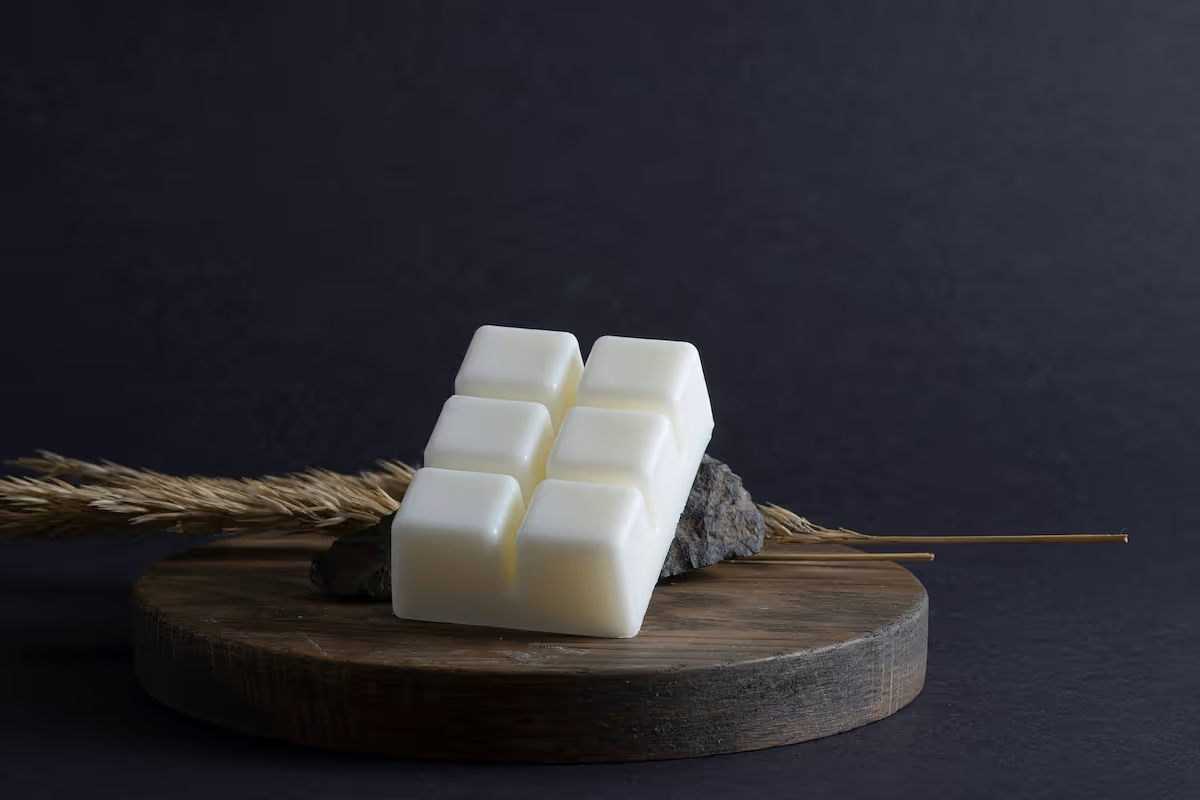
Starting a wax melt business is a rewarding venture that combines a creative flair for scent blending with smart business sense. The home fragrance market is a multi-billion dollar industry, with steady demand for wax melts from home decor enthusiasts, gift shoppers, and those looking to create a cozy atmosphere.
This guide will take you through the practical steps of validating your business concept, obtaining necessary licenses, acquiring equipment, and building supplier relationships to help you launch a successful wax melt business in the U.S.
Step 1: Plan your business and validate your idea
Start by exploring what scents are trending. Use Google Trends to compare search interest for different fragrances. You can also check Pinterest for popular aesthetics and scent combinations that resonate with your target audience. Don't forget to visit local craft markets to see what's selling.
Analyze your competition
Look at the top 10 wax melt sellers on Etsy. Note their pricing, packaging, and photography style. A frequent misstep is to imitate a successful brand. Instead, use this research to find a gap in the market for your unique angle, like eco-friendly packaging or distinct scent blends.
Calculate your startup costs
Your initial investment will likely range from $850 to $2,100. This covers equipment like a large wax melter and digital scales ($150-$400). It also includes your first bulk order of supplies such as wax, fragrance oils, and packaging ($300-$700).
Setting up your business legally, which includes LLC registration and product liability insurance, can add another $400 to $1,000. Planning for these expenses gives you a clear financial picture from day one and helps you set realistic goals.
Here are 3 immediate steps to take:
- List five successful wax melt shops on Etsy and analyze their product photos and prices.
- Use Google Trends to track the popularity of three scent ideas you have.
- Create a startup budget in a spreadsheet using the cost estimates above.
Step 2: Set up your legal structure and get licensed
With your business plan ready, the next move is to make it official. This involves choosing a business structure and securing the necessary licenses to operate legally.
Choose your business structure
You might consider forming a Limited Liability Company (LLC). This structure separates your personal assets from business debts. Filing costs range from $50 to $500, and you can typically register online through your state's Secretary of State website. A sole proprietorship is simpler but offers no liability protection.
Secure the right permits and licenses
At the federal level, your labels must comply with the Fair Packaging and Labeling Act. This means including the product name, your business name and address, and the net weight of the wax. The Federal Trade Commission (FTC) oversees these rules.
You will also need a state-level sales tax permit, sometimes called a seller's permit. You can get this from your state's Department of Revenue, often for free. Finally, check with your city or county clerk for a local business license or home-based business permit, which can cost $25 to $100.
Some new sellers overlook local zoning laws for home businesses. A quick call to your city planning office can clarify if you can operate from your residence, which helps you avoid fines later.
Here are 3 immediate steps to take:
- Decide between an LLC and a sole proprietorship based on your comfort with liability.
- Visit your state's Department of Revenue website to find the sales tax permit application.
- Search your city or county's official website for "home-based business permit" to find local rules.
Step 3: Secure insurance and manage risk
Product liability insurance should be at the top of your list. This policy protects you if a customer claims your wax melt caused an allergic reaction or damaged their property. A standard policy offers $1 million in coverage.
Annual premiums for a small operation typically range from $300 to $600. A frequent oversight is relying on homeowner's insurance, but most policies exclude business-related claims. A separate commercial policy is the safer route to ensure you are fully covered.
You might also consider general liability insurance, which often comes bundled with product liability. It covers accidents like a customer falling at your market booth. Once you hire help, you will need workers' compensation insurance.
When you look for quotes, consider providers that focus on handmade businesses. Companies like Handmade Insurance, the Indie Business Network, and Hiscox understand the specific risks of craft-based ventures and can offer more relevant coverage than a general agent.
Here are 3 immediate steps to take:
- Request a quote for a $1 million product liability policy.
- Review your homeowner's or renter's policy to check for business activity exclusions.
- Compare quotes from at least two insurers that specialize in handmade goods.
Step 4: Set up your workspace and buy equipment
Carve out your production space
You will need a dedicated area of about 100-150 square feet. A spare room or a clean, well-ventilated garage section is a great start. Before you set up, confirm your local zoning ordinances permit small-scale manufacturing from a home address to avoid any issues.
Get the right gear
Your initial equipment budget should cover a few key items. A large wax melter, around 20 quarts, typically costs $150 to $300. You will also need digital scales ($30-$50), a digital thermometer ($15), and a couple of pouring pots ($20 each).
Some new makers use their kitchen pots to save money, but this can contaminate your wax and compromise scent quality. It is a better practice to invest in dedicated equipment from day one to ensure your products are consistent and professional.
Connect with suppliers
With your space ready, it is time to stock it. Suppliers like CandleScience and The Flaming Candle are industry standards. They sell bulk soy wax, often in 45 lb cases, and a wide variety of fragrance oils. Most have low or no minimum order quantities.
This allows you to test different scents and waxes without a huge financial commitment. You might want to start by ordering 1 oz sample sizes of 5-10 fragrance oils to find your signature blends before you buy larger quantities.
Here are 3 immediate steps to take:
- Measure a 10x15 foot space in your home to designate as your workshop.
- Price a 20-quart wax melter and digital scales on a candle supply website.
- Order five different 1 oz fragrance oil samples from a supplier like The Flaming Candle.
Step 5: Set up payment processing
Choose your payment processor
You need a way to accept payments. If you sell on Etsy or Shopify, you will use their built-in systems. These typically charge around 2.9% plus $0.30 per transaction. Some new sellers forget to factor these fees into their pricing, which can reduce profits.
For selling at craft fairs or local markets, a mobile payment solution is a must. For wax melt businesses that need to accept payments on-site or on-the-go, JIM offers a streamlined solution. With JIM, you can accept debit, credit and digital wallets directly through your smartphone - just tap and done.
At just 1.99% per transaction with no hidden costs or extra hardware needed, it's particularly useful for market stalls. Other providers often have rates between 2.5% and 3.5%, so the savings add up. Getting set up with JIM is straightforward.
- Get Started: Download the JIM app for iOS.
- Make a Sale: Type the sales amount, hit sell, and ask your customer to tap their card or device on your phone.
- Access Funds: Your money is available right on your JIM card as soon as the sale is done - no waiting for bank transfers.
Here are 3 immediate steps to take:
- Compare the transaction fees for Etsy Payments and Shopify Payments.
- Download the JIM app to see how the interface works for in-person sales.
- Calculate the total fee on a $25 sale using a 2.9% + $0.30 rate versus JIM's 1.99% rate.
Step 6: Fund your business and manage finances
For initial funding, you might look into an SBA Microloan. These loans go up to $50,000, with interest rates between 8-13%. Another option is Kiva, which offers 0% interest crowdfunded loans up to $15,000, though you need initial support from your network to qualify.
Calculate your working capital
You need funds for more than just startup equipment. This is your working capital. A mistake some new owners make is to forget ongoing costs. Plan for at least six months of expenses like supplies and marketing, which could be $1,800 to $3,000.
From day one, open a separate business checking account. This makes tracking your income and expenses much simpler for tax time. It also reinforces the legal separation between you and your business, especially if you formed an LLC. This simple step builds a strong financial habit.
Here are 3 immediate steps to take:
- Look up the SBA Microloan program on the official SBA website to see lender requirements.
- Create a six-month budget in a spreadsheet to calculate your working capital needs.
- Contact your bank to open a dedicated business checking account.
Step 7: Hire your first employees and set up operations
Hiring your first team members
Once you consistently process over 100 orders a month, you might consider hiring. Your first hire will likely be a part-time Production Assistant. This person can handle pouring wax, preparing molds, and packaging orders, which frees you up for marketing and product development.
Expect to pay around $15 to $20 per hour for this role. A mistake many founders make is not documenting their production process. Before you hire, create a detailed guide with photos for each step. This ensures every wax melt is consistent, no matter who makes it.
Setting up daily operations
With a new person on board, you need a system to manage schedules and tasks. You could use a scheduling app like Homebase, which often has a free plan for single-location businesses. This helps track hours for payroll and keeps everyone on the same page.
As you grow, you might also need help with marketing. A freelance Social Media Assistant could manage your posts and customer interactions for a few hours a week. For organizing these different tasks, a project board on a platform like Trello can give you a clear visual of what needs to get done.
Here are 3 immediate steps to take:
- Draft a one-page job description for a part-time Production Assistant.
- Create a step-by-step photo guide for making one of your signature wax melts.
- Sign up for a free Trello board to map out your weekly production and marketing tasks.
Step 8: Market your business and get customers
Build your online presence
Focus on visual platforms like Instagram and Pinterest. Short videos of your wax pouring process or you packing an order often get more engagement than simple product photos. This behind-the-scenes content builds trust and shows the care you put into your work.
A mistake some new sellers make is to only show the product. Instead, create lifestyle photos. Stage your wax melts in a cozy room with a book and a blanket. This helps customers imagine the experience in their own homes, which makes them more likely to buy.
For your Etsy shop, keyword research is vital. Instead of a generic tag like "vanilla melt," try a long-tail keyword like "creamy vanilla bean soy wax melt." This attracts shoppers with a specific intent. A good conversion rate to aim for on Etsy is between 1% and 3%.
Engage customers directly
You might want to build an email list by offering a 10% discount code for new subscribers. You can use a platform like Mailchimp to manage your list. An email list is a direct line to your customers for announcing new scents and promotions, which drives repeat sales.
Do not underestimate the power of local markets. They provide immediate feedback on your scents and packaging. You can learn what customers are drawn to in real-time, which is information you can use to refine your product line and marketing messages.
Here are 3 immediate steps to take:
- Post one behind-the-scenes video of your process on Instagram or TikTok.
- Research three long-tail keywords for your best-selling product.
- Set up an email sign-up form that offers a 10% discount for first-time customers.
Step 9: Price your products for profit
Calculate your costs accurately
A solid starting point is the cost-plus pricing model. First, calculate your cost of goods sold (COGS) for one unit. This includes wax, fragrance oil, dye, and packaging like clamshells and labels. A frequent oversight is forgetting small expenses, which can eat into your profit.
For example, a 2.5 oz clamshell might cost $0.45 in wax, $0.25 in fragrance, and $0.15 for the container and label. That brings your material cost to $0.85. Now, factor in your labor. If you pay yourself $20/hour and can make 20 units in that hour, your labor cost is $1.00 per unit.
Set your markup and margins
With your total cost per unit at $1.85 ($0.85 materials + $1.00 labor), you can set your price. A standard practice is to multiply your cost by at least 2 to get the wholesale price ($3.70). Then, you typically double the wholesale price to find your retail price ($7.40).
This strategy gives you a 50% profit margin on wholesale orders. Many successful makers aim for a gross margin between 60% and 75%. This ensures you have healthy cash flow for growth and marketing, so you might want to adjust your markup to reach that target.
Analyze the market
After you calculate a cost-based price, see how it fits in the market. Research 5-10 wax melt sellers on Etsy with a similar style and note their prices for comparable products. If your calculated price of $7.40 is much higher, you can re-evaluate your costs or branding to justify it.
Here are 3 immediate steps to take:
- Create a spreadsheet to calculate the total cost per unit for your main product.
- Research the retail prices for 2.5 oz wax melts from five competitors on Etsy.
- Apply the cost-plus formula to determine a starting retail price for one of your wax melts.
Step 10: Maintain quality and scale your operations
Establish your quality standards
Consistency is your best marketing tool. Create a quality control (QC) checklist for every batch. It should confirm the final weight is within 1-2 grams of what is stated on the label. Also, check for a smooth, uniform appearance without cracks or "frosting."
The most important metric is scent throw. Test one melt from each batch to ensure the fragrance is strong both cold (unmelted) and hot (melted). A simple 1-5 rating system for your notes is enough to track consistency over time.
Plan your growth
When you spend over 20 hours a week just on production, it might be time to hire your first assistant. Another sign is when your current space can no longer safely store bulk supplies like 45 lb cases of wax. This is your cue to expand.
Many makers wait too long to use inventory software. Systems like Craftybase or Inventora are built for handmade businesses. They track your raw materials and calculate your cost of goods sold, which helps you price accurately as you grow and buy in larger quantities.
Here are 3 immediate steps to take:
- Create a QC checklist with columns for weight, appearance, and scent throw rating.
- Track your production hours for one week to see if you exceed 20 hours.
- Explore the features of an inventory system like Craftybase to see how it fits your workflow.
You have the steps to launch your wax melt business. Remember that consistency in your scents and brand story is what builds a loyal following. You have a solid plan, so now it is time to get started and bring your unique fragrances to life.
When you make those first sales, JIM offers a simple way to accept payments. It turns your smartphone into a card reader for a flat 1.99% fee, with no extra hardware. Download JIM to be ready for your first customer.
.avif)