How to start an essential oil business: your 10-step launch plan
See article summary
- Budget $2,500 to $5,500 to launch, plus $3,000 to $5,000 in working capital for the first six months.
- Form an LLC ($50 to $500), then get a general business license and a seller's permit from your state.
- Follow FDA cosmetic labeling rules and FTC ad rules: never claim oils diagnose, treat, or cure disease.
- Request a GC/MS report from your supplier to prove oil purity and chemical composition.
- Target a 60% to 80% gross margin using a 3x to 5x cost-plus markup on each bottle.
The U.S. essential oil market generates steady demand from aromatherapy, personal care, and home wellness buyers, and a focused seller can launch with $2,500 to $5,500. Your advantage comes from sourcing pure oils, labeling them correctly, and pricing for a healthy margin rather than racing to the bottom.
Here is the practical path: validate your idea, build supplier relationships, acquire inventory, secure the right licenses, and follow FDA and FTC claim rules so you can launch a profitable essential oil business in the U.S.
Step 1: How to validate your essential oil business idea
Validation means confirming real demand for specific oils before you spend on inventory. Start with market research, compare search interest across oils, and study what existing sellers actually sell.
Use Google Trends to compare search interest for specific oils, like 'frankincense oil' versus 'ylang-ylang'. Browse online communities like Reddit's r/essentialoils to read customer questions and spot unmet needs directly from potential buyers.
Once you have a feel for the market, analyze your competition. Look at successful sellers on Etsy and Amazon. Note their pricing, best-selling products, and how they describe their oils. For deeper data, check if your local library offers free access to databases like Mintel.
A frequent misstep is to launch with too many products. Start with 5 to 10 popular single oils, such as lavender and tea tree, and one or two unique blends. This approach limits your initial investment and helps you learn what sells. Looking at how sellers in adjacent categories validate demand can sharpen your approach, as this guide to starting a body oil business shows for pricing and product selection.
Estimate your startup costs
Your initial budget will likely fall between $2,500 and $5,500. This amount covers your first inventory batch, packaging, and basic setup. Careful management of these early expenses sets up a strong launch.
A typical cost breakdown includes these items.
- Initial Inventory (5-10 oils) - $1,500 to $3,000
- Bottles, Labels, and Shipping Materials - $500 to $1,000
- Business Registration & Licenses - $100 to $500
- Basic E-commerce Website - $300 to $800
Here are 3 immediate steps to take:
- Analyze three competitors on Etsy to document their pricing and top products.
- Use Google Trends to compare search volume for five oils you want to sell.
- Draft a startup budget based on the cost estimates for inventory and packaging.
Step 2: How to establish your legal structure and get licensed
Form an LLC ($50 to $500), get a business license and seller's permit, and follow FDA and FTC claim rules. This combination protects your personal assets and keeps your labeling and advertising compliant.
Most new owners form a Limited Liability Company (LLC). This structure protects your personal assets, like your home and car, if the business faces legal issues. Filing costs range from $50 to $500 depending on your state, and you can file directly on your Secretary of State's website.
Understand the regulations
The Food and Drug Administration (FDA) and the Federal Trade Commission (FTC) are the main regulatory bodies. The FDA oversees product labeling, while the FTC monitors advertising. You can read the full requirements in the FDA's Cosmetic Labeling Guide and the FTC's advertising and marketing guidance. A frequent misstep is making unapproved medical claims, which can lead to significant fines.
You must not claim your oils can diagnose, treat, or cure any disease. For example, you can say a lavender oil blend promotes a 'calm atmosphere' (a cosmetic claim), but not that it 'cures insomnia' (a medical claim). The FDA explains how it treats aromatherapy products on its aromatherapy page.
Get the right permits
You will need a general business license from your city or county. In addition, apply for a seller's permit from your state's tax agency. This permit allows you to buy wholesale inventory without paying sales tax. These permits typically cost between $50 and $150 combined.
Here are 3 immediate steps to take:
- Visit your Secretary of State's website to check LLC filing fees and timelines.
- Review the FDA's Cosmetic Labeling Guide to understand claim restrictions.
- Contact your city or county clerk's office to ask about a general business license.
Step 3: How to secure insurance and manage risk
Carry a combined General and Product Liability policy with at least $1 million in coverage. Product liability is what covers issues from the products you sell, so do not rely on general liability alone.
Your next move is to protect your business with the right insurance. Start with a combined General and Product Liability policy. This is your shield against claims of property damage, customer injury, or adverse reactions to your oils. A $1 million policy is standard for a small e-commerce brand.
Many new sellers mistakenly assume general liability is enough. However, product liability is what specifically covers issues from the products you sell. Expect to pay between $400 and $900 annually for a combined policy, which aligns with Insureon's reported averages for small business liability coverage. Source: Insureon small business insurance cost data.
Additional coverage to consider
As your business grows, look at other types of coverage. These policies address different risks.
- Commercial Property Insurance: This protects your inventory of oils and supplies from events like fire or theft, whether stored at home or in a small facility.
- Workers' Compensation: If you plan to hire employees, even part-time, most states require this coverage for workplace injuries.
When you shop for insurance, seek out providers that understand e-commerce and wellness products. General agents may not grasp the specific risks. Companies like Hiscox, The Hartford, and Veracity Insurance Solutions have experience with businesses like yours and can offer more relevant policies. Sellers in adjacent wellness categories face similar liability questions, and this overview of how to start a holistic wellness business covers the same insurance framework for client reactions to essential oils.
Here are 3 immediate steps to take:
- Request a quote for a $1 million combined general and product liability policy.
- Contact a specialized provider like Hiscox to discuss coverage for an online essential oil store.
- Calculate the total value of your inventory to decide if you need commercial property insurance.
Step 4: How to set up your workspace and buy equipment
Set up a clean, well-ventilated workspace of 50 to 100 square feet at home, or 200 to 500 square feet in a commercial space. Buy a digital gram scale, glass beakers, and a manual bottle capper for accurate, consistent bottling.
Find your workspace
You can start this business from home. You will need a dedicated area of about 50 to 100 square feet that is clean and well-ventilated. Before you begin, check with your city's planning department about regulations for a home-based business, as some areas have restrictions.
If you choose a commercial location, look for a 200 to 500 square foot space zoned for light commercial or retail use. When you negotiate a lease, ask for a shorter initial term, like one or two years, to maintain flexibility as you grow.
Purchase your equipment
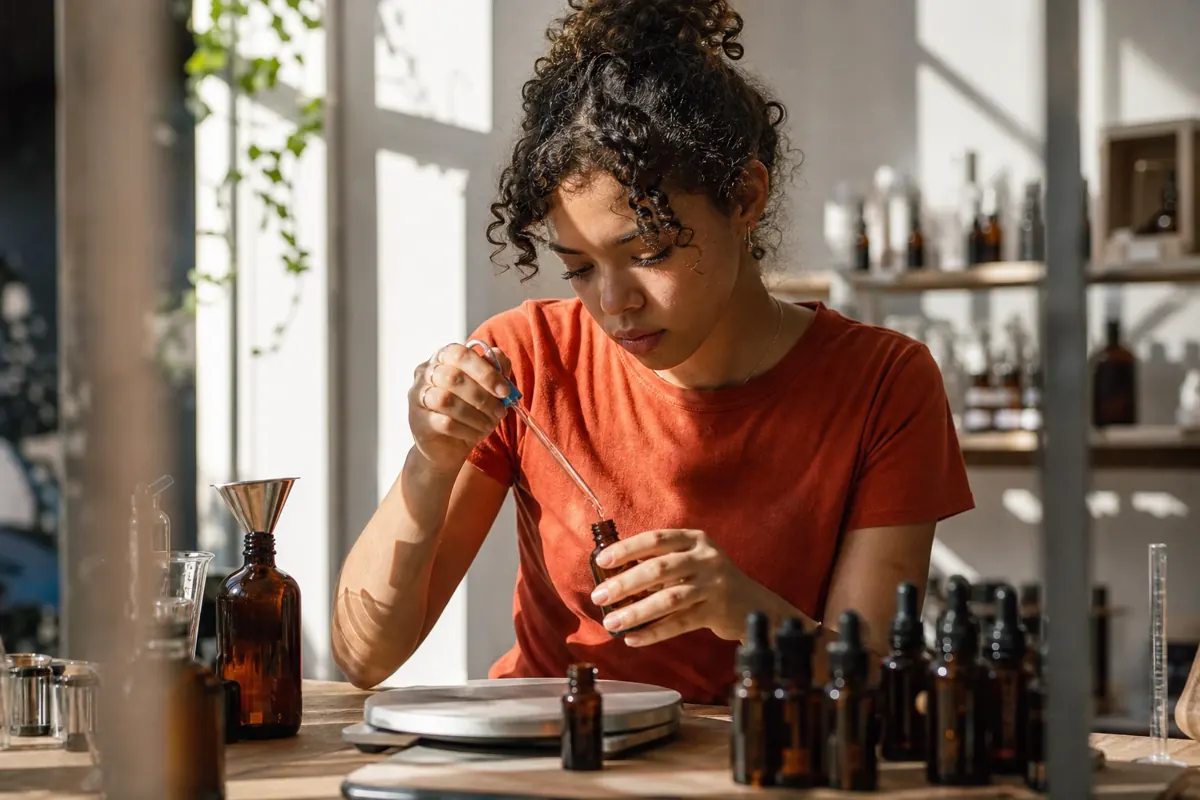
With your space identified, buy the right equipment for accurate bottling. Many new owners find that a consumer kitchen scale is not precise enough. You need a digital gram scale for accurate measurements. This ensures your blends are consistent every time.
Your starter equipment list should include these items.
- Digital Gram Scale (0.01g precision) - $30 to $100
- Glass Beakers and Graduated Cylinders - $50 to $150
- Pipettes and Funnels - $20 to $50
- Manual Bottle Capper - $100 to $300
You can find wholesale suppliers like Bulk Apothecary and New Directions Aromatics online. Their minimum order quantities (MOQs) for your first purchase typically range from $250 to $500, which aligns with the initial inventory budget from Step 1. When you compare suppliers, ask for a GC/MS report, confirm the MOQ, and check the shipping location so you can plan your first order and lead times together.
Here are 3 immediate steps to take:
- Check your city's zoning rules for a home-based business.
- Price out a starter equipment kit including a digital scale and glass beakers.
- Review the minimum order requirements and GC/MS availability for two wholesale suppliers.
Step 5: How to set up payment processing
Use an online processor like Stripe or Shopify Payments for your e-commerce store, and add a mobile option for in-person sales. Online rates run about 2.9% plus $0.30 per sale, so factor that cost into your pricing from day one.
You need a way to accept payments both online and in person. For your e-commerce store, platforms like Stripe or Shopify Payments integrate directly. They handle credit card transactions securely, which builds customer trust. Both charge about 2.9% plus $0.30 per online card transaction, per their published pricing. Source: Stripe pricing and Shopify pricing.
These costs can add up, so compare your options carefully before you commit. Many new sellers forget to account for transaction fees when setting retail prices, which quietly erodes margin.
When you sell at markets or pop-up events, a streamlined solution is best. With JIM, you can accept debit, credit, and digital wallets directly through your smartphone. Just tap and the sale is done.
At 1.99% per transaction with no hidden costs or extra hardware needed, it is a strong choice for in-person sales. This rate is noticeably lower than the online processor average, which helps protect your margins at craft fairs.
Here is how it works:
- Get Started: Download the JIM app for iOS.
- Make a Sale: Type the sales amount, hit sell, and ask your customer to tap their card or device on your phone.
- Access Funds: Your money is available right on your JIM card as soon as the sale is done, with no waiting for bank transfers.
Here are 3 immediate steps to take:
- Compare the transaction fees for two online payment processors.
- Decide if you will sell at markets to see if you need a mobile payment solution.
- Download the JIM app to review its features for in-person sales.
Step 6: How to fund your business and manage finances
An SBA Microloan averages about $13,000 at 8% to 13% interest, available through local nonprofit lenders. Open a dedicated business checking account and use accounting software from day one to keep your books clean.
Secure your funding
You might look into an SBA Microloan. These loans average around $13,000 with interest rates between 8% and 13%, and the program caps loans at $50,000. Requirements vary by intermediary lender, but most prefer a credit score of 620 or higher and a solid business plan. These loans come through local nonprofit lenders, not directly from the SBA. Source: SBA Microloan program.
In addition, you can search for grants. The Amber Grant is a popular option for women-owned businesses. You can also use the federal database at Grants.gov to find opportunities, though these are highly competitive.
Plan your working capital
Your startup costs get you open, but working capital keeps you running. Many new owners underestimate this figure. For the first six months, plan for an additional $3,000 to $5,000 to cover marketing, website fees, and inventory restocks before sales become consistent.
Set up your financial system
Open a dedicated business checking account as soon as your LLC is formed. This separation is vital for tax purposes and protects your personal assets. It also makes your bookkeeping much cleaner.
From day one, use accounting software to track every dollar. Programs like QuickBooks Self-Employed or Wave are designed for small businesses and help you monitor your financial health without needing an accounting degree.
Here are 3 immediate steps to take:
- Research SBA Microloan lenders in your state.
- Open a dedicated business checking account for your new company.
- Draft a six-month budget that includes marketing and inventory restock costs.
Step 7: How to staff your business and manage operations
Run solo until fulfillment takes more than 15 to 20 hours a week or annual sales pass $50,000. Your first hire is usually a part-time Production Assistant at $15 to $20 per hour.
In the early stage, you will likely be the sole operator. You can manage most tasks yourself until your workload justifies a hire. A good signal is when you consistently spend over 15 to 20 hours a week just on fulfillment tasks like bottling and shipping.
Many owners wait until they reach $50,000 to $75,000 in annual sales before hiring. This approach helps ensure you have enough cash flow to support a salary without pressure. Hiring too early can quickly drain your working capital, so it is wise to wait for consistent order volume.
Your first team member
Your first hire is often a part-time Production Assistant. This person handles bottling, labeling, and packing orders. You can expect to pay between $15 and $20 per hour. No specific certifications are required, but a sharp eye for detail is a must to maintain product quality.
Once you have an employee, use scheduling software. Programs like Homebase or When I Work offer free plans that are perfect for managing a single employee's shifts and hours. This keeps your operations organized from the start.
Here are 3 immediate steps to take:
- Track your time for one week to see how many hours you spend on production.
- Write a simple job description for a part-time Production Assistant.
- Explore the features of a free scheduling app like Homebase.
Step 8: How to market your business and find customers
Focus on visual platforms like Instagram and Pinterest with educational content, and start an email list from day one. Aim for a 1% to 2% conversion rate and keep your Customer Acquisition Cost below $30.
Build your online presence
Focus your efforts on visual platforms like Instagram and Pinterest. Instead of just posting product photos, create educational content. You could share a short video on how to make a lavender room spray or a graphic showing the benefits of tea tree oil for skin.
You might also start a simple blog on your website. Write posts that answer common questions, such as "How to Use Eucalyptus Oil in the Shower." This helps you attract customers who search for solutions on Google, not just products.
Track your performance and retain customers
A typical e-commerce conversion rate is 1 to 2%. This means for every 100 website visitors, you can expect one or two sales. Aim to keep your Customer Acquisition Cost (CAC) below $30. If you spend $100 on ads and get four new customers, your CAC is $25.
Once you make a sale, your goal is to earn a repeat purchase. Set up an email list from day one using a service like Mailchimp. You can send a monthly newsletter with tips and exclusive discounts to encourage customers to come back.
Here are 3 immediate steps to take:
- Draft three educational post ideas for your Instagram account.
- Set up a free Mailchimp account to start collecting customer emails.
- Research two competitor blogs to analyze their content strategy.
Step 9: How to price your products for profit
Target a 60% to 80% gross margin using a 3x to 5x cost-plus markup on each bottle. Price too low and you signal poor quality, so use competitor data to position your brand rather than undercut it.
Your pricing strategy does more than cover costs; it communicates your brand's value. A frequent mistake is to price too low, which can signal poor quality and hurt long-term sustainability. You should aim for a gross profit margin between 60% and 80%.
Choose your pricing model
A straightforward approach is cost-plus pricing. First, calculate your total cost per bottle, including the oil, bottle, label, and a small amount for labor. Then, multiply that cost by 3 to 5 to set your retail price.
For example, suppose your cost for a 10ml bottle of peppermint oil is $2.50. A 4x markup sets the price at $10. This gives you a 75% gross margin, which is a healthy target. For unique blends, you might use value-based pricing, where the price reflects its perceived benefit.
With a model in mind, look at your competitors. Check prices for similar products and sizes on Etsy and Amazon. Don't just copy them or try to be the cheapest. Instead, use this data to position your brand correctly in the market. For a closer look at margin and markup in oil products, this breakdown of how to start an apothecary business applies the same cost-plus logic to natural wellness goods.
Here are 3 immediate steps to take:
- Calculate your total cost per bottle for one of your main oils.
- Research the prices of three competitors for a 10ml lavender oil.
- Apply a 4x markup to your cost to set a test price for one product.
Step 10: How to implement quality control and scale
Request a GC/MS report for every oil, keep a batch log, and track your product return rate. Expand your team or inventory software only when revenue or stock value hits a clear threshold.
Maintain product consistency
As you grow, consistent quality is what builds brand loyalty. For each oil you sell, request a Gas Chromatography-Mass Spectrometry (GC/MS) report from your supplier. This document proves the oil's purity and chemical composition, a standard that serious customers look for.
A GC/MS report lists the chemical compounds in a batch by percentage. For true lavender, expect linalool around 25% to 38% and linalyl acetate between 25% and 45%, which signals a genuine lavender rather than a lavandin or synthetic substitute. If the percentages fall far outside those ranges, ask your supplier to explain the discrepancy before you buy.
Many sellers stumble by not tracking their production. Create a batch log to record the date, ingredient amounts, and supplier lot numbers for everything you bottle. This simple spreadsheet helps you trace any issues and ensures your blends are identical every time.
You can also measure quality with customer data. Track your product return rate and monitor reviews for feedback. The National Retail Federation reports that online retailers see an average return rate near 19%, so aim to keep your own rate well below that benchmark as a sign of consistent quality. A sudden dip in ratings can be an early warning of a quality control problem. Source: National Retail Federation 2025 Retail Returns Landscape.
Plan your growth milestones
With quality under control, you can plan your expansion. Once your annual revenue approaches the $50,000 mark, it is time to revisit the job description for a production assistant. This frees you to focus on marketing and product development instead of just fulfillment.
When your inventory value consistently stays above $10,000, a spreadsheet is no longer enough. Look at inventory management software like Katana. It integrates with your e-commerce store to prevent stockouts and streamline ordering from suppliers.
Here are 3 immediate steps to take:
- Ask your supplier for the GC/MS report for your best-selling oil.
- Create a batch log in a spreadsheet to track production dates and ingredient amounts.
- Set a revenue goal that will trigger your search for a part-time production assistant.
Conclusion
Starting your essential oil business is a journey of details. Your customers value purity and transparency, so focus on quality sourcing, GC/MS verification, and clear labeling. You have the roadmap; now go build your brand with confidence.
And when you sell at markets, a simple payment solution helps. JIM turns your phone into a card reader for a flat 1.99% fee, with no extra hardware. Download JIM to keep your sales simple.
Frequently Asked Questions
Do I need FDA approval to sell essential oils?
How profitable is an essential oil business?
Do I need a license to sell essential oils online?
How much does it cost to start an essential oil business?
Is aromatherapy certification required to sell essential oils?


Sell and get paid in seconds with Jim