How to start an Italian ice business and build your brand
See article summary
- Form an LLC, get a free EIN from the IRS, and secure a food handler permit and health permit.
- Budget $9,300 to $28,500 for a cart, batch freezer, dipping cabinet, inventory, and licenses.
- Buy a 6-quart batch freezer and a four-tub dipping cabinet, and rent a licensed commissary kitchen.
- Price a three-tier menu at $4, $5, and $6 to hold a 70% to 80% gross margin per cup.
- Take cards at the cart with JIM Tap to Pay at 1.99% per sale, no hardware required.
Italian ice carries a higher gross margin than ice cream because its base is water, sugar, and fruit instead of dairy, and you can serve it from a cart at community events, summer festivals, and boardwalks where customers already expect to pay. A 6-ounce cup costs roughly $0.45 to make and sells for $4 to $6, which leaves room for a 70% to 80% profit margin once your equipment is paid off.
The work is in the setup: obtaining health permits, choosing a legal structure, buying a batch freezer, and lining up suppliers. The steps below cover licensing, location, equipment, funding, staffing, marketing, pricing, and scaling so you can launch a compliant Italian ice business in the U.S.
How do you plan an Italian ice business and validate the idea?
Most Italian ice carts launch for $9,300 to $28,500, and your first move is to confirm local demand and lock down a startup budget before you spend on equipment.
Research your market
Start by visiting local parks, farmers markets, and community festivals. Observe what other dessert vendors sell and how they price their items. Talk to potential customers and ask what flavors they would buy. This direct feedback is more valuable than generic market reports.
Many new owners guess at popular flavors instead of asking potential customers, which can lead to wasted inventory. Also, check your local chamber of commerce for data on foot traffic and demographics in areas you consider for your business.
Calculate your startup costs
Your initial investment will vary, but you can create a solid budget for starting a small business. A new Italian ice cart can range from $3,000 to $10,000. A commercial batch freezer, which is a significant part of your setup, typically costs between $5,000 and $15,000.
In addition, set aside $1,000 to $2,500 for your first round of inventory like mixes, cups, and spoons. Licenses and permits will add another $300 to $1,000. This brings a typical startup range to between $9,300 and $28,500.
Here are 3 immediate steps to take:
- Visit two local events to observe customer lines and prices at dessert stalls.
- Create a spreadsheet to track potential startup costs for equipment and initial supplies.
- List five potential competitors and note their locations, top flavors, and pricing.
What legal entity and licenses do you need for an Italian ice business?
Most vendors form an LLC because it separates personal and business liability, then secure an EIN, a food handler certification, a food facility health permit, and a general business license.
Most new Italian ice vendors choose a Limited Liability Company (LLC). This structure protects your personal assets from business debts. For tax purposes, an LLC allows profits to pass through to your personal tax return, which simplifies filing. Avoid using personal bank accounts for business expenses.
Navigate permits and regulations
First, get a free Employer Identification Number (EIN) online from the IRS in minutes. You will need this for taxes and banking. Next, contact your local health department for a Food Handler's Permit, which often requires a short ANSI-accredited course. A ServSafe Food Handler course and assessment, for example, costs $15, and comparable state-approved courses range up to about $100 depending on your county. You will also need a Food Facility Health Permit.
This permit involves an inspection of your cart or kiosk and can cost between $100 and $1,000, with processing times from two to six weeks. Finally, secure a general business license from your city or county clerk’s office, which typically costs $50 to $200 annually.
Here are 3 immediate steps to take:
- File for an LLC with your state’s Secretary of State office online.
- Apply for a free EIN through the IRS online EIN application.
- Contact your local health department to request a checklist for a mobile food facility permit.
What insurance does an Italian ice business need?
Carry general liability and product liability from day one, add commercial property for your equipment, and add workers' compensation once you hire, with requirements that vary by state.
Your first policy should be General Liability insurance. This covers claims if a customer slips near your cart. Most event organizers require at least $1 million in coverage. Food vendor specialists such as the Food Liability Insurance Program (FLIP), Next Insurance, and Insureon publish quotes online for mobile food businesses, and pricing varies by location, coverage limit, and deductible, so request at least three quotes before you buy.
Product Liability insurance is just as important and often comes with general liability. It protects you if a customer claims your product caused an illness. Also, consider Commercial Property insurance to cover theft or damage to your cart and freezer.
If you use a vehicle exclusively for your business, you will need a Commercial Auto policy. Once you hire your first employee, most states require Workers' Compensation insurance, which covers lost wages and medical costs if an employee gets hurt on the job. Requirements vary by state, and Texas is the one state where private employers can choose not to carry it. Check your state's labor department before your first hire.
These specialists understand food vendor risks, like equipment failure or spoilage from a power outage, that a general personal-lines agent may not price correctly. Bundling general liability and product liability with the same carrier usually lowers the combined premium.
Here are 3 immediate steps to take:
- Request a quote from a food vendor specialist like FLIP.
- Contact two local event venues to ask for their vendor insurance requirements.
- Make a list of your major equipment and its value for a property insurance quote.
Where do you set up an Italian ice business and what equipment do you buy?
Rent a licensed commissary kitchen for prep and storage, then buy a 6-quart batch freezer and a four-tub dipping cabinet as your core equipment.
Find your home base
You will need a licensed commissary kitchen for prep and storage. Look for a shared-use kitchen, which can save you money. A space of 150-250 square feet is usually enough. Ensure the facility is zoned for commercial food production to meet health department rules.
When you review lease options, ask for a short-term, 3-to-6-month agreement. This gives you flexibility as you learn your sales patterns. Some kitchens even offer month-to-month rentals, which are perfect for a seasonal business like Italian ice.
Purchase your core equipment
Your batch freezer is the heart of your operation. A new 6-quart commercial batch freezer costs $5,000 to $9,000 and produces enough for a solid start. Some owners make the mistake of buying a larger, more expensive unit than they need initially.
You will also need a dipping cabinet to hold and serve your product. A four-tub dipping cabinet runs about $2,000 to $5,000. For suppliers, check out WebstaurantStore for equipment and Restaurant Depot for bulk supplies like cups and spoons, which often have no minimum order.
Here are 3 immediate steps to take:
- Tour two local commissary kitchens and ask about their rental terms.
- Price out a 6-quart batch freezer and a four-tub dipping cabinet from two different suppliers.
- Request a product list from a specialty Italian ice base mix supplier.
How do you set up payments for an Italian ice cart?
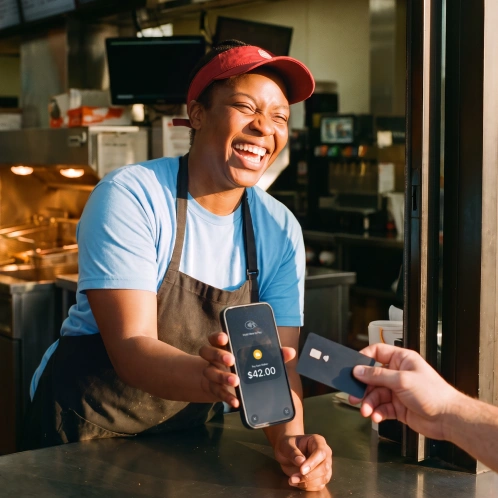
Use a Tap to Pay app that turns your phone into the card reader so you can accept cards and digital wallets at the cart without buying hardware. Compare the per-transaction rate and whether the provider charges monthly fees or sells a separate reader.
Most of your sales will be quick, single transactions. To maximize them, you need a fast way to accept contactless payments from credit cards and digital wallets. Relying only on cash can limit your customer base, especially at large events where people prefer not to carry it.
When you choose a payment processor, look closely at transaction fees. Many new owners get caught by hidden monthly charges or hardware rental costs. For a mobile cart, you want a simple system without extra card readers that need charging or pairing.
The table below compares the published in-person and Tap to Pay rates from four providers. Rates are the single biggest cost for a cart doing hundreds of small-ticket sales per day.
| Provider | In-person / Tap to Pay rate | Hardware | Monthly fee |
|---|---|---|---|
| JIM | 1.99% flat per Tap to Pay sale | None, uses your phone | None |
| Stripe | 2.9% + $0.30 per domestic card transaction | Stripe Reader or Tap to Pay on mobile | None on standard pricing |
| Traditional mobile card readers | 2.6% to 2.75% per swipe, tap, or chip | Card reader, often $50 to $150 | Varies by provider |
| Traditional merchant accounts | 2.5% to 3.5% plus $0.10 to $0.30 | Countertop terminal | Often a monthly fee |
Source: Stripe's official website, accessed August 2026. Traditional reader and merchant account ranges reflect published rates from major processors as of April 2026.
JIM charges a flat 1.99% per Tap to Pay sale with no monthly fees and no hardware to buy, which is useful for quick sales at busy festivals where you do not want to charge a reader overnight. Funds land on your JIM Visa Prepaid Card instantly after each approved sale. Traditional processors typically settle in one to two business days.
Getting started takes minutes: download the JIM app for iOS or Android, complete your seller registration, enter the sale amount, and ask your customer to tap their card or device on your phone.
Here are 3 immediate steps to take:
- Compare the transaction fees of two different payment processors against JIM's 1.99% flat rate.
- Download the JIM app to explore its interface and features.
- Decide if you will accept cash-only, card-only, or both payment types.
How do you fund an Italian ice business?
An SBA Microloan up to $50,000 fits most carts, and equipment financing covers your batch freezer and cart. Keep $4,000 to $8,000 in working capital for the first six months.
Secure your startup capital
For a small operation like an Italian ice cart, an SBA Microloan is a great fit. The Small Business Administration caps microloans at $50,000 and reports that intermediary lenders generally charge interest rates between 8% and 13%. Lenders favor these smaller requests over large, complex business loans. Source: SBA Microloan program.
You might also consider equipment financing. This is a loan specifically for your batch freezer and cart. Companies like Ascentium Capital specialize in this and often have faster approval times than traditional banks because the equipment itself serves as collateral.
Plan your operating budget
With funding secured, your next focus is managing cash flow. Many new owners focus only on the big equipment costs. They forget about the day-to-day expenses like mix refills, fuel, and event fees, which can quickly add up.
Set aside at least $4,000 to $8,000 in working capital. This amount should cover all your operating costs for the first six months. It gives you a buffer before sales become consistent and predictable.
Here are 3 immediate steps to take:
- Research the SBA Microloan program to find a local intermediary lender.
- Request an equipment financing quote from a lender that works with food businesses.
- Create a six-month operating budget that includes inventory, event fees, and fuel.
How do you staff an Italian ice cart?
Hire a Cart Server at $15 to $18 per hour plus tips, certify them with a Food Handler's Permit, and add a second person for payments at large festivals.
Hire and train your team
Your first hire will likely be a Cart Server. This person handles scooping, takes payments, and keeps the cart tidy. Expect to pay around $15 to $18 per hour plus tips. This rate helps attract reliable help for busy weekend events.
Before their first shift, every employee must obtain a Food Handler’s Permit. Your local health department requires this certification. The process is usually a quick online course that costs between $15 and $25 per person.
Manage schedules and workflow
Many new owners try to run the cart alone and get overwhelmed. As a planning estimate, assume one server handles roughly 40 to 60 transactions per hour at peak, depending on cup size and whether you accept cash. Time a few practice runs at your cart to set your own number. For large festivals, a second person dedicated to payments can double your sales speed.
To organize shifts, you can start with a simple shared calendar. As you add staff, consider a dedicated app like Homebase or When I Work. Their free plans are often enough for a small team and simplify communication.
Here are 3 immediate steps to take:
- Write a one-page job description for a Cart Server.
- Check your local health department website for Food Handler's Permit course providers.
- Estimate the number of guests at your first planned event to decide if you need one or two staff members.
How do you market an Italian ice business?
Start on Instagram and Facebook with close-up product photos, pair up with a non-competing local restaurant for cross-promotion, and pitch schools, sports leagues, and corporate offices for events.
Build your online presence
Start with Instagram and Facebook. Post vibrant, high-quality photos of your Italian ice. A great way to engage followers is to run a "flavor of the week" poll on Instagram Stories. This gives you direct feedback on what customers want.
Cherry, lemon, blue raspberry, and mango are the flavors most Italian ice vendors report selling fastest, so lead your menu with at least two of these before testing niche options. Your own sales data is the only reliable ranking for your market, so log which flavors sell out first and adjust your batch sizes each week.
Some owners only post photos of their cart. Instead, feature happy customers (with permission) and close-ups of the product. This approach builds social proof and makes your treats look irresistible.
Partner with local businesses
Team up with non-competing businesses like a local pizza shop for a "dinner and dessert" deal. You could set up your cart outside their location for a day. Cross-promotion puts your product in front of their existing foot traffic at no extra marketing cost, and you can split any joint promotion with the partner. Track the day's sales against a normal day to see whether the partnership is worth repeating.
Leverage event marketing
Do not wait for event organizers to find you. Proactively contact schools for fundraisers, sports leagues for game days, and corporate offices for employee events. Create a one-page sell sheet with your offerings and photos to send them.
Here are 3 immediate steps to take:
- Create a business Instagram account and post five high-quality photos of your product.
- Draft an email to a local pizza shop proposing a weekend partnership.
- Identify three local schools or sports leagues and find their contact information for event outreach.
How do you price Italian ice and maximize profit?
Add up your mix, cup, and spoon cost per serving, then set a three-tier price that holds a 70% to 80% gross margin, which usually lands at $4 for a small, $5 for a medium, and $6 for a large.
Calculate your cost per serving
First, calculate your cost of goods sold (COGS) for each serving. Add the cost of the Italian ice mix, the cup, and the spoon. Common Italian ice base mix suppliers include Rica, Sysco, and Ralph's Italian Ice; request per-gallon pricing from two or three to compare, since mix is your largest recurring ingredient cost. For a 6-ounce cup, your cost might be $0.30 for the mix, $0.10 for the cup, and $0.05 for the spoon, for a total of $0.45.
Some new owners guess at this number or forget items like spoons. This mistake eats into your profit on every sale. A precise calculation is the foundation of a good pricing strategy.
Analyze competitors and set your price
With your cost per serving in hand, research what others charge. Visit local dessert trucks and carts to see their menu prices. Note their portion sizes for small, medium, and large options. This gives you a baseline for your market.
Aim for a gross profit margin of 70-80% per cup. If your 6-ounce cup costs $0.45 to make, a price of $4.00 gives you a profit of $3.55. This is an 88% margin, which is very healthy. A three-tier system like Small ($4), Medium ($5), and Large ($6) works well.
Here are 3 immediate steps to take:
- Calculate the exact cost for one small, medium, and large serving, including the cup and spoon.
- Visit three competing dessert vendors to record their prices and portion sizes.
- Create a three-tier price menu for your cart based on a 70-80% profit margin goal.
How do you maintain quality and scale an Italian ice business?
Hold a smooth, non-grainy texture and distinct flavor on every batch, and expand only when you sell 80% of your inventory at every event for a month or turn down more than two profitable events.
Establish your quality standards
Consistency is your best marketing tool. Create a simple quality checklist. Your Italian ice should have a smooth texture, not grainy, and the flavor should be distinct. A common mistake is to switch to a cheaper base mix to save money, but customers will notice the change.
Track quality with customer feedback. A simple way is to ask one out of every ten customers for their opinion. If you hear the same comment twice, like "the lemon is too sour," adjust your recipe. Keep a log of these adjustments to maintain consistency across batches.
Know when to expand
Growth should be data-driven. When you consistently sell 80% of your inventory at every event for a month, it is time to consider a bigger batch freezer. If you have to turn down more than two profitable events per month, you should plan for a second cart.
Once you hire your third employee, a shared calendar becomes difficult to manage. You might look at employee scheduling software like Sling or 7shifts. Their free or low-cost plans are great for small teams and help you avoid scheduling errors during busy seasons.
Here are 3 immediate steps to take:
- Create a quality checklist for your product covering texture, flavor, and temperature.
- Set a sales benchmark, like selling 80% of inventory per event, to trigger your expansion plan.
- Review the features of two employee scheduling apps, such as Sling or 7shifts.
How much does an Italian ice business make?
Revenue depends on event traffic and your price per cup, but a single cart at a busy weekend event can clear $2,000 in sales. Use your own cost per serving and margin to build a realistic weekly and seasonal forecast.
The math starts with your serving cost. At $0.45 per 6-ounce cup and a $4.00 small, your gross profit is $3.55 per cup. Suppose a two-day weekend festival draws 500 cups sold. That is $2,000 in revenue and $1,775 in gross profit before event fees, labor, and mix refills.
| Scenario | Cups per weekend | Price per cup | Revenue | Gross profit at ~88% margin |
|---|---|---|---|---|
| Small community event | 150 | $4.00 | $600 | $533 |
| Midsize festival | 300 | $4.50 | $1,350 | $1,215 |
| Busy weekend event | 500 | $4.00 | $2,000 | $1,775 |
These are illustrative examples, not guarantees. Subtract your event booth fee, one server at $15 to $18 per hour, fuel, and mix refills to get net profit. Across a 20-week season in most U.S. markets, a single cart that hits the midsize festival scenario on average can gross $27,000 in revenue.
Break-even lands once you recover your $9,300 to $28,500 startup cost. At $1,200 in average weekly gross profit, a cart at the lower startup end breaks even in about eight weeks of selling; at the higher end, closer to 24 weeks. Track weekly revenue against your startup cost so you know exactly when you cross zero.
Italian ice, water ice, and gelato: what is the difference?
Italian ice is a frozen dessert made from water, sugar, and fruit or flavoring, churned to a smooth texture with no dairy. Water ice is the same product under a different regional name, common in Philadelphia and the mid-Atlantic. Gelato uses milk or cream and a lower churn rate, which makes it denser and dairy-based. Italian ice is dairy-free, which lowers your ingredient cost compared to gelato or ice cream.
How do you sell Italian ice in the off-season?
Italian ice is a seasonal product, but you can extend revenue past summer. Book indoor events at schools, corporate offices, and indoor sports complexes through the fall and winter. Offer catering for holiday parties and birthday events, where you scoop on-site from your cart. Some vendors add hot beverages or partner with a coffee shop in winter to keep the cart earning. Aim to bank enough working capital during peak season to carry fixed costs like insurance and kitchen rent in slower months.
Should you franchise or stay independent?
Franchises like Rita's and Jeremiah's give you a proven brand, recipes, and supply chain, but they charge an initial franchise fee, ongoing royalties, and require you to follow their operating system. Going independent means you keep all profit and control your menu, branding, and pricing, but you build brand awareness from scratch. For a first-time operator testing the concept, starting independent with a single cart keeps your startup cost low and lets you validate demand before committing to franchise fees.
Your roadmap now runs from permits to pricing to scaling. If your first month clears $2,000 in a weekend, reinvest in a second cart or a bigger batch freezer before adding overhead. Keep texture consistent, track every cup sold, and expand only when the data tells you to. When you are ready to take cards at the cart, JIM accepts Tap to Pay on your phone at 1.99% per sale with no hardware to buy.
Frequently Asked Questions
How much does it cost to start an Italian ice business?
What is the profit margin on Italian ice?
What licenses do you need to sell Italian ice?
Can you sell Italian ice in the winter?
What equipment do you need for an Italian ice cart?



Sell and get paid in seconds with Jim