How to Take Deposits From Clients and Stop No-Shows

Take deposits from clients by charging a set amount when they book, under a short cancellation policy they accept before they pay. The deposit counts toward the service, and it pays you for the slot when someone doesn't show.
The policy matters as much as the money. Visa's rules say a merchant that limits refunds or cancellations must clearly disclose those policies to the cardholder before the payment goes through.
What is the difference between a deposit, a retainer, and a prepayment?
Use a deposit for single appointments, a retainer for ongoing work, and a prepayment when you want the whole price before you start. The Ohio Attorney General defines a deposit as money a consumer pays in advance toward the purchase of a good or service. The other two terms come from your contract, not from a statute, so spell them out in writing.
| Term | What it pays for | What happens to it |
|---|---|---|
| Deposit | Holding one appointment or date | Counts toward the final bill |
| Retainer | Your availability for a period or project | Applied to work as your contract says |
| Prepayment | The full price, before the service | Nothing left to collect on the day |
For hair, nails, lashes, cleaning, and photo sessions, a deposit is the right tool. Retainers fit freelancers who bill monthly, and the freelancer payment guide compares them with hourly, project, and milestone pricing.
How much deposit should you charge?
Charge enough to cover what a no-show costs you: the product you bought or mixed, plus the slot you can't refill on short notice. The starting points below come from common practice across service businesses. They are not legal limits or industry statistics, so adjust them to your prices and your no-show history.
| Service | Starting deposit | What it protects |
|---|---|---|
| Haircuts, nails, brows | 20% to 25%, or a flat amount | A short slot you can sometimes refill |
| Color, extensions, lash sets | 25% to 50% | Product you buy before the visit |
| House cleaning, first visit | 20% to 25% | Travel time and a half-day block |
| Photo sessions | 25% to 50% | The session plus editing time you reserved |
| Weddings and events | 50% | A date you usually can't resell |
Two checks before you pick a number. Some licensed trades face state caps: California limits a home improvement down payment to $1,000 or 10% of the contract, whichever is less. And a round flat amount, like $25 for a manicure, reads friendlier than an odd percentage.
Are non-refundable deposits enforceable?
Often, yes, if the client agreed to the policy before paying and the amount matches your real loss. Deposit rules come mostly from state consumer law, so the answer changes at the state line. Two official examples show how differently states handle it:
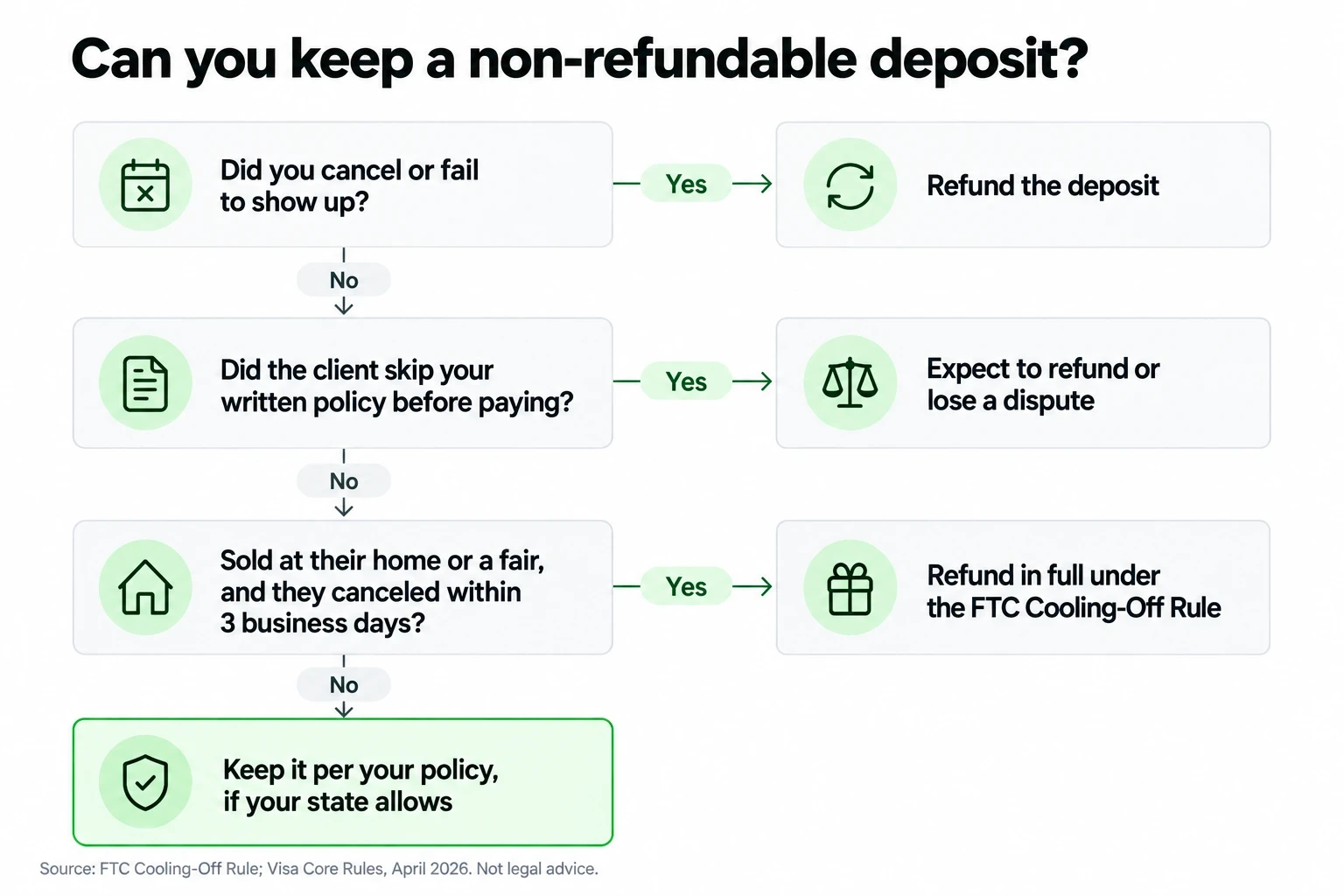
The card network angle matters as much as state law. Visa says a merchant must not require a cardholder to waive the right to dispute a transaction. So "non-refundable" never stops a client from calling their bank. What wins the dispute is proof that the client saw and accepted your policy before paying, one of the evidence types in the credit card chargeback guide.
How do you write a deposit and cancellation policy?
Write it in five or six plain sentences and put it where the client sees it before paying. Copy this template and fill in the brackets:
Then show it at the right moment. Visa's disclosure rules change with how the client pays, and Ohio adds a receipt checklist worth copying:
How do you collect a deposit from a client?
Collect it online at the moment of booking, because a deposit you chase by text after the fact rarely arrives. JIM gives you two ways to take it, plus a cheaper way to collect the balance:
| Method | Best for | JIM fee |
|---|---|---|
| Jim Bookings | Fixed services clients book themselves | 4.99% + $0.30 online, 1.99% in person |
| Payment Link | Custom quotes: events, deep cleans, weddings | 4.99% + $0.30 |
| Tap to Pay | Collecting the balance on the day | 1.99% |
Jim Bookings runs from your free Jim Website. You set services, prices, and availability, and clients book from a link with no app or account. JIM's Help Center guide to Bookings says you can set the deposit amount to collect at booking for each service, then take the rest in person. Automatic reminders go out before the appointment, and you set your own cancellation policy and decide on refunds.
For quote-based work, send a Payment Link for the exact deposit. Enter the amount in the JIM app, add a description like "Deposit for Oct 17 lash fill," and send it by text, email, or DM together with your policy. The payment link guide walks through the setup.
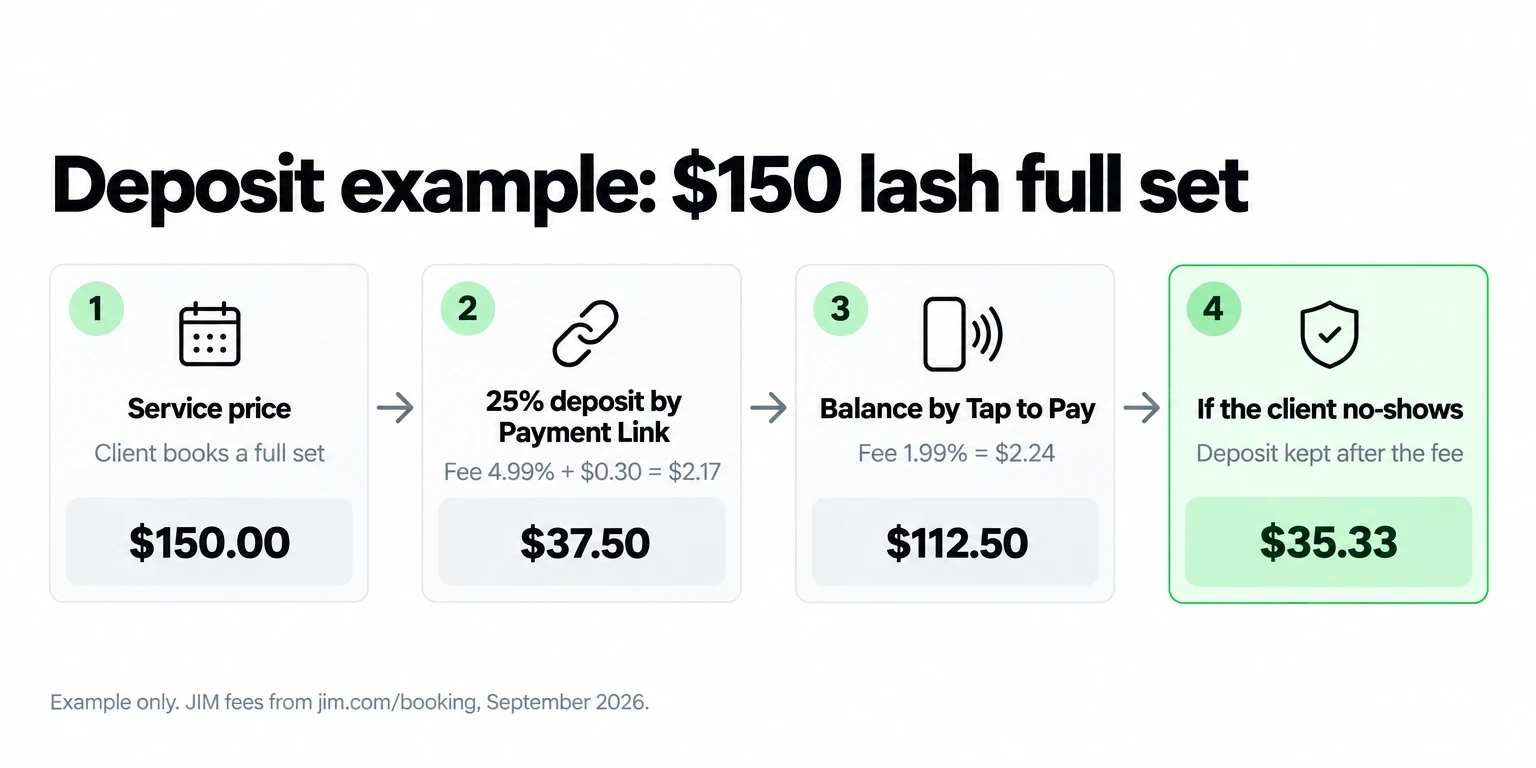
Here is the math on a $150 lash full set with a 25% deposit. The $37.50 deposit by Payment Link costs $2.17, and the $112.50 balance by Tap to Pay costs $2.24, for $4.41 in total fees. Charging the full $150 by link would cost $7.79, so splitting the payment saves you $3.38. If the client no-shows, you keep $35.33 instead of an empty chair.
When do you pay taxes on a client deposit?
On the cash method, count the deposit as income in the year you receive it. IRS Publication 538 says cash-method businesses include income they actually or constructively received during the tax year. The same publication says you generally report an advance payment for services in the year you receive it, and only accrual-method businesses can elect to postpone part of it to the next year.
That matters in December. Suppose a client pays a deposit on December 20 for a January 10 appointment: on the cash method, it counts in the year you took it. Refunds need their own records too. JIM's tax report guide notes that refunds are not deducted from the gross amount on Form 1099-K, so keep a log of every deposit you return.
You saw the numbers: a 25% deposit on a $150 set costs $2.17 to collect and saves $35.33 when a client ghosts you. JIM gives you both routes at no monthly fee: Bookings for self-scheduled services and a Payment Link for custom quotes, with the balance at 1.99% on Tap to Pay. Money lands on your JIM Card, a Visa prepaid card, in seconds; instant settlements subject to terms. JIM is a financial technology company, not a bank; banking services are provided by Lead Bank, Member FDIC. Ready to stop losing slots? Set up my booking page with JIM.




Sell and get paid in seconds with Jim