MCC 1799 is a merchant category code that the International Organization for Standardization (ISO) uses to classify special trade contractors. This code applies to businesses offering specialized services that do not fall under other contractor categories. Transactions with this code typically involve services like asbestos removal, bowling alley installation, sandblasting, and other unique construction-related trades not classified elsewhere.
Which businesses fall under MCC 1799?
MCC 1799 applies to a broad range of specialized contracting establishments:
- Swimming pool construction and installation: This includes companies that build, install, and service residential or commercial swimming pools. Examples range from local builders to national franchises like Premier Pools & Spas.
- Welding services: These businesses provide on-site or in-shop welding for construction, manufacturing, or repair projects. This category covers independent welders and larger fabrication shops that offer specialized welding.
- Chimney cleaning and repair: Businesses in this category, often called chimney sweeps, inspect, clean, and repair chimneys for safety and efficiency. This includes local service providers and national franchises.
- Awning installation: This covers contractors that sell and install awnings and canopies for homes and businesses. Companies like SunSetter or local custom awning fabricators fall into this classification.
- Asbestos removal services: These are highly specialized contractors licensed to safely remove and dispose of asbestos from buildings. This work requires specific certifications and equipment for environmental safety.
- Sandblasting services: Contractors in this field use abrasive blasting to clean, strip, or prepare surfaces like metal or wood. These services are often used in industrial, marine, or restoration projects.
- Bowling alley installation: This niche trade involves the complete construction and setup of bowling lanes and pinsetter equipment. Companies like Brunswick Bowling Products provide these specialized installation services for entertainment centers.
Business implications of MCC 1799
Payment networks including Visa, Mastercard, American Express, and Discover use MCC 1799 to categorize transactions, which affects several aspects of business operations. These networks use the code to assess a merchant's risk profile. Because MCC 1799 covers specialized, often high-ticket services, it can be associated with higher interchange fees to offset potential risks like chargebacks.
Beyond risk assessment and transaction fees, the MCC code also influences other important operational areas for both the merchant and their clients. These classifications help streamline internal financial processes and can even shape customer spending habits.
Expense tracking
Companies use MCC codes to automatically sort business expenses. When a payment is made to a contractor under MCC 1799, it appears on credit card statements with that classification, simplifying the process of tracking project costs and identifying tax-deductible expenditures.
Financial analysis
Businesses can analyze spending patterns by filtering transactions with MCC 1799. This data allows them to monitor costs related to specialized contractors, create more accurate financial forecasts, and develop better budgets for future projects that require these services.
Compliance and auditing
The consistent application of MCC 1799 creates a clear audit trail. This documentation helps businesses verify expenses during internal or external audits, confirming that payments were directed toward legitimate specialized trade services.
Rewards and customer behavior
Credit card rewards programs often tie bonuses to specific MCCs. If a card offers extra points on home improvement or contractor services, customers may be more inclined to use it for payments to businesses classified under MCC 1799.
How to verify your business's MCC
Special trade contractor owners should confirm their MCC classification for proper transaction processing and to avoid customer confusion regarding rewards eligibility. If you find your business is incorrectly classified, for example, a swimming pool installer coded as a general contractor, contact your payment processor immediately to request reclassification.
Here's how to verify if your MCC classification is set up correctly:
- Contact Your Payment Processor: Your merchant services provider assigned the MCC during account setup. To verify your classification, contact their customer service department or review the details in your original merchant agreement documents. This is the most direct method.
- Review Processing Statements: Your monthly merchant statements typically display the assigned MCC. Look for a four-digit number in the account information or business profile section of the document to find your code and confirm its accuracy.
- Check with Your Acquirer: The acquiring bank or financial institution that processes your transactions also maintains your MCC code. Their merchant support team can access your account details and confirm your current classification upon request.
- Test Transaction Method: Some merchants run a small test transaction on a personal credit card to see how it appears on the statement. This method is less reliable than direct confirmation, as statement descriptions can sometimes be generic.
How to choose a reliable payment service provider
Your MCC 1799 classification influences interchange rates, making your choice of payment processor important. Providers handle this category differently, with variations in pricing, settlement speed, and support that affect your bottom line. Consider these factors when you select a payment service provider.
- Transparent pricing: Flat-rate pricing offers predictability over complex models that obscure final costs. The JIM tap-to-pay app for iPhone and Android charges 1.99% per transaction with no setup costs, monthly fees, or premium card surcharges, simplifying financial planning.
- Payment method support: Your processor should accept all major credit cards and digital wallets to meet customer expectations. This includes Visa, Mastercard, Discover, Apple Pay, and Google Pay for flexible payment options.
- Fast fund access: Quick access to funds helps manage cash flow for project-based work. Instant settlements allow you to cover immediate expenses like supplier payments, payroll, and material purchases without delay, keeping operations smooth.
- Security: A provider should protect customer data with encryption and tokenization. With tokenization, card numbers are never stored on your device, which reduces the risk of data breaches and protects your business.
- Reporting: Advanced analytics help track business performance. The JIM AI assistant provides sales reports and transaction history through a chat interface, offering clear business insights.
Streamline payments with JIM
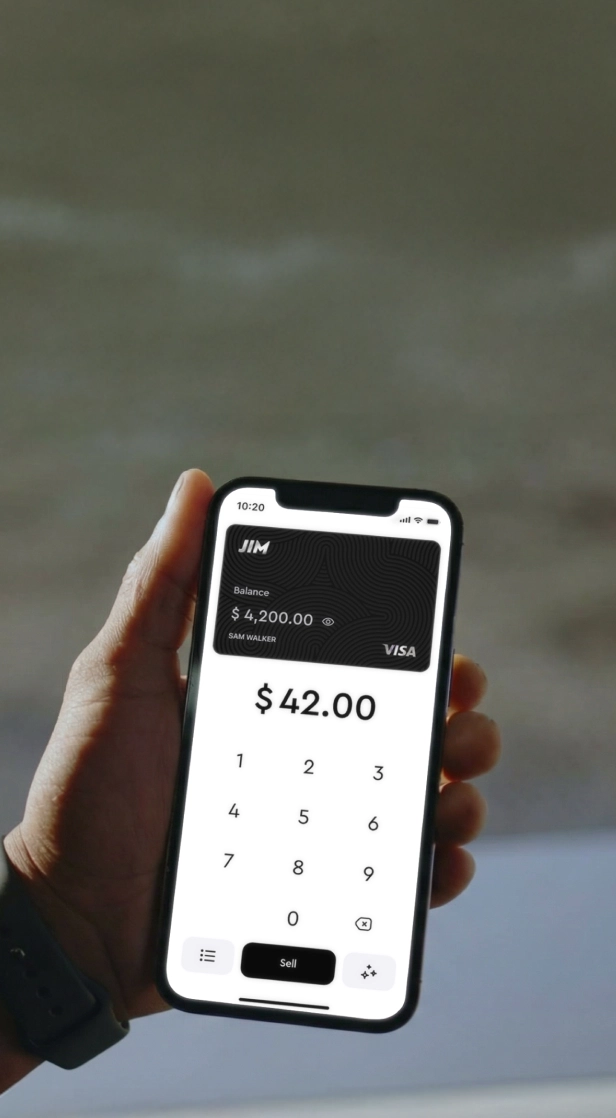
JIM offers special trade contractor owners a straightforward payment solution. You can turn your iPhone or Android phone into a tap-to-pay terminal with the JIM tap-to-pay app. It uses NFC technology, so you do not need extra hardware to accept payments on site. The price structure is simple: a flat 1.99% per transaction with no setup costs, monthly fees, or variable rates for premium cards.
For remote transactions, you can use link payments to collect a deposit before you start a project. This option costs 4.99% + $0.30 per sale. After a transaction completes, your funds become available instantly on your JIM Visa Prepaid Card. You can add this card to Apple Pay or Google Pay, which allows you to use your money right away.
.avif)