The International Organization for Standardization (ISO) uses Merchant Category Code (MCC) 4899 to classify businesses that provide CABLE AND OTHER PAY TELEVISION SERVICES. This code applies to companies offering television services to consumers on a subscription or fee basis. Transactions covered include payments for cable television, direct broadcast satellite services, and other pay television providers. It specifically categorizes purchases related to subscription-based video entertainment.
Which businesses fall under MCC 4899?
MCC 4899 applies to a broad range of pay television establishments:
- Cable Television Providers: These companies deliver television programming to consumers through coaxial or fiber-optic cables. Well-known examples include Comcast Xfinity, Spectrum, and Cox Communications, which bill customers on a subscription basis.
- Satellite Television Providers: Businesses in this category transmit television signals directly to subscribers' homes via satellite dishes. Major providers like DirecTV and Dish Network use this MCC for their monthly subscription fees.
- IPTV Providers: Internet Protocol Television services deliver television content through internet networks instead of traditional cable or satellite formats. Companies like Verizon Fios TV and AT&T U-verse fall into this classification.
- Live TV Streaming Services: These platforms offer subscription packages for live television channels over the internet, acting as modern cable alternatives. Examples include YouTube TV, Sling TV, and Hulu + Live TV.
- Pay-Per-View Services: This category covers one-time purchases for specific live events, such as sports or concerts, offered by television providers. Transactions for events like a UFC fight night are classified here.
- Video on Demand (VOD) Subscription Services: This applies to services that provide a library of movies and shows as part of a pay television package. Cable company VOD libraries or premium channel add-ons like Showtime fit here.
Business implications of MCC 4899
Payment networks including Visa, Mastercard, American Express, and Discover use MCC 4899 to categorize transactions, which affects several aspects of business operations. These networks use the code to assess a business's risk profile. For MCC 4899, the subscription model often implies lower risk, potentially leading to more favorable interchange rates.
Beyond risk and fees, the code influences other operational functions. It impacts internal financial management and can shape customer spending habits tied to credit card benefits, which has direct consequences for a business.
Expense tracking
Companies use MCC codes to automatically categorize purchases. For business accounts, this simplifies tracking entertainment or utility expenses on credit card statements. This clear categorization supports accurate record-keeping for potential tax deductions where applicable, such as a sports bar subscribing to television packages.
Financial analysis
Businesses analyze spending data associated with MCC 4899 to understand expenditure patterns. This information allows finance teams to track subscription costs against budgets, forecast future expenses with greater accuracy, and identify opportunities for cost management within the organization.
Compliance and auditing
The consistent application of MCC 4899 creates a clear audit trail. This simplifies the process for internal and external auditors to verify expenses and confirm that payments align with company policy.
Rewards and customer behavior
Credit card issuers often offer bonus rewards or cash back for specific categories, such as streaming services. MCC 4899 determines eligibility for these perks, which can influence a customer's choice of payment method and even their selection of a television provider.
How to verify your business's MCC
Pay television service owners should confirm their MCC classification to ensure proper transaction processing and avoid customer confusion regarding rewards eligibility. If you find that your business is incorrectly classified, for example, a cable provider coded as a movie theater, contact your payment processor immediately to request reclassification.
Here's how to verify is your MCC classification is set up correctly:
- Contact Your Payment Processor: Your merchant services provider assigned the MCC during account setup. Contact their customer service or check your merchant agreement documents to verify the classification. This provides the most direct confirmation of your business's code.
- Review Processing Statements: Your monthly merchant statements typically display the assigned MCC. Look for a four-digit number, often located in the account information or business profile section, to confirm the code your processor uses for your transactions.
- Check with Your Acquirer: The acquiring bank or financial institution that processes your payments also maintains the MCC in their system. Their merchant support team can confirm your current classification upon request and provide details about your account setup.
- Test Transaction Method: Some merchants run a small test transaction on a personal credit card. They then check the statement to see how the purchase is categorized. This method is less reliable than direct confirmation from your payment processor.
How to choose a reliable payment service provider
Your MCC 4899 classification affects interchange rates and processing requirements, making your choice of payment processor important. Providers handle subscription transactions differently, with variations in pricing, settlement speed, and support. These differences accumulate, so consider the following factors before you commit.
- Transparent pricing: Flat-rate pricing avoids complex models that obscure the true cost per transaction. The JIM tap-to-pay app for iPhone and Android charges 1.99% per transaction with no setup costs, monthly fees, or premium card surcharges.
- Payment method support: Your processor should accept all major credit cards, like Visa, Mastercard, and Discover, to meet customer expectations. Support for digital wallets such as Apple Pay and Google Pay is also standard.
- Fast fund access: Quick access to funds helps manage cash flow for operational costs. For pay television services, this means timely payments to content suppliers and consistent payroll processing without waiting on slow settlements.
- Security: The provider must protect customer data with end-to-end encryption and tokenization. Tokenization ensures sensitive card numbers are never stored on your device or servers, which reduces liability in a data breach.
- Reporting: Modern processors offer more than basic statements. The JIM AI assistant, for example, provides sales reports and transaction history through a chat interface for quick business insights.
Streamline payments with JIM
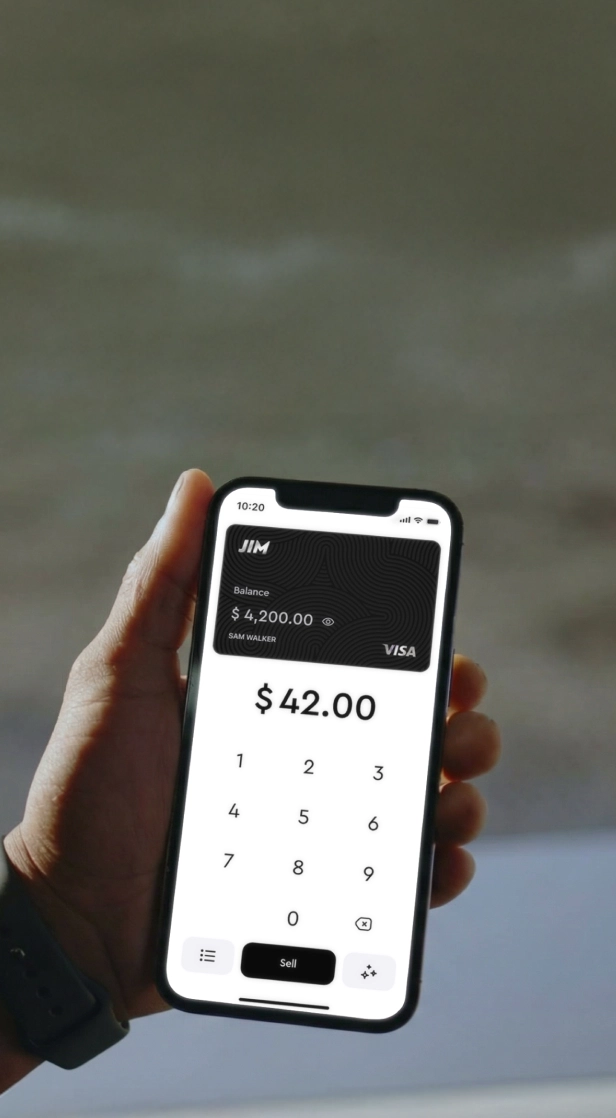
JIM offers pay television service owners a straightforward payment solution. The JIM tap-to-pay app for iPhone and Android transforms your smartphone into a payment terminal, so you need no extra hardware. It uses built-in NFC technology to accept tap-to-pay transactions. You pay a flat 1.99% per transaction with no setup costs, monthly fees, or variable rates for premium cards.
For remote payments, you can create payment links for 4.99% + $0.30 per sale, a useful option for online subscription sign-ups or pay-per-view event sales. After each transaction, your funds become available instantly on a JIM Visa Prepaid Card. You can add this card to Apple Pay or Google Pay for immediate use of your revenue.
.avif)