Merchant Payment Explained: Fees, Settlement, and Setup

See article summary
- A merchant payment is any electronic payment a customer makes to your business for goods or services.
- Each transaction moves through a gateway, processor, card network, and your merchant account before it reaches your bank.
- Traditional processors settle in one to three business days; some modern options settle instantly.
- Card networks set interchange fees, and your processor adds a markup, so the advertised rate is rarely your true cost.
- Match your processor to your volume, mobility, and settlement-speed needs before you commit.
A merchant payment is any electronic payment a customer makes to your business for goods or services. The charge on your bank statement labeled "merchant payment processing" is the deposit and the associated fees from your payment processor for a batch of completed card sales.
Understanding what sits behind that line item matters because it drives three decisions: which payment processor you choose, what fees eat into your margins, and how quickly money reaches your bank account. For a small business accepting card transactions, that knowledge shapes cash flow and the bottom line.
What Is a Merchant Payment?
A merchant payment differs from a consumer or peer-to-peer payment in one practical way: you are on the receiving end, and you pay fees to make it happen. When a friend sends you $20 through a mobile app, that is a peer-to-peer transfer with no processing infrastructure. When a customer pays $20 for your handmade candles, the transaction runs through a payment gateway, a processor, a card network, and a merchant account, and each layer costs money to operate.
The flow is consistent across channels. A customer initiates a card payment at checkout. That payment travels through a payment gateway and payment processor, gets authorized by the card network (Visa, Mastercard, etc.), and lands in your merchant account before transferring to your business checking account.
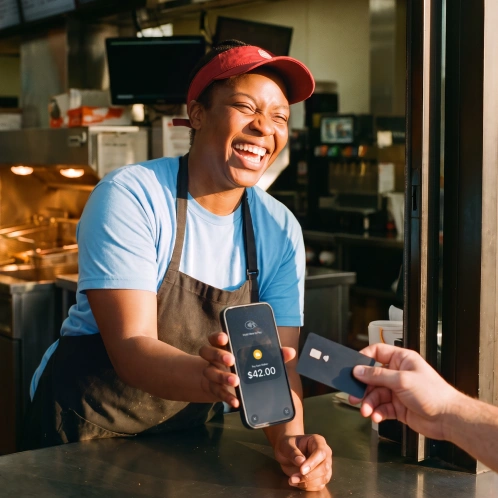
Picture a food truck selling a $14 lunch bowl. The customer taps their contactless card, the sale completes in seconds, and the funds move through the processor and card network before they reach the truck's bank account. Behind that single tap, an issuing bank verifies available funds, an acquiring bank accepts the deposit, and interchange fees are deducted, all within the same transaction.
How Do Merchant Payments Work?
A merchant payment moves through five stages: initiation, gateway encryption, authorization, approval, and settlement. The steps finish in seconds at checkout, but the final settlement, when money actually reaches your account, takes longer.
Here is what happens during payment processing:
Step 1: Customer initiates payment. Whether in-store or online, the customer provides their payment information through a card reader, tap to pay, or checkout form.
Step 2: The payment gateway encrypts and transmits. The payment gateway captures the card data, encrypts it for security, and sends it to your payment processor. This happens in milliseconds.
Step 3: Authorization request. Your merchant payment processor routes the request through the appropriate card network to the customer's issuing bank. The bank checks for available funds and fraud indicators.
Step 4: Approval or decline. The issuing bank sends back a response. If approved, the transaction is authorized and the customer sees confirmation.
Step 5: Settlement. This is where merchant payment settlement comes into play. Approved funds move into your merchant account, then transfer to your business checking account. Traditional payment processors typically complete this in one to three business days, while some modern platforms settle instantly.
Settlement timing varies by processor and by the contractual arrangement between the merchant and the acquiring bank. The card networks settle funds between banks on an aggregate net basis, and your processor then releases the net amount to your account on its own schedule.
What does "processing merchant payment" mean on a bank statement?
When you see "processing merchant payment" on a bank statement, it refers to the settlement deposit for a batch of card transactions. Your processor groups approved sales, deducts interchange fees and its markup, then deposits the net amount as a single line item, usually within one to three business days for traditional processors.
Traditional vs. Modern Payment Methods
Traditional merchant services require separate relationships with payment gateways, processors, and merchant accounts. For many small business owners, that complexity creates unnecessary friction.
Modern payment processing solutions bundle these functions together. JIM turns your iPhone into a point-of-sale system with no separate merchant account setup required. The flat 1.99% fee per transaction includes everything, and funds appear on your JIM Visa® Prepaid Card instantly rather than waiting business days for settlement, subject to terms.
This approach eliminates much of the traditional merchant payment processing services overhead while still giving you full functionality for in-person card transactions.
What Payment Methods Can Small Businesses Accept?
Your customers expect multiple payment options. Card payments continue to grow year over year, according to the Federal Reserve Payments Study. The table below compares the most common types businesses accept, their typical cost, settlement speed, and best use case.
| Payment method | Typical cost | Settlement speed | Best for |
|---|---|---|---|
| Credit and debit cards | 1.5% to 3.5% per transaction | 1 to 3 business days (traditional) | Most in-person and online sales |
| Digital wallets | Same rate as the underlying card | Same as card, often instant | Fast checkout, mobile customers |
| Contactless payments | Same rate as the underlying card | Same as card | High-volume, quick-service retail |
| Online payments | 2.9% plus $0.30 common | 1 to 3 business days | Ecommerce and remote sales |
| ACH transfers | $0.25 to $1.00 flat fee | 1 to 3 business days, same-day available | Invoicing, recurring, and B2B payments |
| Mobile payment apps | Varies by provider | Instant to next day | Service providers, mobile sellers |
- Credit and debit cards remain the foundation of merchant services. Visa, Mastercard, American Express, and Discover cover the vast majority of card transactions.
- Digital wallets like Apple Pay, Google Pay, and Samsung Pay let customers pay with their phones or smartwatches. These use the same card networks but add a layer of tokenization for security.
- Contactless payments have expanded rapidly. Customers tap their card or mobile device instead of swiping or inserting. This speeds up checkout and reduces physical contact.
- Online payments require a payment gateway to securely capture card information through your website. Ecommerce platforms often bundle this functionality.
- ACH transfers move money directly between bank accounts. They're common for invoicing, recurring payments, and larger B2B transactions. ACH typically costs less than card processing but takes longer to settle.
- Mobile payments through merchant payment apps let you accept payments anywhere using mobile devices. This flexibility matters for service providers, food trucks, and anyone who doesn't operate from a fixed location.
Digital wallets deserve a closer look because tokenization makes them one of the most secure ways to accept a card. For more on this payment category, see our guide to digital wallets.
What Are the Types of Merchant Payment Processing Services?
The merchant services landscape offers several distinct models, each designed for different business situations and priorities. Some providers focus on comprehensive infrastructure for high-volume operations, while others prioritize speed and simplicity for smaller businesses.
Understanding these differences helps you match payment processing services to your actual needs rather than settling for a one-size-fits-all approach. Here's how the main categories compare:
- Traditional payment processors require a merchant account application, underwriting review, and approval process that can take days or weeks. They work with separate payment gateway providers for online transactions and often require long-term contracts.
- Payment gateway providers focus specifically on online merchant payment functionality. They handle the secure transmission of card data for ecommerce transactions and integrate with various shopping carts through APIs.
- All-in-one payment solutions combine transaction processing, POS systems, and settlement into a single platform. These typically offer simpler pricing and faster setup, trading some customization for convenience.
- Mobile merchant payment apps turn smartphones into payment terminals. These work well for businesses that need mobility and don't want to invest in traditional hardware or point-of-sale systems.
Each model has trade-offs. Traditional setups may offer lower per-transaction rates at high volume but come with complexity and monthly fees. All-in-one solutions prioritize simplicity but may cost more per transaction.
How Do You Accept Merchant Payments?
Once you understand how merchant payments work, the next step is setting up your business to accept them. The right approach depends on where your customers are: whether they're standing in front of you, browsing your website, or calling to place an order.
Modern payment solutions span all these scenarios, but the setup requirements and costs vary significantly between in-person and online channels.
For In-Person Payments
Accepting in-person payments requires hardware, software, or both. Your options include:
- Traditional POS systems: Full terminals with card readers, receipt printers, and often inventory management functionality. Setup can take weeks and requires hardware investment.
- Card readers: Standalone devices that connect to a smartphone or tablet. More affordable than full POS systems but still require purchasing equipment.
- Tap to pay on iPhone: No additional hardware needed. Your phone becomes the payment terminal, accepting credit card, debit card, and digital wallet payments directly. This option eliminates card reader costs entirely.
For Online Merchant Payments
Online payments require a payment gateway integrated with your website or ecommerce platform. Most website builders offer built-in options or integrations. You'll need to ensure your setup meets PCI DSS standards for protecting customer payment data.
Virtual terminal functionality lets you accept payments over the phone by manually entering card details. This works for service businesses that take orders remotely but don't have a full ecommerce presence.
How Do You Choose the Right Payment Solution?
Match your processor to three factors: transaction volume, mobility, and settlement speed. High-volume retailers benefit from interchange-plus pricing, while mobile sellers should prioritize flat-rate mobile apps with instant settlement.
No single payment processor works best for every business. What makes sense for a high-volume retail store with predictable sales patterns won't necessarily fit a seasonal pop-up shop or a mobile service provider.
Consider these factors when evaluating your options:
- Transaction volume: Higher volume may justify traditional merchant services with lower per-transaction rates.
- Mobility: Mobile businesses need payment solutions that work anywhere.
- Settlement speed: If cash flow is tight, instant payouts matter more than saving a fraction of a percent per transaction.
- Setup complexity: Some businesses prefer to start accepting payments immediately rather than waiting for merchant account approval.
How Do Merchant Payment Fees Work?
Merchant payment fees are rarely as simple as the percentage you see advertised. Different providers structure their pricing in fundamentally different ways, and the model matters as much as the rate.
A provider advertising 2.5% might actually cost more than one charging 2.9% once you account for monthly fees, compliance charges, and how they categorize different card types.
Here's a worked example. Suppose your business processes $10,000 in card volume a month. A provider charging 2.5% plus a $25 monthly fee costs $275, an effective rate of 2.75%. A flat 2.9% with no monthly fee costs $290. Now add a $15 PCI compliance fee and $10 statement fee to the first provider, and its effective rate climbs to 2.9%, erasing the advertised advantage. The card networks set the base interchange cost, which every processor pays; Visa's published interchange rates show the floor your processor marks up.
This benchmark shows how effective rates compare across processor types at $10,000 in monthly card volume. Effective rate is your total fees divided by processing volume, including monthly and compliance fees, not just the advertised percentage.
| Processor type | Typical effective rate | Setup | Payout speed |
|---|---|---|---|
| JIM (flat rate, Tap to Pay) | 1.99% | No hardware, minutes | Instant |
| Flat-rate mobile processors | 2.6% to 2.9% | Reader purchase or free reader | 1 to 2 business days |
| Traditional merchant services | 2.5% to 3.5% plus monthly fees | Underwriting, days to weeks | 1 to 3 business days |
| Interchange-plus (high volume) | 2.0% to 2.5% at scale | Underwriting, days to weeks | 1 to 3 business days |
Rates reflect typical small business pricing as of 2026 and exclude one-time promo offers. Your effective rate depends on your card mix, average ticket size, and monthly volume.
Here's how to decode the main pricing structures:
- Flat rate: A fixed percentage per transaction, regardless of card type. Simple to understand and predict.
- Interchange-plus: The actual interchange fee (set by card networks) plus a fixed markup. More transparent but variable.
- Tiered pricing: Transactions are categorized into qualified, mid-qualified, and non-qualified tiers with different rates. Often the least transparent.
Beyond transaction fees, watch for monthly fees, PCI compliance fees, chargeback fees, statement fees, and early termination penalties. These hidden costs can significantly increase your effective rate.
To evaluate total cost, calculate your expected monthly processing volume and apply each provider's complete fee structure, not just the advertised rate.
How Do You Keep Merchant Payments Secure?
Protecting customer payment information isn't optional. The Payment Card Industry Data Security Standard (PCI DSS) establishes requirements for any business that handles card data.
- Tokenization replaces actual card numbers with unique tokens that have no value if stolen. This is why mobile payments and tap-to-pay are considered secure.
- Encryption protects data during transmission between your checkout and the payment processor.
- Fraud protection tools monitor transactions for suspicious patterns and can flag or block potentially fraudulent purchases.
Small business owners often worry about security complexity, but modern payment processing solutions handle most compliance requirements automatically. Using a PCI-compliant merchant service provider significantly reduces your direct obligations.
Which Merchant Payment Setup Fits Your Business Type?
Your ideal merchant services setup depends on how and where you operate:
Mobile businesses and food trucks need payment solutions that work anywhere with cellular service. Hardware-free options eliminate the risk of damaged equipment. See our complete guide to food truck POS solutions.
Retail and boutiques benefit from POS systems with inventory tracking, customer experience features, and consistent in-store checkout flows.
Service providers like salons and barbers often need invoicing capabilities alongside in-person payment acceptance. Virtual terminal functionality helps with phone bookings.
Pop-up shops and market vendors prioritize portability, quick setup, and low fixed costs. Committing to monthly fees doesn't make sense for seasonal or occasional selling.
Chargebacks, Refunds, and Tax Reporting
Three areas catch small business owners off guard after the sale is complete: chargebacks, refunds, and tax forms.
Chargebacks occur when a cardholder disputes a transaction with their issuing bank. The bank reverses the funds while it investigates, and you may pay a chargeback fee of $15 to $25 per incident regardless of the outcome. A clear refund policy, accurate receipts, and proof of delivery are your best defense. Read our guide to credit card chargebacks to understand the dispute process and how to reduce losses.
Refunds return money to the customer's card through the same processor that handled the original sale. The processor reverses the transaction, and the interchange fee is typically returned to you, though some processors charge a refund processing fee. Issuing a prompt refund often costs less than fighting a chargeback.
Form 1099-K reports your card and third-party network payment volume to the IRS. For the 2025 tax year, a payment platform must issue Form 1099-K only when your gross payments exceed $20,000 and you have more than 200 transactions through that single platform. Whether or not you receive the form, you must report all business income on your tax return. Source: IRS Understanding Your Form 1099-K.
Making Merchant Payments Work for Your Business
Understanding merchant payments gives you control over a fundamental part of your business operations. You now know how payment transactions flow from customer to your bank account, what fees to expect, and how different merchant payment solutions match different business needs.
The right setup depends on your specific situation: your volume, mobility requirements, and how much you value simplicity versus optimization of every basis point in fees. Modern options have made accepting payments more accessible than ever, with lower barriers to entry and faster access to your earnings.
Ready to explore your options? Review JIM's pricing to see how flat-rate, instant-settlement payment processing compares to your current setup, or learn more about merchant processing services to continue your research.
Frequently Asked Questions
What is a merchant payment on my bank statement?
How long does merchant payment settlement take?
What fees do merchants pay to accept card payments?
What is the difference between a merchant account and a business checking account?
Do I need a merchant account to accept card payments?



Sell and get paid in seconds with Jim