Square for Small Business: Fees, Limits, and a Simpler Alternative

See article summary
- Square for small business fees track the payment channel, not the $0/month headline; an $8 tap costs 36 cents.
- JIM's Tap to Pay runs that same tap at 1.99%, 16 cents; a remote Payment Link costs 70 cents.
- JIM runs the lean workflow from your phone with no reader; funds hit the JIM Card in seconds.
- A bank transfer lands your balance the same business day for 1.99% + $0.99 if requested in business hours.
- A week of real sales, sorted by channel and ticket size and priced per formula, shows the cheaper path.
Square fits a small business that needs its broad point-of-sale ecosystem and hardware, but JIM is the simpler choice for a lean, mostly in-person workflow. Point of sale, or POS, is the checkout system that rings up a sale and moves the money to you.
Your call turns on three things: which payment channels you use (card taps in person or remote links), how much hardware and POS breadth you need, and when the sale's proceeds must be usable, right away or after a bank deposit clears.
Judge Square by the workflow you run, then price the same week of sales by channel and ticket size before you commit.
How Square Costs Change With Your Sales Mix
Square's real cost for a small business depends on two things you control: which payment channel each sale uses, and how many paid tools you switch on, not the "$0 per month" headline. It runs a broad point-of-sale ecosystem, paid software tiers, branded readers, and online checkout, so your bill tracks the pieces you actually use.
Square's Broader POS Path Comes With More Layers
Square's credit card processing fees change with the channel: a card tapped in person is not priced like a link you email, and paid tiers and hardware add fixed costs on top. So "how much is Square" has no single answer until you name the channel and the tools.
Compare the same sale under each matching formula. With JIM first, here is the like-for-like picture on an $8 sale a food truck rings up all day:
| Processor and channel | Sale | Fee formula | Fee | Funds path | What you need |
|---|---|---|---|---|---|
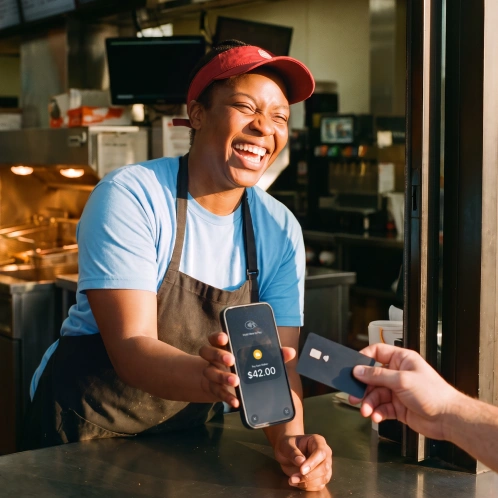
| JIM Tap to Pay, in person | $8.00 | 1.99% | $0.16 | Instant on JIM Card | Your phone, no hardware |
| Square, in person | $8.00 | 2.6% + $0.15 | $0.36 | Standard payout to linked bank | Reader or terminal |
| JIM Payment Link, remote | $8.00 | 4.99% + $0.30 | $0.70 | Instant on JIM Card | A shared link |
Square figures reflect its current published in-person card rate and standard payout path. Source: Square's official website, accessed August 2026. Independent analysis of Square's 2026 processing fees confirms the 2.6% + $0.15 in-person rate. Reports of automated account freezes highlight why cash-availability timing matters for a small business.
On that $8 tap, JIM's 1.99% costs 16 cents; Square's 2.6% plus a flat 15 cents costs 36 cents, because the fixed cents land hard on a small ticket.
Switch to a remote link and JIM's own price jumps to 70 cents, so never assume one rate covers every channel. JIM's Tap to Pay also turns the phone you already carry into a mobile POS, with no reader to buy.
Run a Three-Step Cost Test Before You Commit
- Group one week of real sales by channel and ticket size. Separate in-person taps from remote links, then sort each by dollar amount so the small tickets are visible.
- Price each group under its matching formula. Use the in-person rate for taps and the remote rate for links; never score a tap with an online-checkout number.
- Check hardware, POS breadth, and when you need the cash. JIM proceeds land on the free JIM Card in seconds; moving that balance to a bank in your name runs through a Same-Day Automated Clearing House, or ACH, transfer, an electronic bank-to-bank payment, at 1.99% + $0.99 that reaches your US bank account the same business day when you request it during business hours. Those are two paths, not one blanket promise.
Read more
When JIM Is the Simpler Small-Business Alternative
If your week of sales landed mostly on contactless, in-person taps with an occasional remote deposit, you do not need a broader point-of-sale stack. JIM runs that lean workflow from a phone, and its AI agent handles the busywork around each sale.
Take the Deposit Remotely and the Balance in Person
Picture a mobile dog groomer who books clients before driving to each home. She wants a deposit to hold the slot and the balance once the job is done, without carrying a card reader. Here is how that runs on JIM:
- Publish a free JIM Website with Bookings. JIM auto-generates a customizable website from your profile at sign-up, and clients book 24/7 without downloading an app.
- Take the deposit by Payment Link. When the remote step fits, a shared checkout payment link charges 4.99% + $0.30 per sale, and the money lands instantly on your JIM Card.
- Collect the balance in person with Tap to Pay. Using Tap to Pay on iPhone, the 1.99% rate runs straight from the phone you already own, with no reader to rent.
Then choose how you use the money. Sales funds sit on a free virtual JIM Card, a Visa prepaid card in Apple or Google Wallet, in seconds, so the groomer can buy gas or supplies that same day.
Prefer your bank? Same-Day ACH, an electronic transfer between US bank accounts, moves your balance to an account in your name for 1.99% + $0.99, arriving the same business day when you request it during business hours.
Use the AI Agent for Owner Tasks, Not Financial Advice
The JIM AI Agent, "Ask Jim," generates statements, pulls transaction details, shares receipts, runs real-time diagnostics, and offers marketing or analytics tips. Treat it as an owner's assistant for records and day-to-day questions, not as accounting, legal, or financial advice.
Be honest about scope: if you truly need a broader point-of-sale setup with its own hardware, price that requirement against this workflow before you switch. For a lean, in-person operation, though, JIM covers the payment methods for small businesses at a lower per-sale cost without the extra layers.
Test Your Actual Sales Mix Before You Switch
You have the method; now run it on your own numbers before you change anything. Work through this quick checklist:
- List one week of real sales, sorted by ticket size and payment channel.
- Run each group through its matching fee formula, not one headline rate.
- Test the JIM payment and settlement path you would actually use.
If that test comes out mostly in-person, contactless payments without a need for a broader point-of-sale system or rented hardware, try JIM. Tap to Pay runs at 1.99% straight from the phone you already own, and that no-hardware fit is the reason to make the switch. Start your account at https://onboarding.jim.com.
Frequently Asked Questions
Why does a fixed per-sale fee matter on a small ticket?
A fixed per-sale charge takes a bigger bite the smaller the sale, so it quietly raises your real rate on low tickets.
On a $5 tap, an illustrative amount, a rate of 2.6% plus a flat 15 cents costs about 28 cents, an effective 5.6%. JIM Tap to Pay's flat 1.99% with no fixed fee costs about 10 cents. The percentages look close; the fixed cents do the damage.
Do remote payment costs equal in-person Tap to Pay costs?
No. Never assume one rate covers both channels.
In-person Tap to Pay runs at a flat 1.99%, while the same charge sent as a remote Payment Link runs at 4.99% plus 30 cents. The identical sale costs far more collected by link than by tap, so price each sale under the flow you will actually use.
What should you check before choosing a settlement path?
Decide when you need the money and where it has to land.
Sales funds are available in seconds on the virtual JIM Card, ready for same-day operating purchases with no transfer wait.
If you would rather move the balance to a bank account in your name, a Same-Day ACH transfer, the standard electronic route between US banks, carries its own 1.99% plus 99 cents fee and arrives the same business day only when you request it during business hours.




Sell and get paid in seconds with Jim