What is a contactless payment system? Exploring the everyday checkout problem
See article summary
- A contactless payment is a short-range NFC tap of a card, phone, or smartwatch with no swipe or chip insert.
- Tap is a card-present sale like chip, so your processor's published rate, not the tap, sets what you pay.
- Each tap swaps the real card number for a one-time token, keeping fraud near 0.0005% per transaction.
- Before buying a reader, run a five-point check: device, connectivity, accepted methods, card-present rate, payout timing.
- JIM Tap to Pay turns an iPhone XS+ or NFC Android into a terminal: flat 1.99% per tap, no extra hardware, funds in seconds.
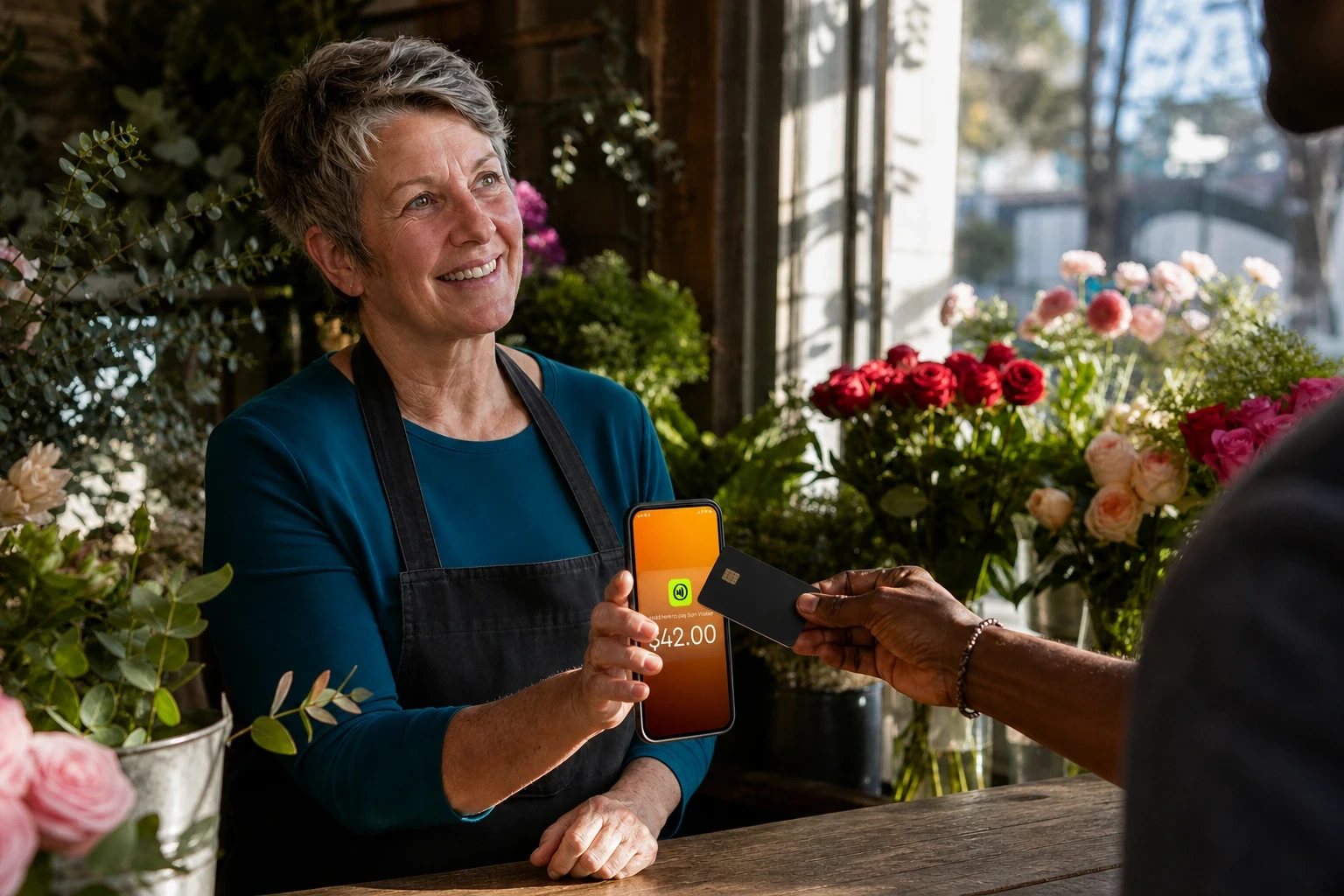
A contactless payment is a short-range tap that uses Near Field Communication (NFC) to send card details from a card, phone, or smartwatch to your terminal. You spot it by the four curved lines, the contactless symbol, on tap-ready cards and at checkout.
For a food truck or pop-up owner, the acceptance base is already broad: contactless payments made up about 20% of in-person general-purpose card payments in 2022, up from under 5% in 2020. Source: Federal Reserve Payments Study. That is a useful sign that a tap-ready checkout is now routine for many customers.
How Does Contactless Payment Work?
A contactless payment runs in one quick exchange: your terminal wakes the customer's card or wallet, and the sale clears in about half a second, far faster than a chip insert that can take 10 to 20 seconds. The sequence has five steps:
- The customer holds a card, phone, or smartwatch within about 4 cm of the tap spot.
- The card's antenna sends payment data to the terminal over NFC radio waves.
- The card creates a token, a one-time code that stands in for the real card number.
- The issuer checks that token and approves the amount.
- Your point-of-sale confirms and records the sale.
Keep in mind that acceptance is still ahead of habitual use: even with tap widely available, not every customer will reach for it. Offer contactless as an option rather than assuming it is the default, and keep a chip or swipe fallback ready for the customers who prefer it.
Across JIM's base of more than 20,000 US sellers, a phone running Tap to Pay clears each contactless sale in seconds and lands the funds on the seller's virtual card instantly, so the tap-to-usable-cash gap is near zero rather than the one to two business days a traditional terminal settlement takes.
Why a Battery-Free Card Can Tap
A plastic card has no battery, yet it still taps. NFC runs on magnetic induction: your terminal sends a weak electromagnetic field that briefly powers the card and pulls its data across the roughly 4 cm gap.
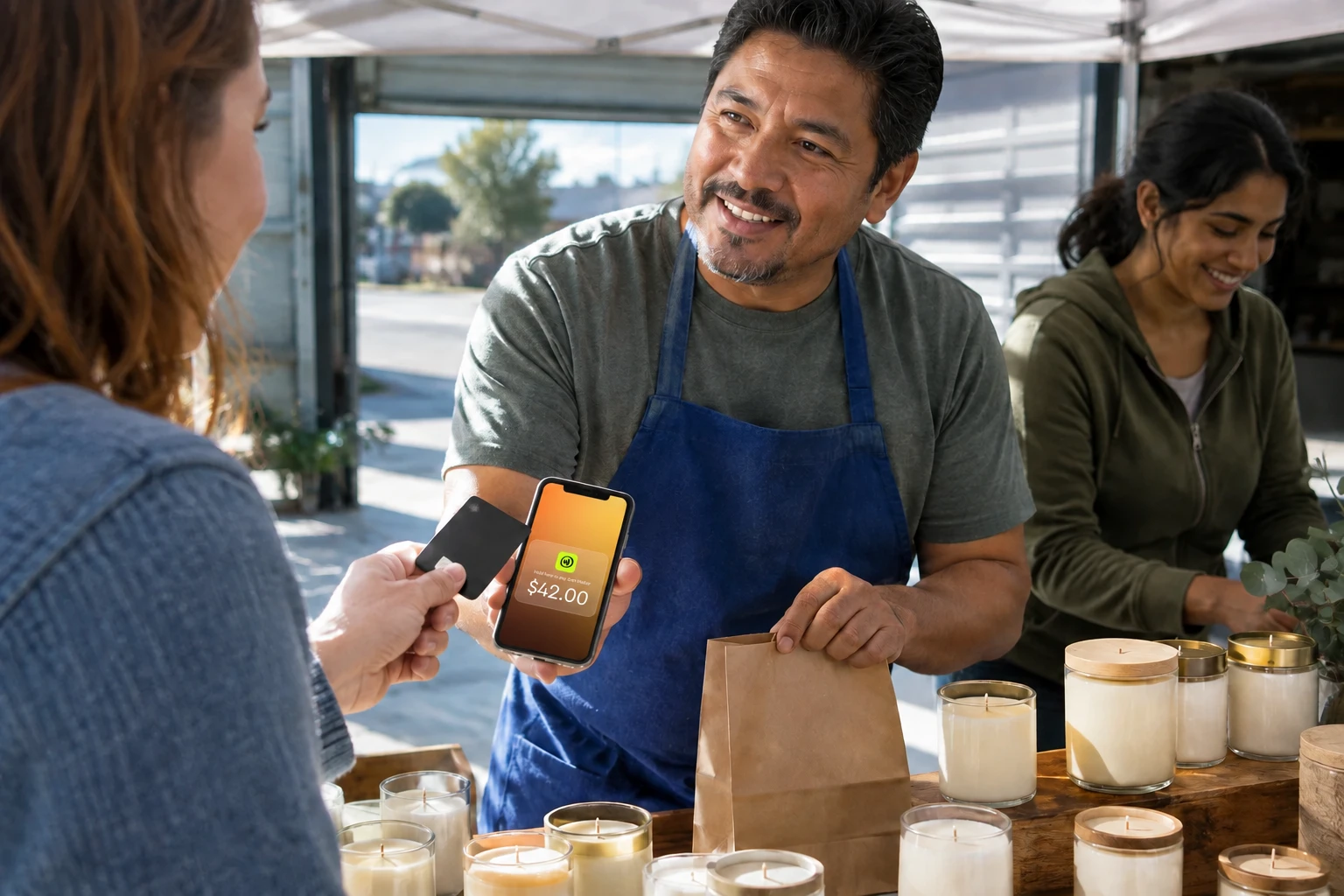
Picture a food-truck owner mid-rush as a customer taps a battery-free debit card; the reader supplies the power, and the account number never travels in plain form. If you want to go deeper on the underlying radio technology, see our explainer on what NFC is and how it works.
Contactless Card, Wallet, or Wearable?
The same tap comes from several sources: contactless credit and debit cards, digital wallets like Apple Pay and Google Pay, NFC smartwatches and fitness bands, and tap-to-pay apps that turn a phone into the reader. All ride the same NFC rails, so none is a different kind of card sale.
The deciding factor is your average ticket and foot traffic, not the payment source. A high-volume cafe turning over $8 tickets benefits most from wallet taps, because Apple Pay and Google Pay confirm identity on the device and skip the PIN prompt, keeping the line moving. A weekend craft market with $60 average sales sees more contactless card taps, and a single larger transaction matters less when the line is short. For you, the acceptance path is identical in every case: an NFC reader or a Tap to Pay phone takes all three, so you never pick one source over another at checkout.
| Source | What the customer taps | Setup the customer needs | What you accept it with |
|---|---|---|---|
| Contactless card | Plastic card with the contactless symbol | None, if already issued | NFC terminal or Tap to Pay phone |
| Digital wallet | Phone with Apple Pay, Google Pay, or Samsung Pay | Card loaded into the wallet app | NFC terminal or Tap to Pay phone |
| Wearable | Smartwatch or fitness band | Card linked to the wearable | NFC terminal or Tap to Pay phone |
| Tap-to-pay app | The merchant's phone is the reader | Merchant downloads the app | The phone itself becomes the terminal |
Tap uses the same card-present rails as chip and swipe, so it is not a pricier category; your processor's published rate, not the tap, sets what you pay.
Is Contactless Payment the Same as Tap to Pay?
Yes, at the customer level. "Contactless payment" describes the NFC tap itself, while "tap to pay" is the everyday phrase customers and merchants use for the same action. The one distinction to keep straight is direction: a customer taps to pay you, and you accept that tap with a terminal or a Tap to Pay phone app that turns your device into the reader.
Do Contactless Payments Cost Merchants More?
No. A contactless tap is a card-present transaction, the same category as a chip insert, so it runs through the same interchange and processing rails. Your processor's published in-person rate applies, not a separate tap surcharge. The fee you pay is set by your processor and card network, not by the fact that the card was tapped rather than dipped.
Is Contactless Payment Safe and Are There Limits?
Yes, a tap is one of the safer ways to take a card, because it protects the account number by design. That does not mean zero fraud, but the common counter fears rarely match how the technology actually works.
What Protects Each Tap
Two features do the heavy lifting, on top of NFC's short reach. Tokenization swaps the real card number for a one-time token, a stand-in code that is useless after the sale. And each tap creates its own encrypted code that expires the moment the payment clears.
| The worry | What actually happens |
|---|---|
| "Someone skims a card in line" | The tap signal reaches only about 4 cm, so a thief would need to press special gear against your counter. |
| "The card number gets copied" | The token carries no reusable value, so intercepted data leads nowhere. |
| "A tap gets replayed later" | The one-time code expires instantly and cannot run a second sale. |
| "I end up holding card details" | You never see or store the full number, security code, or expiry date. |
Visa reports that tokenization has reduced fraud in card-not-present environments, and that contactless devices generate unique, dynamic transaction data for each use, making stolen card information of little use for creating fraudulent transactions. Source: Visa security overview. As a JIM-specific proof point, JIM is certified under Payment Card Industry Data Security Standard version 4.0.1, the current data-protection benchmark set by the PCI Security Standards Council, and blocks manual card-number entry entirely.
Why a PIN or Signature Prompt Is Not a Failed Tap
When a higher-value tap asks for a PIN or signature, that is usually the card issuer verifying identity, not a broken terminal. In the US, Visa does not set a universal contactless transaction limit; instead, the verification threshold varies by card network, issuing bank, the specific card, and the transaction context, so there is no single figure to memorize. Source: Visa merchant configuration guidance.
That prompt is a verification step, not a national spending cap. A wallet payment unlocked by fingerprint or face has no fixed contactless ceiling, because identity is already confirmed. And if a tap is ever compromised, federal law caps a cardholder's liability for unauthorized credit card charges at $50. Source: FTC consumer advice on lost or stolen cards.
How to Accept Contactless Payments Without Extra Hardware
You can start taking taps without buying a reader first. Run a quick readiness check on what you already own, and if a phone qualifies, turn it into the terminal itself.
Use This Merchant Readiness Check
Before spending on hardware, confirm five things:
- Acceptance device: a phone with NFC built in, or a terminal that shows the four-line contactless symbol.
- Connectivity: stable cellular or Wi-Fi, since each tap clears in real time.
- Accepted methods: the card networks and wallets your customers actually reach for.
- Card-present rate: your processor's published in-person price, not an invented tap surcharge.
- Payout timing: how fast the money reaches an account you can spend from.
A pop-up owner heading into a weekend market can walk this list in minutes: check the phone, test the signal, and confirm accepted cards before deciding a reader is even necessary.
A Phone-Based Tap to Pay Route
If your phone passes the check, JIM Tap to Pay turns an iPhone XS or later, or an Android phone with NFC, into a full terminal, with no extra hardware, cables, or dongles. Setup takes three steps:
- Download the JIM app and register your seller profile.
- Enter the sale amount, starting from a $1 minimum.
- Have the customer tap a card, phone, or smartwatch, then confirm with a PIN or signature if the issuer's verification prompt appears.
This short demo shows how tap to pay works on a phone:
JIM fit for eligible US in-person sellers: JIM charges a flat 1.99% per in-person tap, the same rate across card types, with no monthly or setup fees. Funds land in seconds on the JIM Visa Prepaid Card, and Tap to Pay accepts major networks plus Apple Pay, Google Pay, and Samsung Pay.
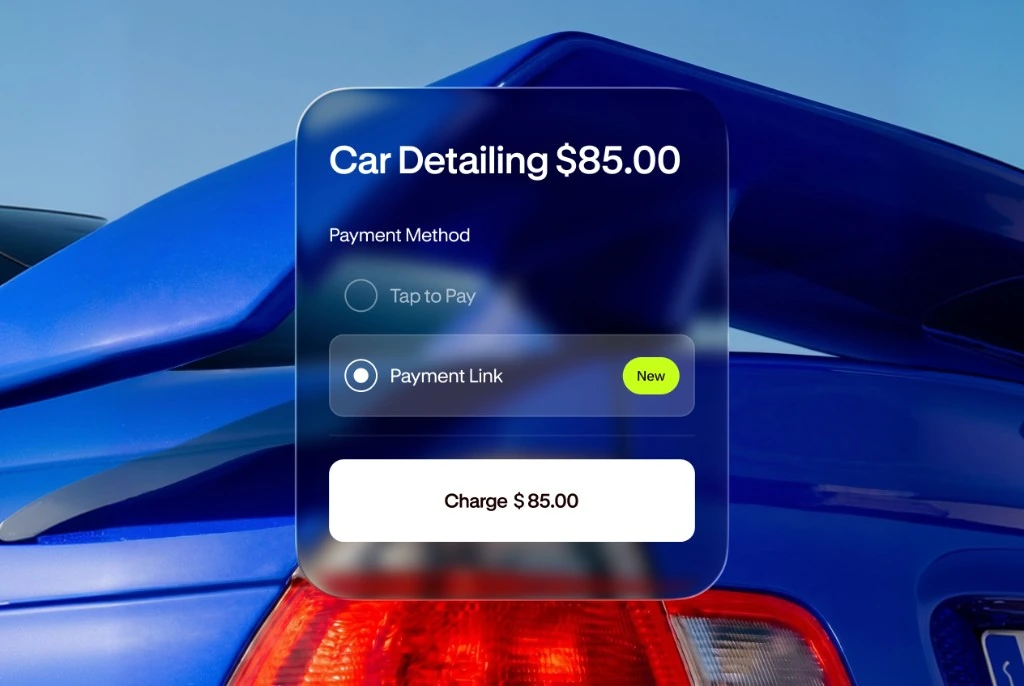
Selling remotely instead? A Payment Link charges 4.99% plus $0.30 with built-in 3D Secure identity checks. Tap to Pay processing is US-only.
How Do I Start Accepting Contactless Payments Today?
If your phone passed the readiness check, you can accept in-person taps without buying a separate reader first. For an eligible US seller, that means skipping the extra hardware and starting with the phone already in your pocket.
Download the JIM app and register your seller profile to start taking taps today. For the full walkthrough, see our guide on how to accept contactless payments.
Contactless Payment FAQ
What is a contactless payment card?
It is an ordinary credit or debit card that carries the four curved lines of the contactless symbol, letting a customer tap instead of swipe or insert. The chip and account work the usual way; the symbol just signals that NFC tapping is built in.
What should I do if a contactless payment does not work?
Run a few quick checks before giving up on the sale. Hold the card or phone flat against the symbol for a second instead of tapping too fast, confirm your phone's NFC is switched on, and make sure your setup accepts that card or wallet type.
If the customer's bank has set a limit on the card, ask them to insert the chip and enter a PIN instead. A failed tap is usually a technique or setup issue, not a security concern.
What is the contactless payment limit in the US?
There is no universal US spending cap. Instead, the contactless verification threshold varies by card network, issuing bank, card, and transaction context; above that point the terminal may ask the cardholder to confirm identity, and the payment still goes through.
Is contactless or chip payment safer?
Both are secure, but they protect the cardholder differently. A chip insert relies on an EMV cryptogram that changes per transaction, while a contactless tap adds tokenization that replaces the real card number entirely, so the merchant never sees it. Neither method exposes the static card number the way a magnetic stripe does, so both are far safer than a swipe.
Frequently Asked Questions
What is a contactless payment card?
What should I do if a contactless payment does not work?
What is the contactless payment limit in the US?

Sell and get paid in seconds with Jim