BNPL companies: Compare fees, fit, and risk

Buy now, pay later (BNPL) is worth offering only when a specific quote from a BNPL company fits your United States sales channel and net contribution from genuinely new sales can cover its fee premium.
BNPL is checkout financing that lets customers repay over time, but customer terms do not set the merchant's fee.
What to compare across BNPL companies
Compare offers by checkout channel and written terms, not by company name or an “interest-free” label.
A typical Pay in 4 takes a first installment at purchase, then splits the balance into three payments two weeks apart. Longer monthly installment loans run longer and may charge interest or other fees, according to the Congressional Research Service.
Providers primarily collect merchant transaction fees, reports the Federal Reserve Bank of Richmond. Some also earn customer interest, late fees, or other revenue, as the Congressional Research Service describes. Revenue models differ.
| What to compare | What to verify |
|---|---|
| U.S. availability | Confirm the provider currently accepts your business and industry, serves your customers, and supports the offer in the states and channels where you sell. |
| Customer plan | Identify Pay in 4 or a longer monthly installment loan. Record payment dates, customer interest or fees, eligibility, and terms shown at checkout. |
| Merchant quote | Get the written rate and fixed fee per transaction, plus recurring, setup, refund, or dispute charges. Do not infer your fee from customer interest terms. |
| Channel and platform | Test the actual online checkout or in-person workflow, platform integration, and customer-facing offer before rollout. |
| Payout | Confirm when funds become available, the payout schedule, any holds, and how cancellations affect settlement. |
| Returns and refunds | Ask who receives the return, initiates full or partial refunds, adjusts the customer’s remaining payments, and handles fee adjustments. |
| Disputes | Record who handles billing disputes and chargebacks, supplies evidence by the deadline, and pays any dispute charge. |
Compare an offer with the payment methods for small businesses you already accept, and check whether it fits your current e-commerce payment systems.
Keep the written quote beside the channel and operating terms; those are the inputs for the fee-premium check that follows.
Calculate the sales contribution needed to cover BNPL fees
Use your written offer and the same channel’s current processing cost to test whether genuinely new, retained orders cover BNPL’s added cost. Do not count a customer who switches an existing card purchase to BNPL as a new sale.
Set the fee baseline. Record the BNPL quote, including percentage, per-order, and monthly charges. Compare it with what you pay to accept the same sale through your existing channel. For a purchase that would have happened anyway, the added cost is the BNPL charge minus the ordinary processing charge. For a truly new sale, count the full BNPL charge because no ordinary card fee would otherwise apply. JIM’s Tap to Pay and Payment Link accept card payments; they are not BNPL financing. For context on the card-cost side, review this merchant-services total-cost audit and guide to credit-card processing fees for small businesses.
Measure what changed. In a comparable period or controlled test, separate genuinely added BNPL orders from existing purchases that shifted from card. Count only added orders that customers kept. Remove returned orders from retained sales, and include any actual unrecovered return costs or fees in the added-cost total. Do not assume every BNPL order is incremental.
Find contribution per new order. Subtract product, fulfillment, discounts, and other variable costs from revenue, before payment processing fees. Multiply that amount by the number of new, retained orders. This keeps ordinary operating costs separate from the fee comparison.
Compare the totals. Use this monthly check:
Net change = (new retained orders × contribution per order) − [BNPL fees on new orders + fee premium on shifted orders + unrecovered return costs + other added charges]The fee premium on shifted orders is the BNPL charge minus the ordinary same-channel charge. A positive result clears the fee test; a negative one means measured new-order contribution did not cover the added costs.
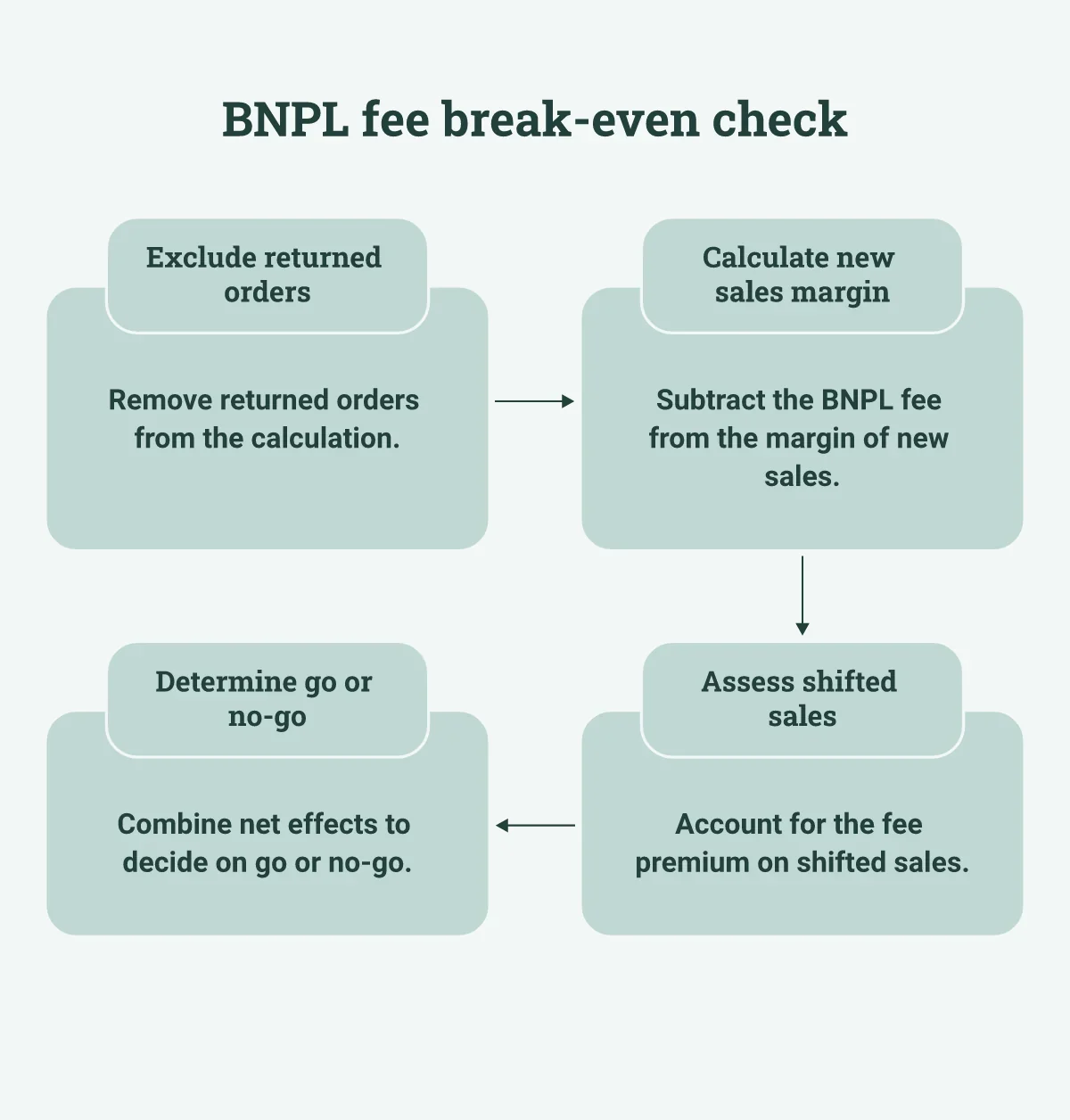
Positive net change clears added BNPL costs; negative net change does not.
Hypothetical illustration: Suppose a $100 average order leaves $40 before payment fees, the BNPL quote is 6%, and ordinary card processing costs 3%. If 120 existing monthly orders shift to BNPL, their added fee is $360.
Each genuinely new, retained order contributes $40 minus its $6 BNPL fee, or $34. You need 11 such orders to cover the $360 premium, before any other added costs or return losses.
Treat a claimed conversion or average-order-value increase as a hypothesis, not a forecast. Use your measured result to set a go/no-go threshold.
Make the decision with your actual offer
Before enabling a US BNPL offer, request the final written quote, confirm platform compatibility, payout timing, and who handles returns, refunds, and disputes, then compare its fee premium with your measured break-even threshold.
If new, retained orders do not cover the premium, keep BNPL off. If card acceptance is all you need, JIM’s Tap to Pay and Payment Link accept cards, not BNPL, through the JIM app.



Sell and get paid in seconds with Jim