How to Become a Vendor at a Farmers Market in 7 Steps

To become a vendor at a farmers market, pick a market whose shoppers want what you make, apply before its deadline, and have your permits and insurance ready before your first market day. Most markets review every applicant, so treat the application like a pitch, not a form.
There are plenty of markets to choose from. The latest USDA National Farmers Market Survey estimated 8,140 farmers markets operating in the lower 48 states in 2019, and USDA opened a new national survey on February 17, 2026.
How do you find a farmers market to sell at?
Start with the USDA National Farmers Market Directory. It lists markets with two or more farm vendors and shows each market's location, hours, products, and accepted forms of payment. Shortlist three markets within driving distance, then shop each one on a busy morning before you apply.
You can also ask JIM. The JIM AI agent in the app surfaces nearby events, markets, and fairs based on your business type, so a question like "Any markets near me this Saturday?" returns options you can check against this list.
How does the farmers market vendor application work?
Apply in winter for a spring start, because the best markets fill early. The Puyallup Farmers' Market 2026 Applicant Handbook opened applications to returning vendors in December 2025 and to new applicants only from January 9 to January 26, 2026, with decisions by February 19, 2026. By then, its prepared food and several craft categories were already closed.
Expect a jury, a review where the market decides who gets a booth. The Eagle Saturday Market in Idaho, run by the city, juries on five criteria: good standing for returning vendors, local vendors first, uniqueness, product quality, and a complete application. Many markets also enforce a producer rule: Eagle requires produce vendors to grow 80% of what they sell.
How much is a farmers market booth fee?
Budget for three costs: an application fee, a booth fee per market, and at some markets a commission on your sales. Here is what three 2026 market pages charge for a standard 10 by 10 foot booth:
| Market | Application fee | Booth fee | Commission |
|---|---|---|---|
| Eagle Saturday Market, ID | Not listed | $25 per market | None listed |
| Metro Denver Farmers' Market, CO | $100 | $50 to $60 per day | None listed |
| Puyallup Farmers' Market, WA | $40 | $40 per week | 5% to 10% of sales |
Sources: each market's vendor handbook or rules page, accessed September 2026. Local examples, not nationwide rules. Prepaying can cut the bill: Puyallup charges $575 for a full season of 23 to 25 dates, a $425 savings over paying weekly, and Denver takes 15% off for full-season payment.
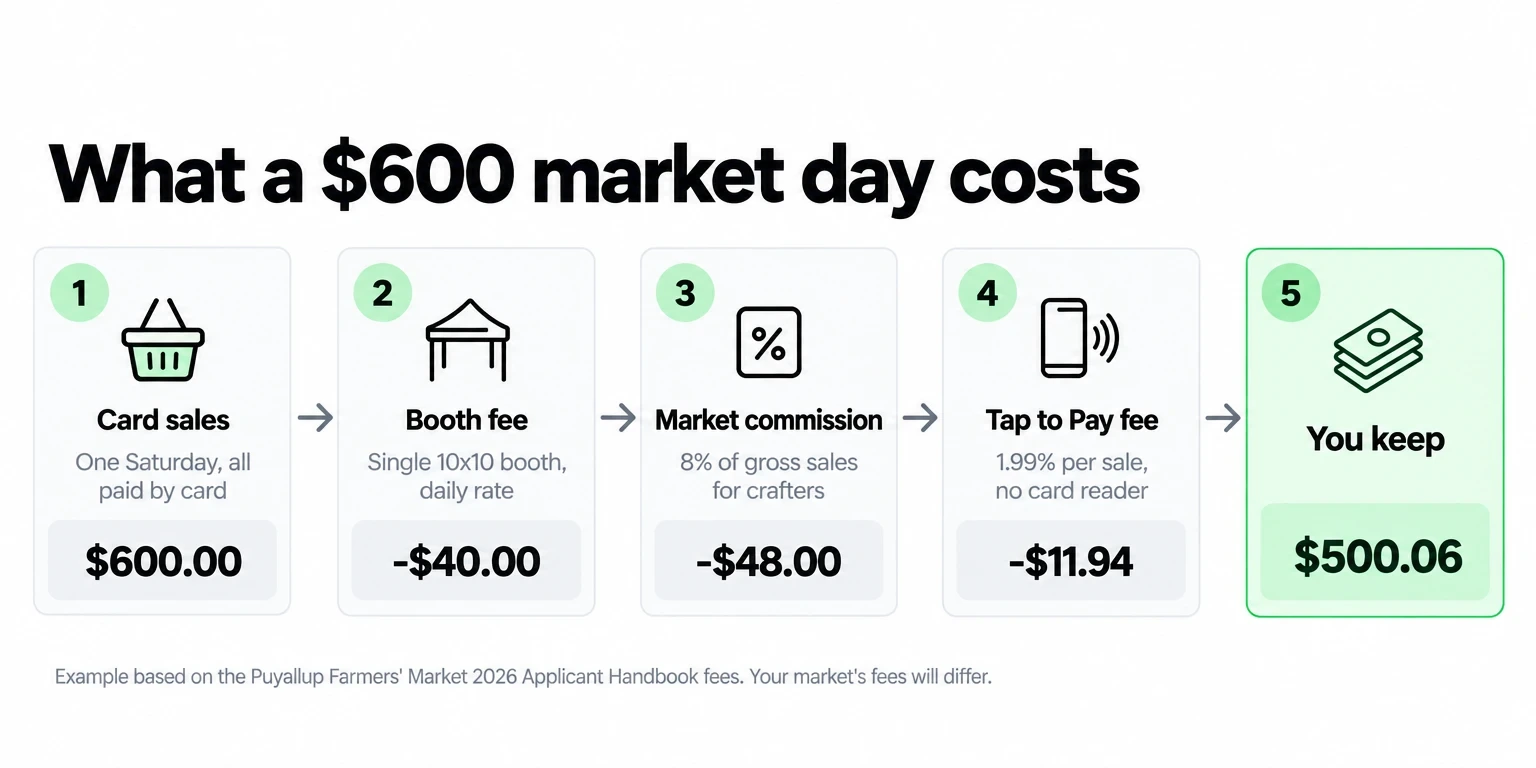
Run the numbers before you sign. Suppose you sell $600 of crafts on a Puyallup Saturday, all by card: the $40 booth, the 8% crafter commission, and a 1.99% card fee leave you $500.06. If booth fee plus commission would eat more than 15% of what you expect to sell, test a smaller or cheaper market first.
What permits do I need to sell at a farmers market?
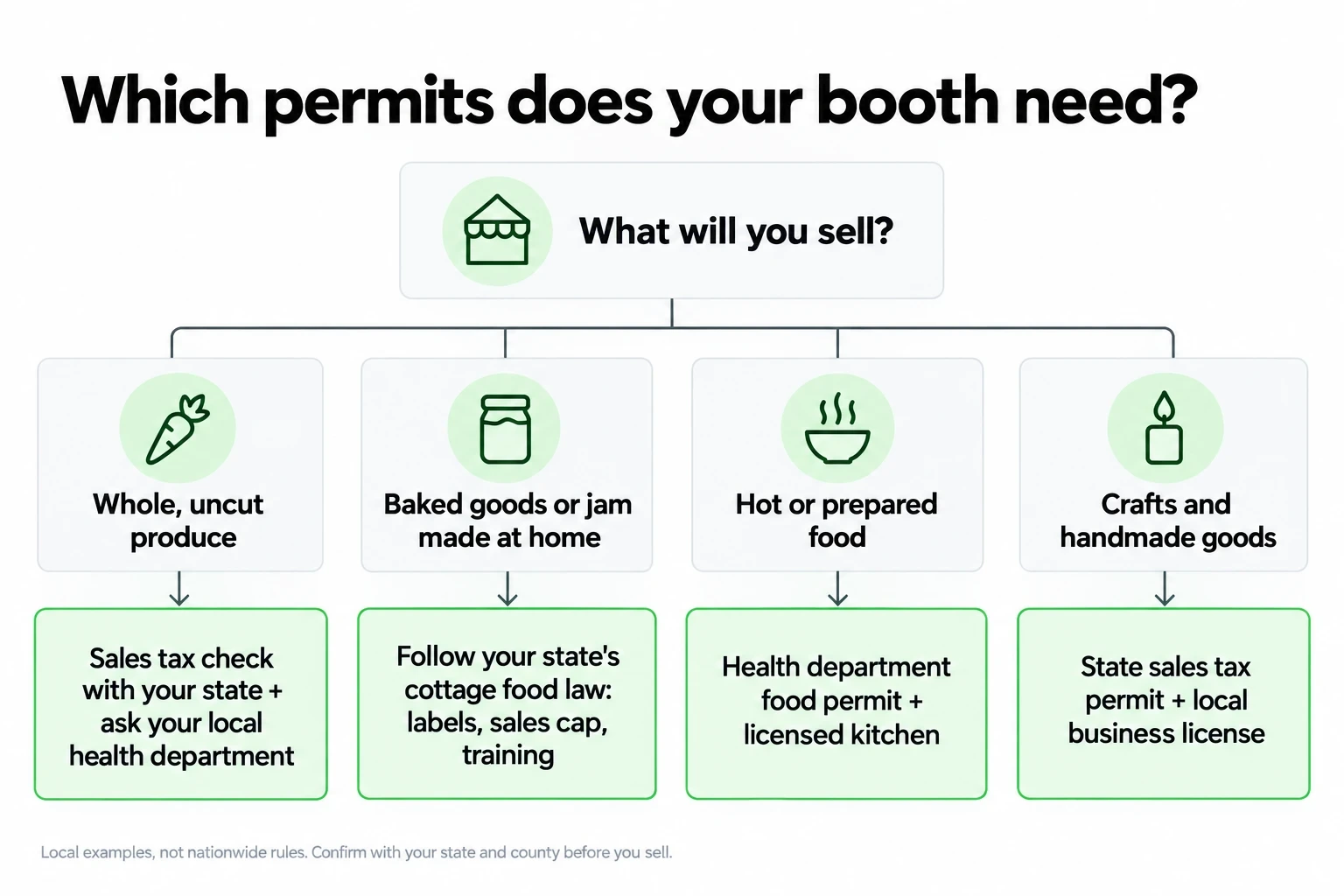
Plan on two layers: a sales tax registration from your state, and a food permit or cottage food compliance if you sell anything edible. The SBA says license requirements and fees vary based on your business activities, location, and government rules, and points you to your state's Department of Revenue for a state tax ID.
Food is where local rules split the most. In Austin, Austin Public Health charges $100 for a farmers market permit but does not require one for whole, uncut produce or cottage food. In Eagle, Central District Health wants a temporary food establishment application from anyone selling food, whole fruits and vegetables included.
If you bake or make jam at home, your state's cottage food law decides what you can sell. Three state examples:
| State | Annual sales cap | Permit to sell | Key rule |
|---|---|---|---|
| Texas | $150,000 | No local permit; state registration for foods kept cold or hot | Food handler training and a home-kitchen label disclosure |
| Florida | $250,000 | No state food permit | Packaged, labeled products; samples must be prepackaged |
| California | Set by class, adjusted yearly | Register with your county | Operator training within 3 months |
Sources: Texas DSHS, Florida FDACS, and California CDPH, accessed September 2026. Sell hot or prepared food and you step outside most cottage laws into a full health permit and a licensed kitchen. The pickle business guide walks through that path for acidified foods.
Do you need insurance to be a farmers market vendor?
Yes, at most established markets, so buy $1 million per occurrence of general liability with product liability included. Puyallup requires $1,000,000 each occurrence plus $1,000,000 for products and a $1,000,000 general aggregate, and wants the certificate 30 days before your first market. Denver requires product liability insurance from every vendor.
The Farmers Market Coalition notes that many markets ask vendors to name the market as an "additional insured," which extends your policy to the market if a shopper sues both of you. Ask the manager for the exact wording before you buy, because a certificate with the wrong name can keep you out on opening day.
Should you accept SNAP/EBT at your booth?
If you sell produce, eggs, bread, or other eligible groceries, yes: SNAP shoppers bring federal food benefits to spend. According to USDA's SNAP Farmer/Producer page, the owner of a direct-marketing farm applies online for authorization, and every authorized seller must use Electronic Benefits Transfer (EBT) equipment, which can be a smartphone or tablet app.
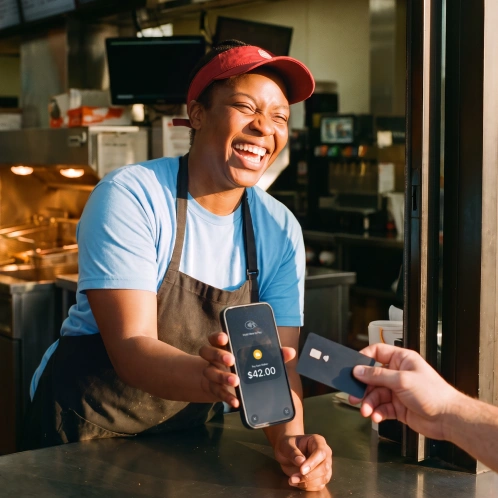
Ask your market first. Some markets hold one SNAP authorization and hand shoppers tokens you redeem with the manager, which saves you the application. SNAP runs on its own EBT approval, separate from your card app, so plan both. For every other shopper paying with a credit card, debit card, or phone wallet, JIM Tap to Pay covers the sale at 1.99%.
What do you need for your first farmers market booth?
Pack for the rules in your handbook, not a generic list. These items come straight from 2026 market rules:
| Item | Why you need it |
|---|---|
| 10 by 10 foot canopy | Eagle requires one; most spaces are 10 by 10 feet |
| Canopy weights | Eagle asks for 25 pounds per leg; Denver asks for 40 |
| Tables and a tablecloth | Keep products off the ground and inside your space |
| Price signs | Eagle requires legible prices on every item |
| Registered scale | Required if you sell by weight at Eagle and Puyallup |
| Permits and insurance certificate | Many markets ask to see them on market day |
| Charged phone and power bank | Card sales on your phone need battery and signal |
| Trash bags | Eagle makes vendors take home anything over one bag |
Arrive early. Eagle wants vendors unloaded by 8:30 AM for a 9:00 AM opening, and late arrivals cannot set up. For a broader starter kit and first-season budget, see how to start a flea market business.
How should you price and take payments at a farmers market?
Price in round dollars that cover your booth fee and commission, and take cards from the first sale. Round prices speed up the line, and a card option keeps the sale when a shopper runs out of cash.
Instant settlements subject to terms. JIM is a financial technology company, not a bank; banking services are provided by Lead Bank, Member FDIC. For more ways to get paid without hardware, read how to accept credit card payments without a machine. Testing a one-off event before a full season? The pop-up shop guide has a break-even worksheet.
You saw the math: at a $40 booth with an 8% commission, a $600 Saturday leaves $500.06 after JIM's 1.99% card fee. Keep more of every market day and let the JIM AI agent find your next one. Download JIM and set up my seller profile.


Sell and get paid in seconds with Jim