How to Pay Yourself as a Business Owner: Draw vs. Salary

You pay yourself as a business owner in one of two ways: an owner's draw, where you move profit from the business account to your personal account, or a salary that runs through payroll. Your business structure decides which one the IRS expects.
Either way, the profit carries tax. The IRS self-employment tax rate is 15.3%, before income tax.
What is the difference between an owner's draw and a salary?
Use an owner's draw if you're a sole proprietor or a single-member LLC owner. Use a salary only if your business is taxed as a corporation, usually an S corp. The two work differently:
| Owner's draw | Salary | |
|---|---|---|
| Who uses it | Sole proprietors, single-member LLCs, partners | S corp and C corp owners who work in the business |
| How it works | Transfer from the business account to your personal account | Paycheck through payroll, with a Form W-2 |
| Taxes withheld | None, you pay estimated taxes | Income tax, Social Security and Medicare withheld |
| Amount | Flexible, based on profit | Fixed and reasonable for your role |
| Tax is based on | Business profit, whether you draw or not | The salary, plus tax on distributions |
The IRS guidance on paying yourself is direct on one point: you can't turn yourself into an employee only by issuing a Form W-2. Your structure sets the rule, not the form you choose.
How do you pay yourself under each business structure?
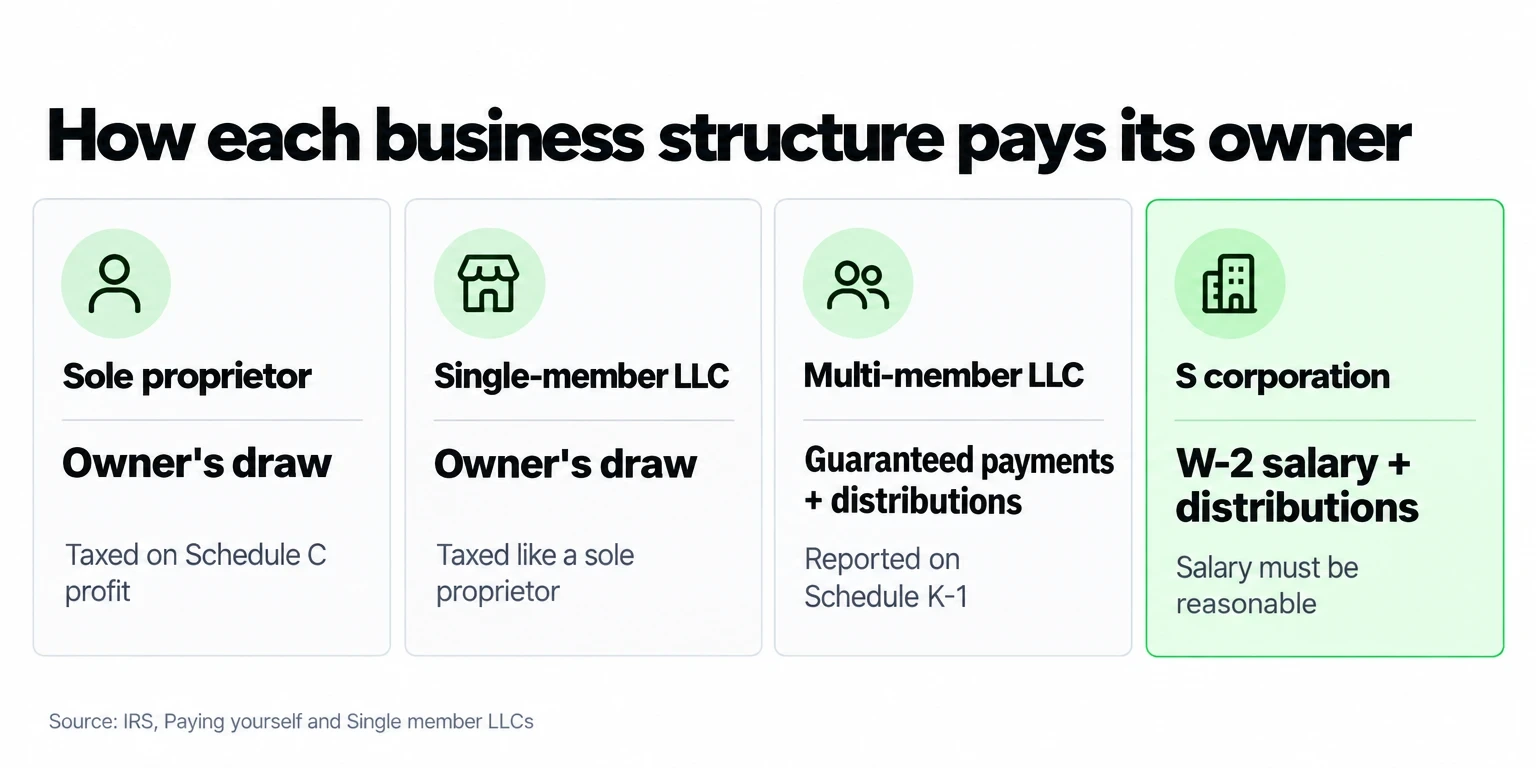
Check your structure first, then follow its method:
Not sure which structure fits you? Compare the trade-offs in LLC vs. sole proprietorship.
How do you pay yourself from an LLC?
Pay yourself from a single-member LLC with an owner's draw. The IRS rules for single-member LLCs say the owner pays tax on net earnings from self-employment the same way a sole proprietor does. Payroll for yourself is off the table unless the LLC files Form 8832 or an S corp election.
A multi-member LLC is taxed as a partnership by default. Each member can take guaranteed payments for the work they do and a share of the profit as distributions, both reported on the Schedule K-1. Write the split into your operating agreement so every member knows the rule before the money moves.
In practice, the draw is a bank transfer. Open a business account, keep all sales there and move your pay to your personal account on a set date. The guide on how to separate business and personal finances shows how to set this up.
How much should you pay yourself?
Pay yourself from profit, never from revenue. Follow this order every month:
Find your monthly profit: revenue minus business expenses.
Move your tax reserve to a separate savings account.
Leave a buffer in the business for slow weeks and repairs.
Take what's left as your draw.
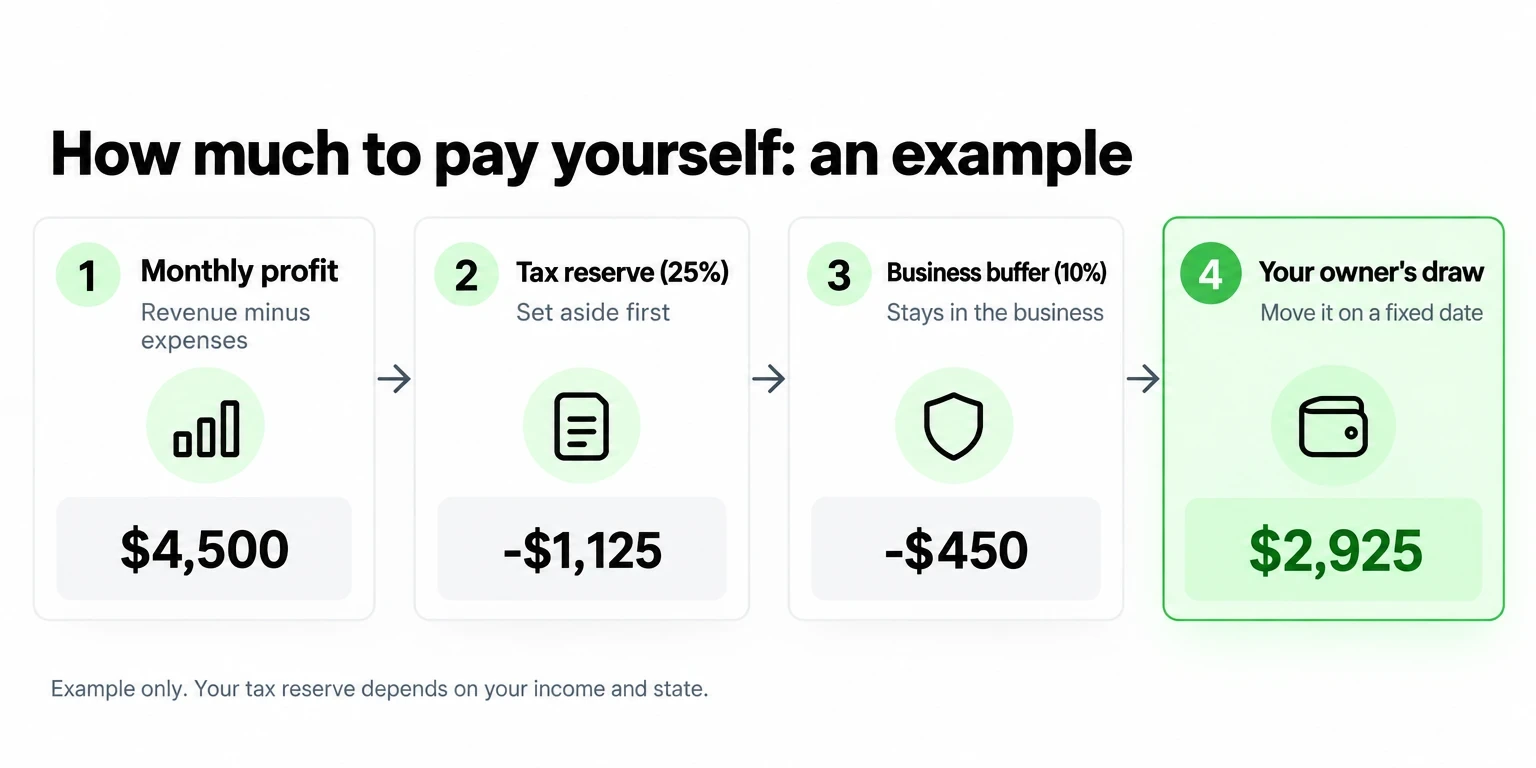
Suppose a repair shop makes $4,500 in monthly profit. With an example tax reserve of 25% ($1,125) and a 10% business buffer ($450), the owner takes a draw of $2,925. Your tax reserve depends on your income tax bracket and your state, so run your own numbers on the Form 1040-ES worksheet.
Keep the draw the same each month for at least a quarter. If profit drops for two months in a row, cut the draw before you dip into the tax reserve. That money already belongs to the IRS.
What taxes do you pay when you pay yourself?
As a sole proprietor or LLC owner, you pay self-employment tax and income tax on your profit, not on the draw. The 2026 numbers come from the IRS and the Social Security Administration:
Here's what that means for a real budget. Suppose your net profit for the year is $60,000. The taxable share is $55,410 (92.35%), and self-employment tax on it is $8,477.73, about 14.1% of your profit. Income tax comes on top of that. The full breakdown is in the guide to self-employment tax.
Since nobody withholds tax from a draw, you pay estimated taxes if you expect to owe $1,000 or more. For the 2026 tax year, the Form 1040-ES lists these due dates:
| Payment | Covers income from | Due date |
|---|---|---|
| 1st | January 1 to March 31 | April 15, 2026 |
| 2nd | April 1 to May 31 | June 15, 2026 |
| 3rd | June 1 to August 31 | September 15, 2026 |
| 4th | September 1 to December 31 | January 15, 2027 |
The IRS also accepts weekly or monthly payments, as long as you've paid enough by each due date. If you set aside your reserve every month, pay it monthly too, and the January 15, 2027 deadline won't catch you short.
How do S corp owners pay themselves?
Put yourself on payroll with a reasonable salary, then take the rest of the profit as distributions. The IRS requires reasonable compensation before any non-wage distribution, and it can reclassify distributions as wages if your salary is too low.
The IRS lists the factors it checks to judge whether a salary is reasonable:
your training and experience;
your duties and responsibilities;
the time and effort you put into the business;
what comparable businesses pay for similar services;
what you pay employees who aren't shareholders.
The payoff of an S corp is that distributions skip Social Security and Medicare taxes. That only works with a defensible salary, a payroll service and a tax professional who reviews your numbers every year. Payroll and yearly tax filings add costs, so stay with the draw until a tax professional shows you that the savings beat those costs.
How often should you pay yourself?
Pay yourself every two weeks or once a month, on the same date. A fixed date keeps your personal bills on schedule and gives you a monthly checkpoint: if the business can't cover the draw plus the tax reserve, you see it right away, not in April.
Avoid paying personal bills straight from the business account. Every personal charge in the business records turns tax season into detective work. Move one amount, on one date, and spend from your personal account.
With Jim, your Tap to Pay sales land in your Jim balance in seconds, and Same Day ACH moves your draw to a U.S. bank account in your name for 1.99% + $0.99 per transfer, per Jim pricing. A transfer can go up to $10,000, so the $2,925 draw from the example fits in one move. Sent before 2:00 PM CT on a business day, it arrives the same day, as the Jim Help Center explains.




Sell and get paid in seconds with Jim