Break Even Point: Formula, Examples and How to Calculate
Your break-even point is the number of sales where your revenue covers every cost, so the month ends with zero profit and zero loss. Divide your monthly fixed costs by what each sale leaves after its variable costs, and you have it.
It's the first number to know before you open. More than 1 in 5 private-sector business locations opened in the year ending March 2024 had closed a year later, according to the Bureau of Labor Statistics.
What is the break-even point?
Treat the break-even point as your monthly sales floor. The U.S. Small Business Administration defines it as the point where total cost and total revenue are equal, with no loss or gain. Below it, you lose money on the month. Above it, every sale adds profit.
You can express it two ways, and both answer the same question:
What is the break-even point formula?
Use the SBA formula: fixed costs divided by price minus variable cost per unit. The dollar version swaps the per-unit margin for the contribution margin ratio.
| What you want | Formula |
|---|---|
| Break-even in units | Fixed costs ÷ (price per unit - variable cost per unit) |
| Contribution margin per unit | Price per unit - variable cost per unit |
| Contribution margin ratio | Contribution margin per unit ÷ price per unit |
| Break-even in sales dollars | Fixed costs ÷ contribution margin ratio |
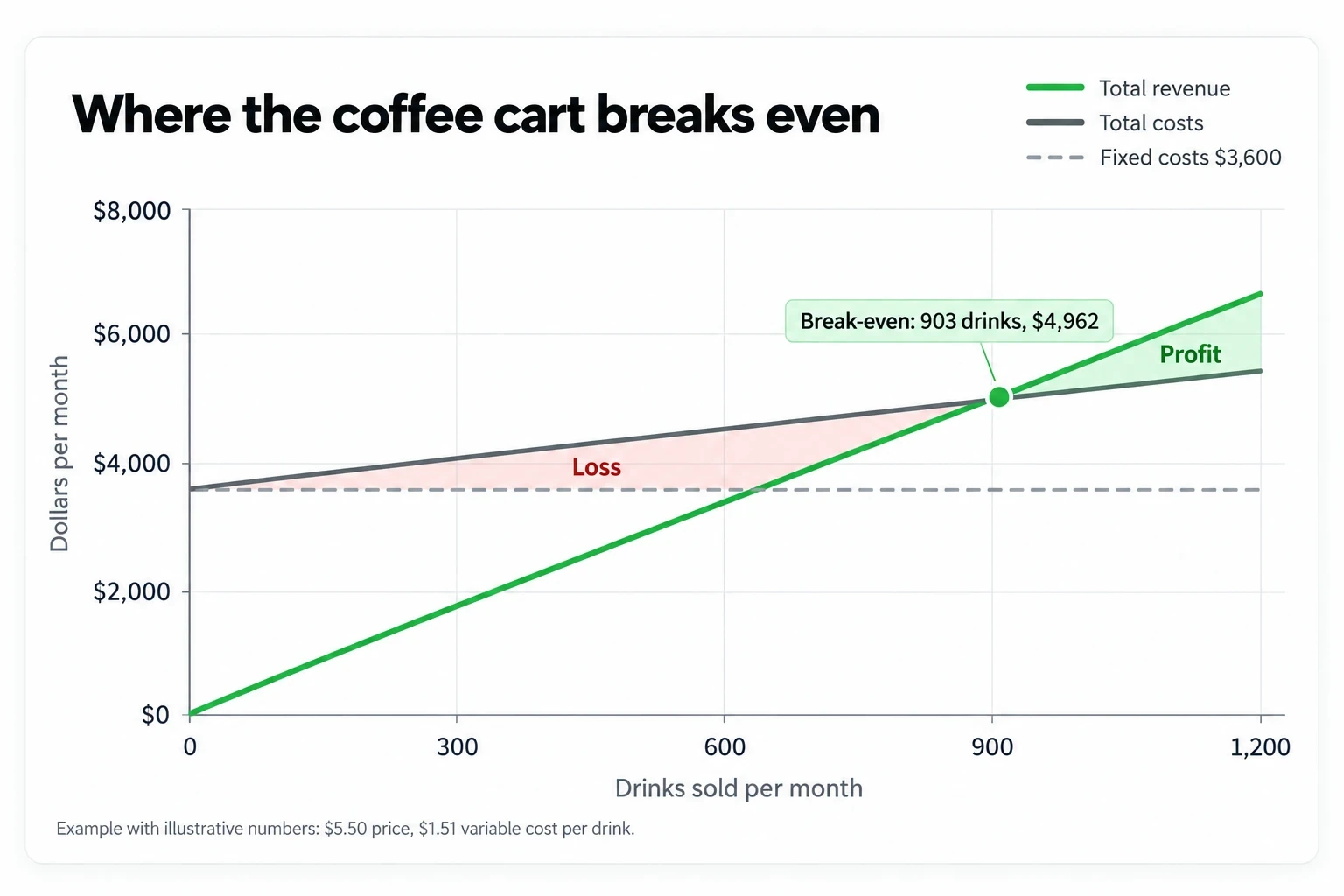
Contribution margin is the part of each sale left to pay fixed costs. A $5.50 drink that costs $1.51 to make and sell leaves $3.99, a 72.6% ratio.
How do you calculate the break-even point?
Work it out in four steps with monthly numbers. Suppose a mobile coffee cart has these costs. They're illustrative, not a benchmark.
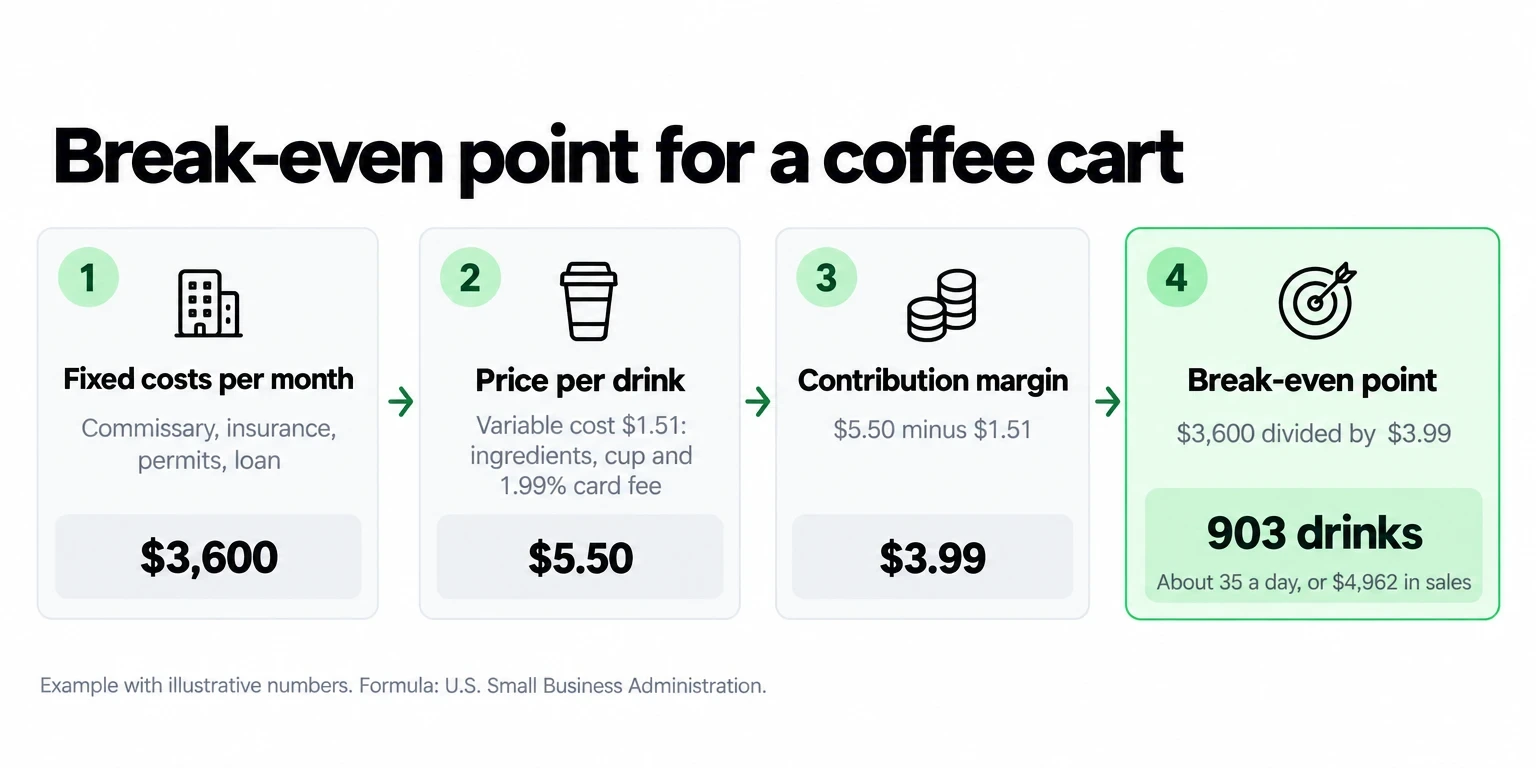
At 26 selling days a month, 903 drinks means about 35 a day. That daily target is the number to write on the cart, because nobody tracks a monthly goal at 7 a.m.
The SBA also suggests adding about 10% to cover expenses you can't predict. With $3,960 in fixed costs, the cart needs 993 drinks, or about 38 a day.
What counts as fixed and variable costs?
Sort every expense by one test: does it change when you sell one more unit? If it does, it's variable. If it doesn't, it's fixed.
Card fees are the variable cost owners forget most. If a fee is a percentage of the sale, it grows with every sale, so it belongs in the per-unit cost, not in fixed overhead.
How do you find the break-even point in dollars?
Divide fixed costs by your contribution margin ratio. This version works for a shop with 200 products, where counting units makes no sense.
Pull the ratio from your profit and loss statement: subtract all variable costs from revenue, then divide the result by revenue. Suppose a gift shop has $40,000 in monthly revenue and $24,000 in variable costs. Its ratio is 40%, so $6,000 in fixed costs means a break-even of $15,000 in sales.
How do price and costs change your break-even point?
Price moves break-even more than anything else. On the coffee cart, a $0.50 increase saves 99 drinks a month, while a $400 rent increase adds 100.
| Scenario | Margin per drink | Break-even drinks | Drinks per day |
|---|---|---|---|
| Base case ($5.50 price) | $3.99 | 903 | 34.7 |
| Price raised to $6.00 | $4.48 | 804 | 30.9 |
| Price cut to $5.00 | $3.50 | 1,029 | 39.6 |
| Milk up $0.25 per drink | $3.74 | 963 | 37.0 |
| Rent up $400 a month | $3.99 | 1,003 | 38.6 |
The price cut is the trap. Dropping $0.50 to win customers means you need 126 more drinks each month just to stand still. Test a higher price first, then use how to price a product to check the new price still leaves the margin you want.
What is the margin of safety?
Margin of safety tells you how far sales can fall before you lose money. Subtract break-even sales from your actual sales, then divide by actual sales.
If the cart sells 1,200 drinks in a month, its margin of safety is 1,200 minus 903, divided by 1,200: 24.8%. Sales can drop almost a quarter before the month turns red. Keep it above 20% and a rainy week won't put you underwater.
How long does it take a business to break even?
Count the months it takes your monthly profit to pay back what you spent to open. The SBA notes that some companies take years before turning a profit, which is why lenders and investors ask for this number.
Suppose the cart cost $15,000 to start. At 1,200 drinks a month it earns $1,188.66 after fixed costs, so it pays back the startup cost in about 13 months. Track the same math monthly in a cash flow spreadsheet so you see the payback date move as sales change.
How do you track your sales against break-even?
Check progress every week, not at month end, when it's too late to fix. The coffee cart's target is $4,962 a month, or about 35 drinks a day.
Ask the JIM Agent "Am I on track for $4,962 this month?" and it answers from your real sales. Card fees stay simple to model, too: Tap to Pay costs a flat 1.99% per sale with no monthly fee, which is the $0.11 per drink built into the variable cost above. See JIM pricing for the rate on payment links.



Sell and get paid in seconds with Jim