How to Ask a Client for Payment (With Templates)
Ask a client for payment with a short, polite message that states the amount and gives them a link to pay from their phone. Then follow up on a fixed schedule until the money arrives, so no reminder feels personal.
Start with a due date in writing. In New York City, the Freelance Isn't Free Act says a client must pay by the date in your contract or, with no date set, within 30 days after you complete the work. That date is what every message below points to.
What should a payment request include?
Include five details in every request, and make the last one a link. Each missing detail gives the client a reason to reply with a question instead of paying.
New to billing? JIM's page on what an invoice includes covers the document itself, and the pro forma invoice workflow helps you get approval on a quote before the final bill goes out.
How do you politely ask a client for payment?
Be brief, specific, and neutral at first, then get firmer with each late reminder. Politeness comes from clarity, not from apologizing for asking. Match your tone to how late the payment is:
| Stage | Tone | Avoid |
|---|---|---|
| Before the due date | Warm and helpful | Apologizing for the reminder |
| On the due date | Neutral and short | Long explanations |
| 7 days late | Direct, asks a question | Accusing the client of forgetting |
| 30 days late | Firm and factual | All caps or emotional words |
| Final notice | Formal, with a deadline | Threats you won't carry out |
Email works for the full message. Text or a DM works for a nudge if that is how you and the client already talk. Keep both channels consistent, with the same amount and the same link.
When should you send payment reminders?
Send five messages on a schedule you set once and reuse for every client: a heads-up 3 days before the due date, a nudge on the day, a follow-up at 7 days late, a firm request at 30 days, and a final notice about 2 weeks later. This is a practical routine, not a legal requirement.
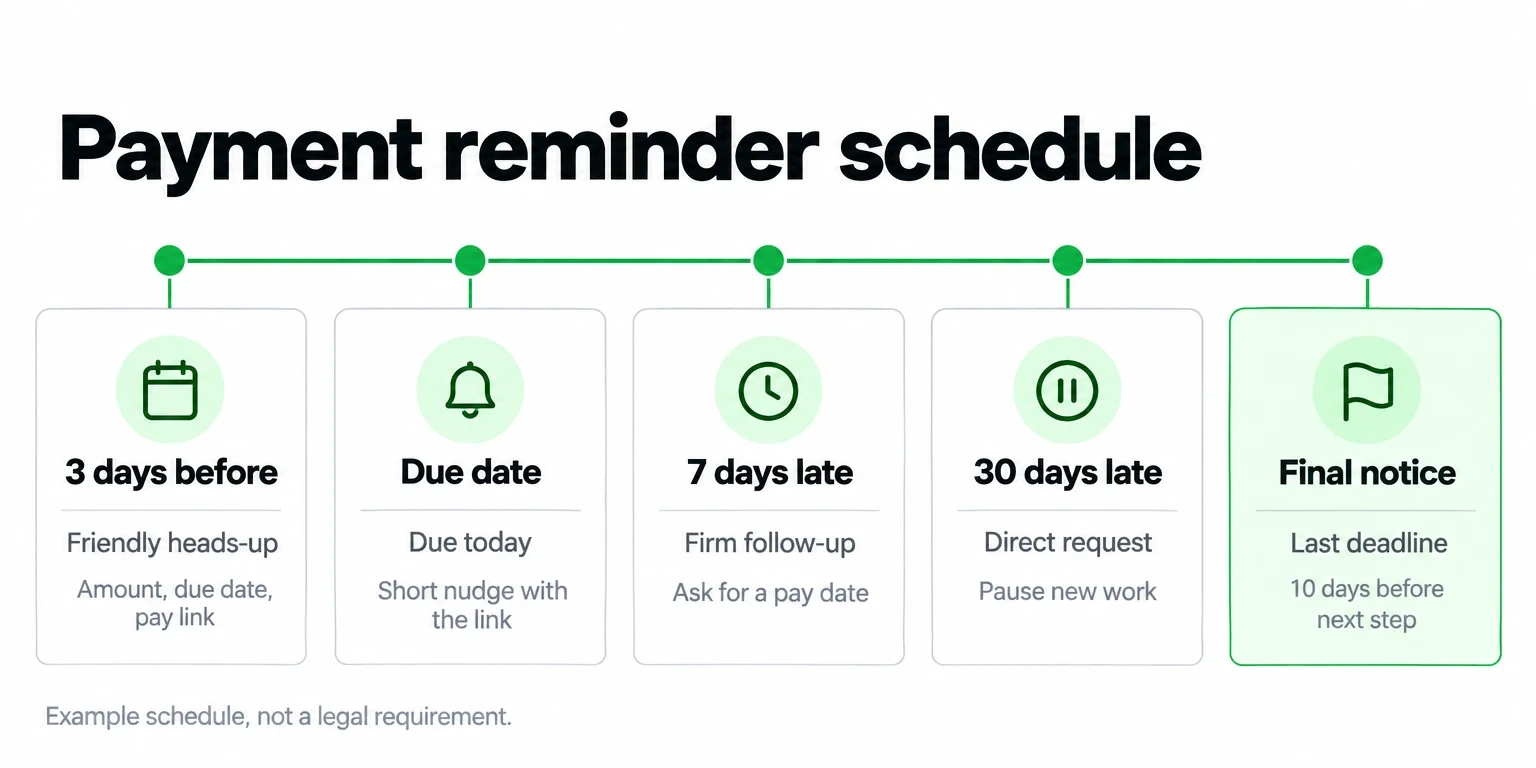
Put the dates on your calendar the day you send the invoice. When the reminder goes out on schedule, it reads as your process, not as a reaction to this client.
What are the best payment reminder templates?
Copy the template for your stage, fill in the brackets, and paste your payment link where it says [link]. Each one comes with a short version for text or DM.
Before the due date
On the due date
7 days late
30 days late
Final notice
Can you charge a late fee on an overdue invoice?
Charge a late fee only if the client agreed to it in writing before the work started. As a general practice, freelancers write the fee, when it applies, and how it is calculated into the contract or proposal, then quote that clause in the 30-day reminder: "Per our agreement, a late fee of [amount] applies after [date]."
States limit interest and late charges in different ways, so check your state's rules or ask a local attorney before you set a rate. This is general information, not legal advice. JIM's free service contract template has a payment terms section where the clause fits.
What can you do if a client still won't pay?
Pick up the phone first, then escalate in writing. A call often surfaces the real problem, such as a missing purchase order or an invoice sent to the wrong person.
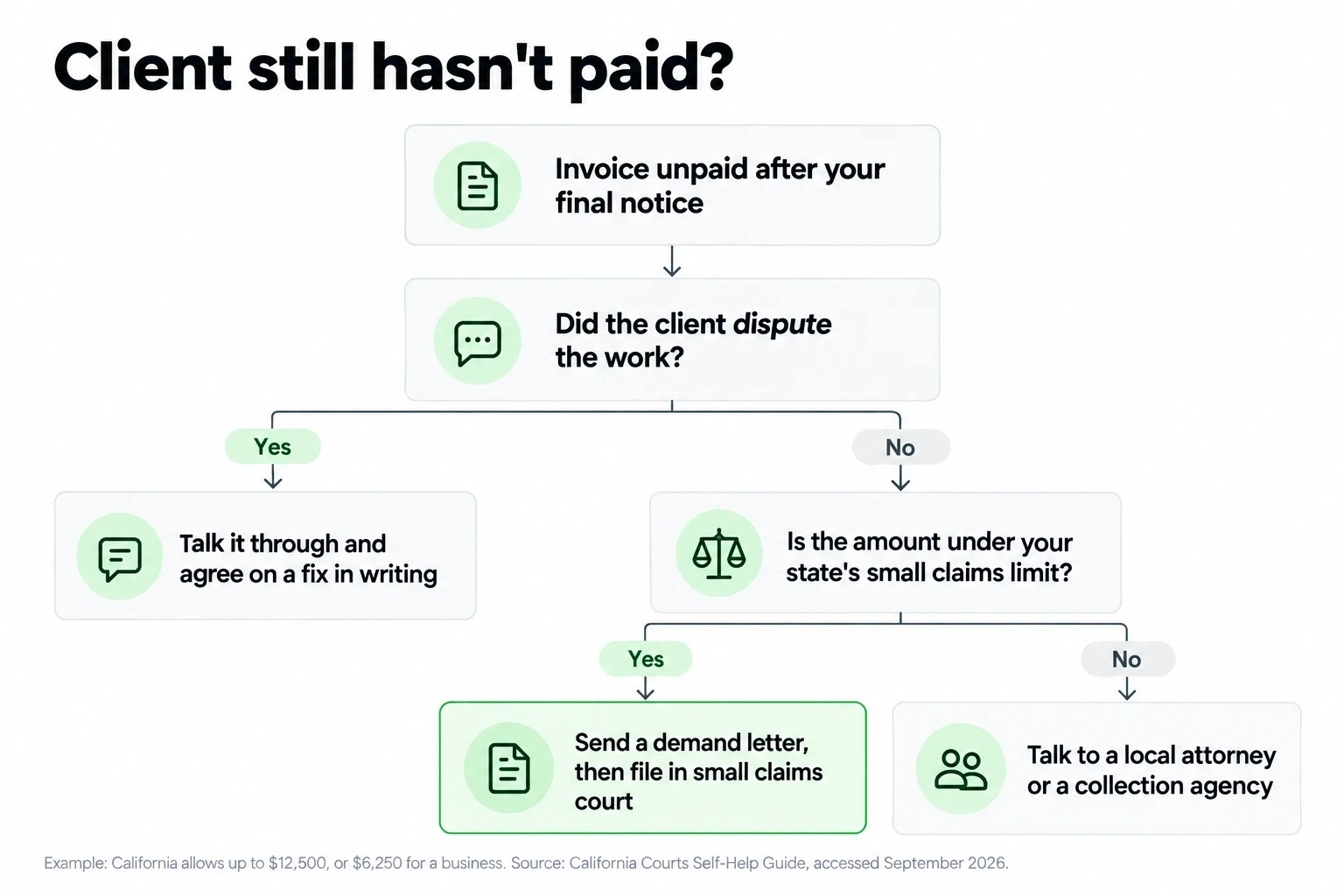
Above your state's small claims limit, a local attorney or a collection agency is the next step. For contracts, deposits, and milestone billing that prevent the problem next time, see freelancer payment methods.
Do debt collection laws apply when you collect your own invoices?
The main federal law generally does not, as long as you collect in your own name. The Fair Debt Collection Practices Act (FDCPA) defines a debt collector as someone who collects debts owed to another, and it pulls in a creditor who uses a different name that suggests a third party is collecting.
The Consumer Financial Protection Bureau (CFPB) adds that the FDCPA covers personal, family, or household debts, and that it doesn't cover business debts or, generally, collection by the original creditor. State laws are different: the CFPB notes some of them cover the original creditor too. So sign reminders with your real name, stay factual, and check with your state attorney general's office if a client is an individual rather than a company.
How does a payment link help you get paid faster?
A payment link removes the last excuse. The client taps it in your email or text and pays by card on the spot, with no bank details to type and no check to mail. For a deeper look at how links work, read payment links for business.
With a JIM Payment Link, you create the link in the app, add a description like "Invoice 1042, brand design", and share it by text, email, or DM. Your client opens a secure checkout page and pays by card, Apple Pay, Google Pay, or Samsung Pay, with no app to download. The step-by-step lives in JIM's selling guide.
| Invoice paid by | JIM fee | Fee on $1,200 | You keep |
|---|---|---|---|
| Payment Link (remote) | 4.99% + $0.30 | $60.18 | $1,139.82 |
| Tap to Pay (in person) | 1.99% | $23.88 | $1,176.12 |
Fees from jim.com/pricing, with no monthly fee. The money lands on your JIM Card, a Visa prepaid card, in seconds after the client pays. Instant settlements subject to terms. JIM is a financial technology company, not a bank; banking services are provided by Lead Bank, Member FDIC.
A $1,200 invoice paid through a JIM Payment Link costs $60.18 and reaches your JIM Card in seconds, so put the link in the first reminder, not the last. Finishing the job at the client's place? Tap to Pay drops that fee to $23.88. Create my first Payment Link.




Sell and get paid in seconds with Jim