1099-K for Payment App Sellers: 2026 Threshold and Rules

Form 1099-K reports the gross payments you received for goods and services through card processors, payment apps, and online marketplaces. Card sales land on the form at any amount, while payment apps must file only when you pass $20,000 in payments and more than 200 transactions in a year.
The IRS says the form goes to you and to the IRS by January 31 of the next year. The number on it is rarely what you owe tax on, and knowing why can save you money when you file.
Last reviewed September 2026. This article explains IRS guidance and is not tax advice. Talk to a tax professional about your own return.
What is Form 1099-K?
It is an information return, a record of money that passed through a payment company. The IRS says it covers payments from credit, debit, or stored value cards such as gift cards and from payment apps or online marketplaces, which the IRS calls third party settlement organizations. Sell on two platforms and you can get two forms.
What is the 1099-K threshold for 2026?
It depends on how your customer paid. For card payments there is no threshold. The IRS FAQ says a card processor reports if you received even $0.01 in card payments. For payment apps and online marketplaces, the federal rule is more than $20,000 in payments and more than 200 transactions in a calendar year.
| How you got paid | Who files | Federal threshold | Tax years |
|---|---|---|---|
| Credit, debit, or gift card | Card processor | Any amount | Every year |
| Payment app or online marketplace | The app or marketplace | Over $20,000 and over 200 transactions | 2025 and 2026 under current IRS guidance |
| Gift or repayment from friends or family | Nobody should | Not reportable | Every year |
The $20,000 rule came back in 2025. The One Big Beautiful Bill Act, signed July 4, 2025 and now called the Working Families Tax Cuts by the IRS, retroactively reverted the threshold for payment apps. It replaced the lower $600 threshold that prior law had scheduled. The IRS told filers to expect a 2025 form in January 2026 only above $20,000 in more than 200 transactions, and its guidance as of September 2026 lists the same rule with no end date, so it applies to what you earn in 2026 too.
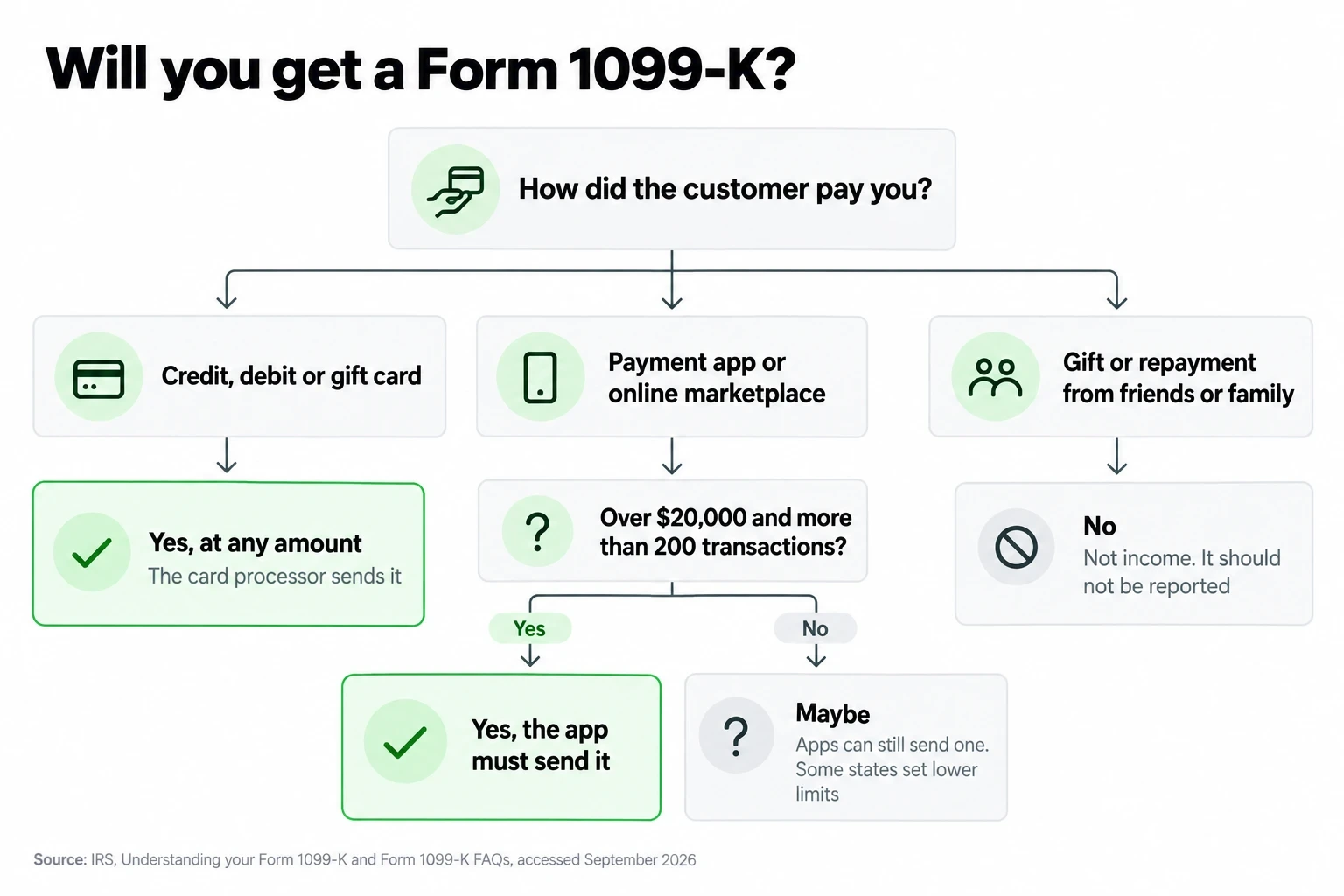
Your state can ask for more. The IRS notes that a state may set a lower threshold. Massachusetts, for one, requires payment apps to file for gross payments of $600 or more to anyone with a Massachusetts address, whatever the number of transactions. Check your own state revenue department before you assume no form is coming.
Do you have to report 1099-K income?
Yes, and you report it with or without the form. The IRS says you must report all income from selling goods or services, no matter the amount. The threshold only controls when a company must send a form, not what counts as income.
Selling as a sole proprietor with no LLC? The same rules apply to you. The guide on how to accept card payments without a business covers signup and licenses, and LLC vs sole proprietorship explains how your structure changes the tax forms you file.
How do you report a 1099-K on Schedule C?
Start from the gross amount and subtract your costs line by line. The IRS says Box 1a is not adjusted for fees, credits, refunds, shipping, cash equivalents, or discounts, and those amounts may be deductible. The Schedule C instructions put each one in its place:
Here is how the math plays out for a seller who took $30,000 in card sales in a year. The example is illustrative and uses the 1.99% JIM Tap to Pay rate from jim.com/pricing.
| Step | Schedule C line | Amount |
|---|---|---|
| Gross payments on Form 1099-K | Line 1 | $30,000 |
| Refunds to customers | Line 2 | -$450 |
| Net sales | Line 3 | $29,550 |
| Cost of goods sold | Part III, line 4 | -$9,000 |
| Gross profit | Line 5 | $20,550 |
| Card fees at 1.99% of $30,000 | Line 10 | -$597 |
| Profit before other expenses | $19,953 |
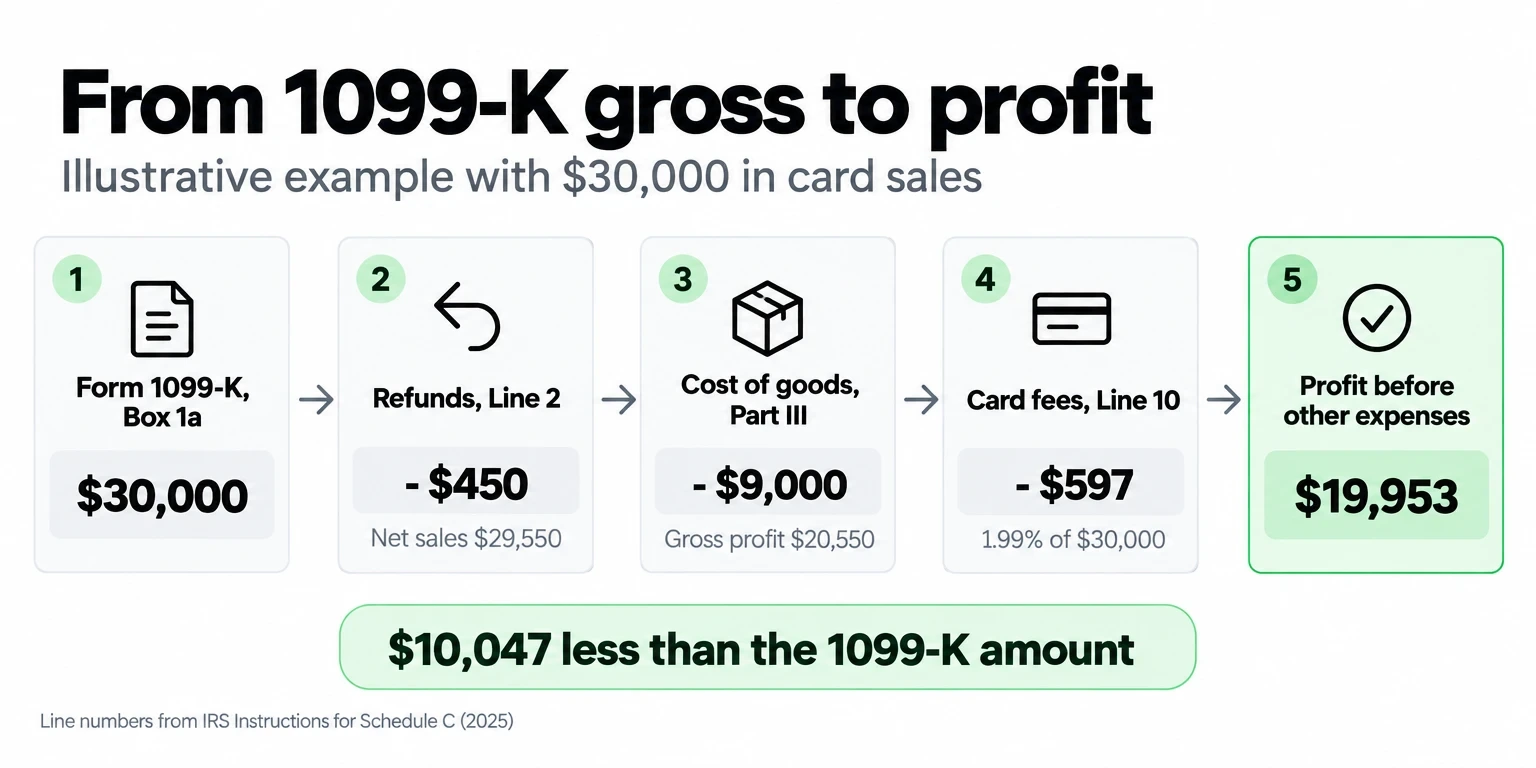
Reporting only what the form shows would overstate this seller's profit by $10,047. Rent, supplies, mileage, and other expenses on Part II lower it further. The side hustle guide walks through Schedule C basics if this is your first year selling.
1099-K vs 1099-NEC: what's the difference?
The difference is who sends it. A 1099-K comes from the company that processed the payment. A 1099-NEC comes from a business client that paid you directly for services, by check, bank transfer, or cash.
| Form 1099-K | Form 1099-NEC | |
|---|---|---|
| Who sends it | Card processor, payment app, or marketplace | A business client that paid you |
| What it covers | Card and app payments for goods or services | Pay for services you did as a nonemployee |
| Payment method | Card or payment app | Check, bank transfer, or cash |
| Where you report it | Schedule C, line 1 | Schedule C, line 1 |
You should not get both for the same payment. The IRS instructions for Forms 1099-MISC and 1099-NEC (Rev. April 2025) say card payments and third party network transactions go on Form 1099-K and are not reported on Form 1099-NEC. If your 1099-NEC totals come to more than your line 1, the Schedule C instructions ask you to attach a statement explaining the difference. Freelancers who bill clients in several ways can compare options in freelancer payment methods.
What if you got a 1099-K for personal payments?
Personal payments are not income, so they are not taxable. The IRS says money from friends and family as gifts or repayment for a shared cost, such as rent or a dinner bill, should not be reported on a 1099-K. It also reminds you that a payment appearing on the form does not mean it is taxable.
Mixing personal and business money is the most common cause. The IRS FAQ on common situations suggests keeping the two apart. The Cash App vs PayPal comparison explains how personal and business accounts differ on those apps.
What should you do if your 1099-K is wrong?
Contact the company that sent it, not the IRS. The IRS says to reach the filer listed in the upper left corner and request a corrected form, and it states it can't correct your Form 1099-K itself. If you don't recognize the filer, call the payment settlement entity at the bottom left.
| Problem | What the IRS tells you to do |
|---|---|
| Wrong taxpayer ID number | Ask for a correction, and report your income as usual. |
| Wrong gross amount | Ask for a corrected form. If it does not arrive, follow the IRS steps for Schedule 1 and keep your proof. |
| Not your account, or a duplicate | Ask the filer for a corrected form showing zero. |
| Correction still pending at tax time | File on time with your own records. Don't wait for the new form. |
How does JIM handle your 1099-K?
JIM sends you one 1099-K with the payments you received during the year. JIM must report sales activity for card and other eligible payments no matter the amount, so even a small year produces a form. According to JIM help on the tax report, the 2025 form was in your JIM account and your email by January 31, 2026.
For the records behind the form, ask JIM Agent. Tap the ✨ icon in the app, type "Show my statements," and it pulls your sales history. You can also ask "How much did I make in Q1?" JIM help notes JIM Agent it is free and available 24/7, and you can try it at jim.com/chat.
What records should you keep for a 1099-K?
Keep anything that proves what you earned and what you spent. The IRS recordkeeping guide lists receipts, invoices, and bank statements, and for a 1099-K it points to app reports, card receipts, and merchant statements.
Download your 1099-K each year, export statements monthly, and share them with your accountant early. A simple cash flow spreadsheet template keeps the totals in one place, and the small business bookkeeping guide covers the rest of the setup.
Remember the math: on $30,000 of card sales, refunds, cost of goods, and fees cut the taxable figure by $10,047 before any other expense. That only works if your records match the form. JIM reports card sales at any amount and keeps every statement in the app. Take cards with JIM Tap to Pay at 1.99% per sale and ask JIM Agent for your numbers at tax time. Instant settlements subject to terms. JIM is a financial technology company, not a bank; banking services are provided by Lead Bank, Member FDIC. This article is not tax advice; talk to a tax professional before you file.




Sell and get paid in seconds with Jim