How to Price a Product: Formula, Markup vs Margin and Fees
To price a product, add up everything one unit costs you, including your own time, then divide that total by 1 minus the profit margin you want to keep. The U.S. Small Business Administration, or SBA, says knowing your break-even point helps you price your products smarter, and it runs on the same cost numbers.
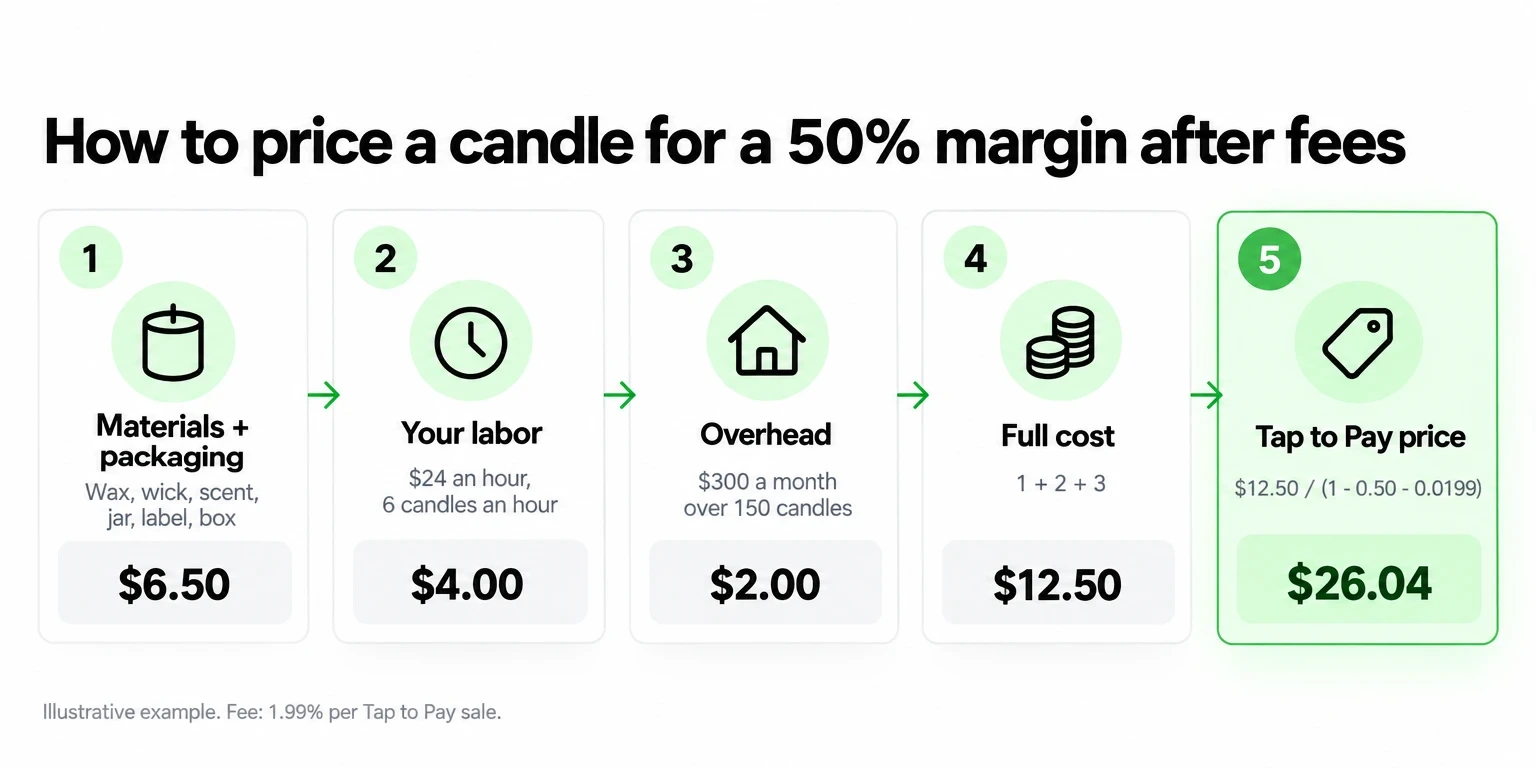
Most solo sellers leave out two lines: the wage they owe themselves and the card fee on each sale. Add both, and a candle that costs $12.50 needs a $26.04 price to keep half of every Tap to Pay sale.
What goes into the cost of a product?
Count five costs per unit: materials, packaging, your labor, a share of overhead and the payment fee. Skip one and a price that looks profitable loses money every time you sell.
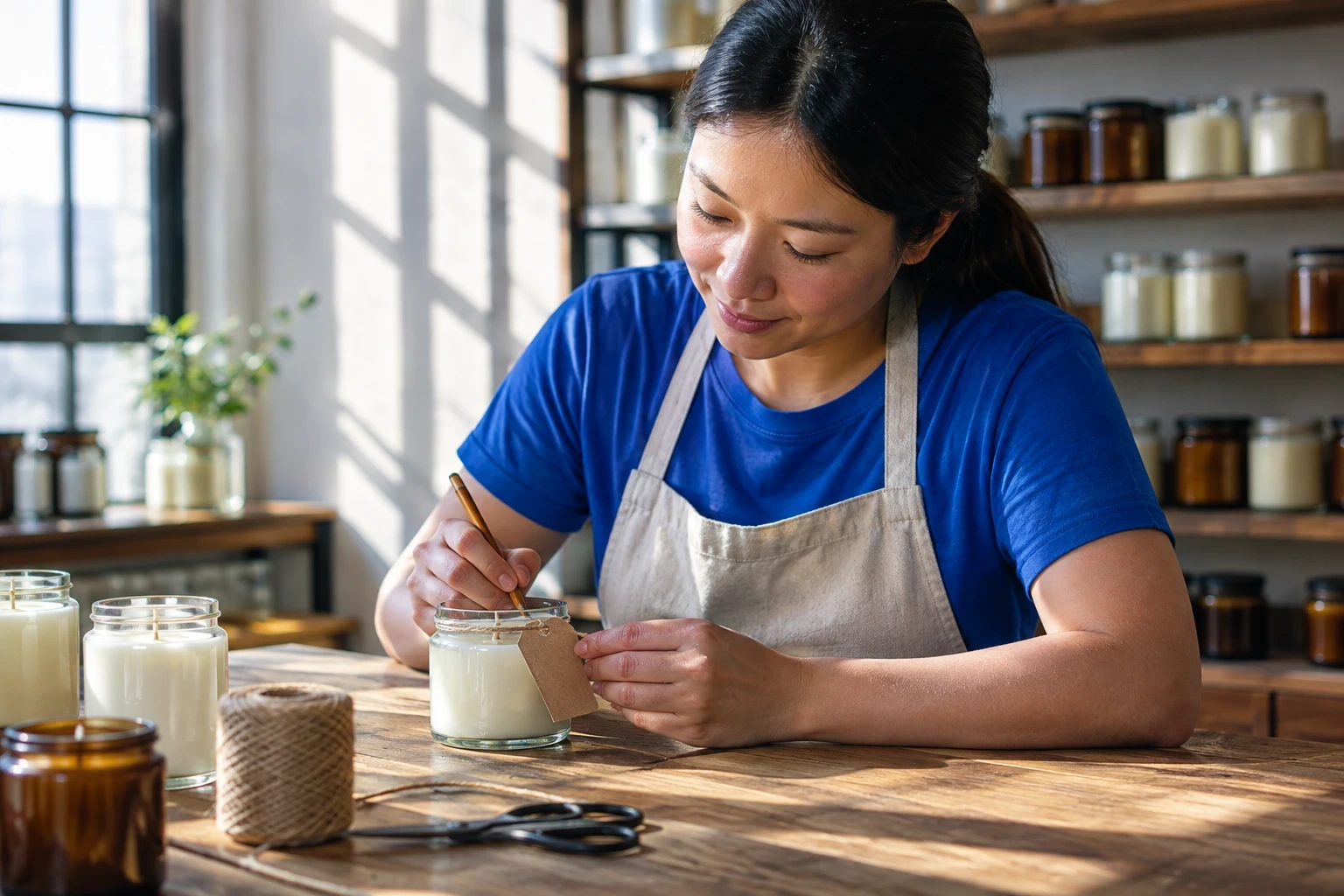
Suppose these are your numbers for one 8-ounce soy candle:
| Cost line | How you get it | Per candle |
|---|---|---|
| Materials | Wax $2.40, wick $0.20, fragrance $1.50, jar $1.60, label $0.30 | $6.00 |
| Packaging | Gift box | $0.50 |
| Labor | $24 an hour, 6 candles an hour | $4.00 |
| Overhead | $300 a month over 150 candles | $2.00 |
| Full cost | Sum of the four lines | $12.50 |
Your cost of goods sold here is $6.50, but your full cost is $12.50. Price from the $6.50 and every candle underpays your time and your booth.
What is the formula to price a product?
Use cost-plus pricing: price equals full cost divided by 1 minus your target margin. For the $12.50 candle at a 50% margin, that's $12.50 divided by 0.50, or $25.00.
Margin is the share of the price you keep after full cost. The SBA glossary defines gross profit margin as gross profit divided by net sales, the part of each sales dollar left to cover operating costs and profit. Because your wage already sits inside the $12.50, the 50% is profit on top of paying yourself.
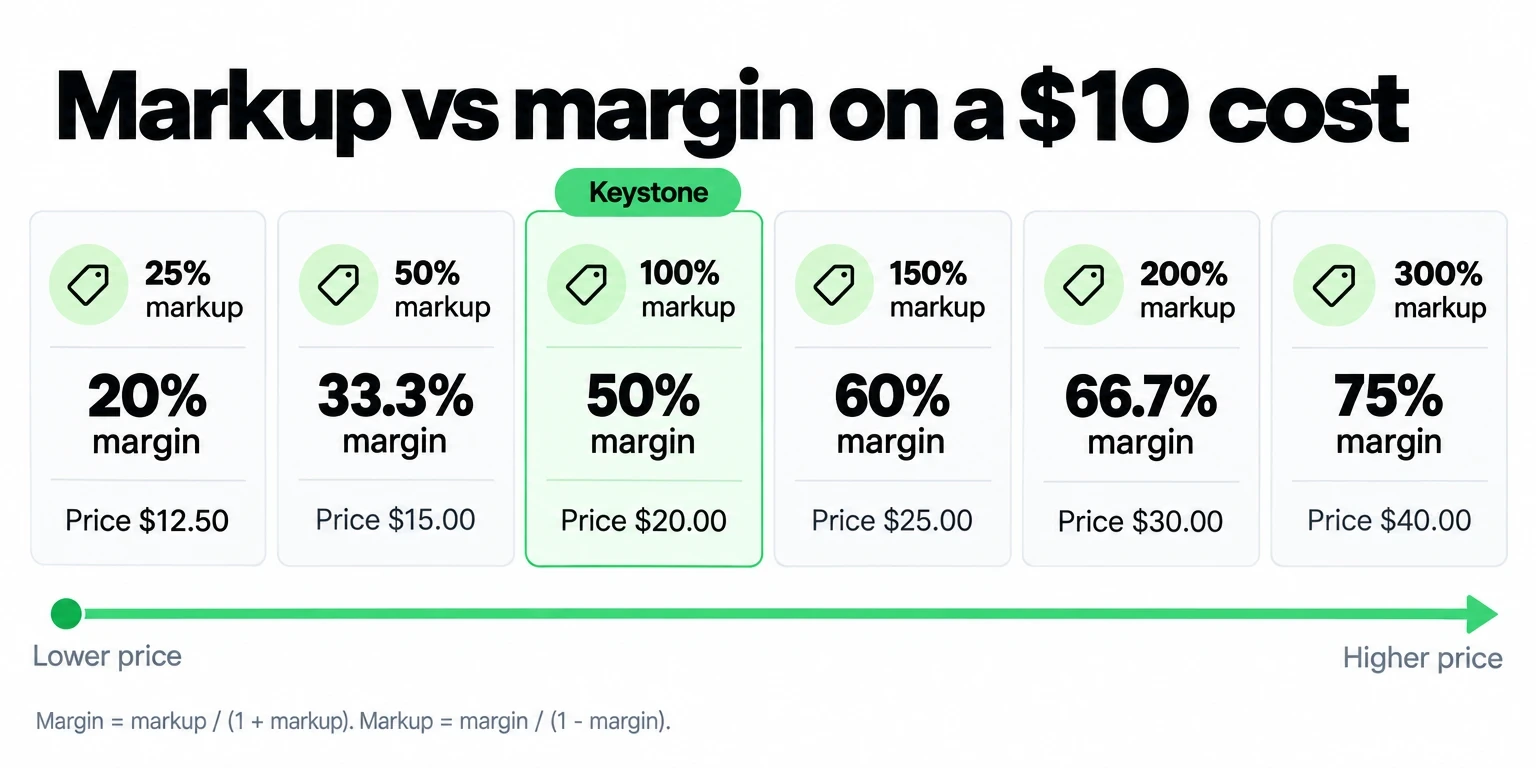
Keystone pricing means doubling your cost: a 100% markup and a 50% margin. Treat it as a retail habit, not a rule. Keystone on the full $12.50 gives the same $25.00, but keystone on the $6.50 materials gives $13.00, which leaves $0.50 over full cost before the card fee. Start at a 50% margin because the math is easy to check, then move it up or down once you compare it with the market.
What is the difference between markup and margin?
Markup is profit as a share of cost, and margin is profit as a share of price. The same $10 profit on a $10 cost is a 100% markup and a 50% margin.
| Markup on cost | Margin on price | Price on a $10 cost |
|---|---|---|
| 25% | 20.0% | $12.50 |
| 33.3% | 25.0% | $13.33 |
| 50% | 33.3% | $15.00 |
| 100% (keystone) | 50.0% | $20.00 |
| 150% | 60.0% | $25.00 |
| 200% | 66.7% | $30.00 |
| 300% | 75.0% | $40.00 |
To convert, margin equals markup divided by 1 plus markup, and markup equals margin divided by 1 minus margin. The mix-up costs money: add 40% to your cost and you get a 28.6% margin, not 40%. A 40% margin needs a 66.7% markup.
How do payment fees change your price?
Put the fee rate in the formula: price equals full cost plus any fixed fee, divided by 1 minus your target margin minus the fee rate. For the $12.50 candle at 50%, that's $26.04 on Tap to Pay and $28.44 on a Payment Link.
| Sale | Fee | Profit after cost and fee | Margin |
|---|---|---|---|
| Tap to Pay at $25.00 | $0.50 | $12.00 | 48.0% |
| Payment Link at $25.00 | $1.55 | $10.95 | 43.8% |
| Tap to Pay at $26.04 | $0.52 | $13.02 | 50.0% |
| Payment Link at $28.44 | $1.72 | $14.22 | 50.0% |
The fee comes out of the price, so a price built for 50% before fees lands at 48.0% on Tap to Pay and 43.8% on a Payment Link. JIM charges 1.99% per Tap to Pay sale and 4.99% + $0.30 per Payment Link or website sale (JIM pricing, September 2026). If you sell both in person and online, set one price for each channel, or price everything at the online level and treat the gap as extra margin at the booth.
Adding the fee at checkout instead is a surcharge, and state law and card network caps limit it. Credit card surcharge rules walks through why pricing it in keeps the same money with less risk. To see what a single sale leaves you after the fee, enter the amount in JIM's calculator, which shows the net for Tap to Pay or a Payment Link.
How do you set wholesale and retail prices?
Set your wholesale price from your cost first, then set retail at about double that, because a shop using keystone pricing will double what it pays you. Pick retail first and halve it, and you can end up selling at cost.
The candle shows the risk. Halve the $26.04 retail price and wholesale lands at $13.02, a 4.0% margin on a $12.50 cost. Suppose you want 30% on wholesale orders instead: $12.50 divided by 0.70 is $17.86 wholesale, and keystone puts the shelf price at $35.72.
How do you check your price against the market?
Run three checks before you print tags: what similar items sell for, what buyers value, and how many units you need to break even.
The SBA also suggests adding a little extra, such as 10%, to a break-even analysis for expenses you can't predict. Selling at an event? The break-even worksheet in how to open a pop-up shop adds booth and setup costs to the same formula.
How do you price handmade items, food and resale goods?
Use the same formula for all three. What changes is which cost line grows fastest and gets forgotten.
| Product type | Biggest cost to count | What sellers miss |
|---|---|---|
| Handmade goods | Your labor | Time spent designing, sourcing and packing, not only making |
| Food | Ingredients and waste | Unsold batches: spread spoilage across the units you sell |
| Resale | What you paid per item | Sourcing trips and items that never sell |
Resellers can set value-based prices from sold listings, the method in how to start a clothing resale business. If you sell secondhand goods at a booth, how to start a flea market business covers the booth side.
The candle math comes down to $12.50 of full cost plus a 1.99% fee, priced at $26.04 to keep half of each sale. Tap to Pay on JIM charges that flat 1.99% on every tap, with no card reader and no monthly fee, and each sale reaches your JIM Card in seconds. Instant settlements subject to terms.




Sell and get paid in seconds with Jim