How to Separate Business and Personal Finances in 8 Steps

To separate business and personal finances, give your business its own account or card, run every sale and every business expense through it, and pay yourself on a schedule. The IRS tells new owners in Publication 583 to open a business checking account, keep it apart from personal checking, and deposit all daily receipts there.
That one habit makes deductions easier to prove and tax numbers easier to find. It works the same for a side hustle run on your Social Security number and for a single-member LLC.
Last reviewed September 2026. This article explains IRS and SBA guidance and is not tax or legal advice.
Why should you separate business and personal finances?
Because the burden of proof sits with you. The IRS says you must be able to prove certain elements of expenses to deduct them, and a shared account buries each business purchase among groceries and rent.
Still deciding on a structure? LLC vs sole proprietorship compares the liability and tax side of each.
Can a sole proprietor open a business account with only an SSN?
Often yes, but each bank sets its own policy, so ask before you apply. Federal rules require a bank to collect a taxpayer identification number from a U.S. customer, and Publication 583 counts both your Social Security number (SSN) and an Employer Identification Number (EIN), the federal tax ID for a business, as taxpayer identification numbers.
The SBA says a business needs an EIN if it pays employees or operates as a corporation or partnership, and it tells owners they can open a business account once they have one. Get the EIN anyway if your bank asks for it or you would rather give clients a business number than your SSN. The IRS issues it online for free, often in minutes, and warns against sites that charge for it. Selling under a trade name? The SBA notes that a DBA plus an EIN lets you open a business account in that name.
How do you separate business and personal finances step by step?
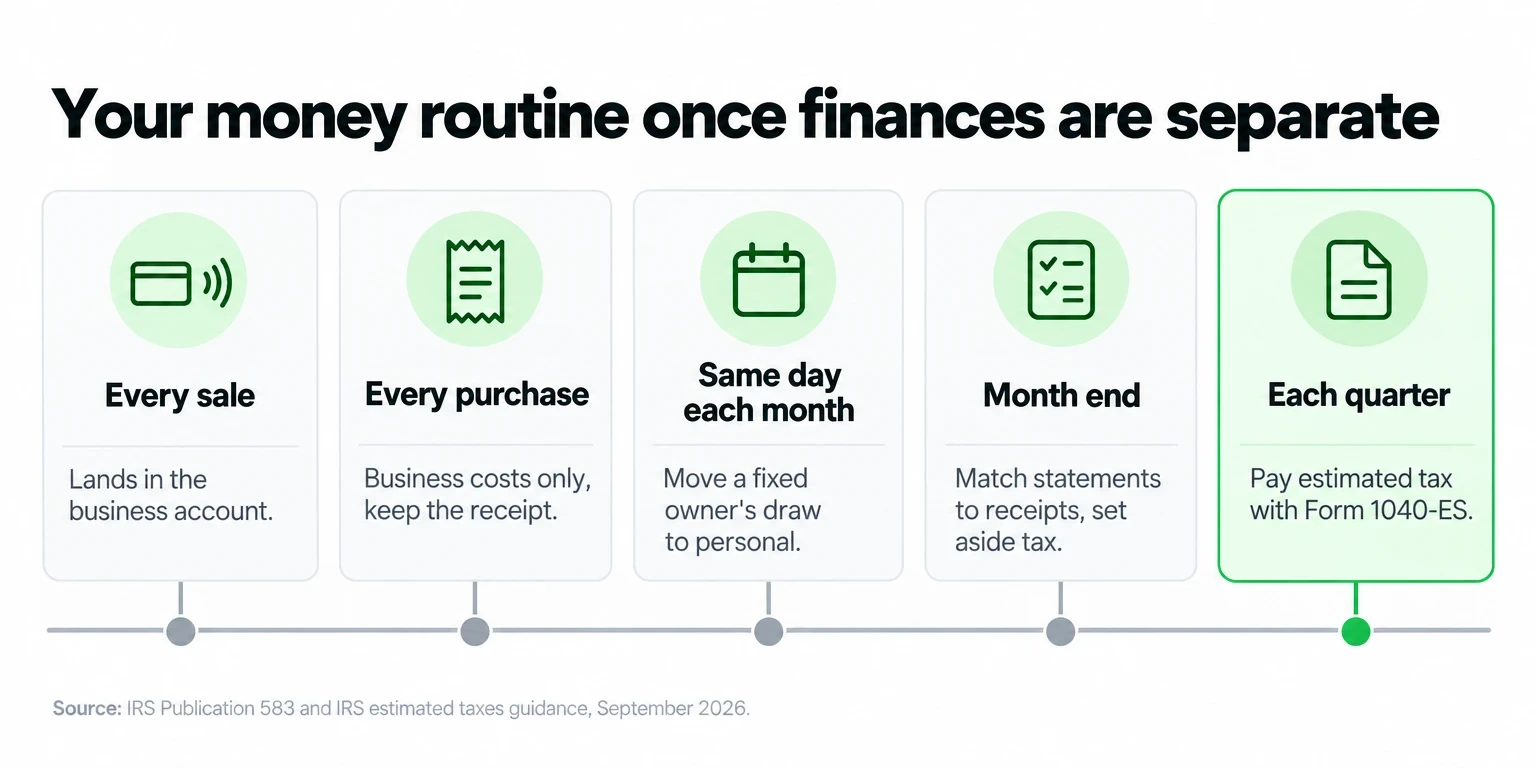
Do the first four steps once. The last four become a monthly routine.
| Step | What to do | Why it matters |
|---|---|---|
| 1. Get an EIN if useful | Apply free on IRS.gov if your bank asks or you want to keep your SSN private | A business ID for bank forms and client paperwork |
| 2. Open one business account or card | Use it for the business and nothing else | Publication 583: use the business account for business purposes only |
| 3. Route every sale there | Card, link, and app payments all land in one place | Your sales total lines up with any 1099-K |
| 4. Pay business costs only from it | Supplies, fees, repairs, ads | Each expense has a payment record |
| 5. Pay yourself a fixed draw | Same amount, same date, moved to personal | No random withdrawals to explain |
| 6. Set aside tax every month | A share of profit, before you spend | Quarterly estimated tax is ready |
| 7. Keep every receipt | Photo or paper, filed by month | Proof of payee, amount, date, and purpose |
| 8. Review once a month | Match statements to receipts | Catch personal charges and errors early |
Personal money you put into the business is a contribution, not a sale. Publication 583 suggests marking whether each deposit is business income, personal funds, or loans, so note the source the day it happens. A free cash flow spreadsheet template gives you one place to log the monthly review.
How much should you pay yourself from your business?
Keep your owner's draw under two-thirds of your average monthly profit over the last three months, and move it on the same date every month. That ceiling is a JIM rule of thumb, not an IRS rule, and it leaves room for taxes and a buffer.
As a sole proprietor, you report the business income and expenses on your personal return, according to Publication 583. The draw is a transfer to yourself, not a business expense, so it does not lower your taxable profit. Publication 583 also tells owners to pay themselves from the business account only when making withdrawals for personal use, which is exactly what a scheduled draw does.
How much should you set aside for taxes?
Set aside 25% to 30% of each month's profit as a starting point, then ask a tax preparer to fine-tune it. That range is a planning estimate, not an IRS figure. It covers the 15.3% self-employment tax for Social Security and Medicare, which applies once net earnings reach $400, plus federal and any state income tax.
The IRS says sole proprietors generally make estimated tax payments if they expect to owe $1,000 or more when they file, using Form 1040-ES. The year splits into four payment periods, each with its own due date. Keep the set-aside where you won't spend it, and pay each quarter from it.
What does one month look like with separate finances?
Suppose a solo alterations shop takes $4,000 in a month: $3,200 in person with Tap to Pay and $800 through 16 Payment Links. The fees come from jim.com/pricing; the other numbers are an example.
| Line | How it's figured | Amount |
|---|---|---|
| Sales | $3,200 in person + $800 online | $4,000.00 |
| Tap to Pay fees | 1.99% of $3,200 | -$63.68 |
| Payment Link fees | 4.99% of $800 + 16 x $0.30 | -$44.72 |
| Business expenses | Fabric, thread, machine repair | -$700.00 |
| Profit | What you owe tax on | $3,191.60 |
| Tax set-aside | 25% of profit | -$797.90 |
| Owner's draw | Fixed monthly amount | -$2,000.00 |
| Same-Day ACH fee | 1.99% of $2,000 + $0.99 | -$40.79 |
| Left in the business | Buffer for next month | $352.91 |
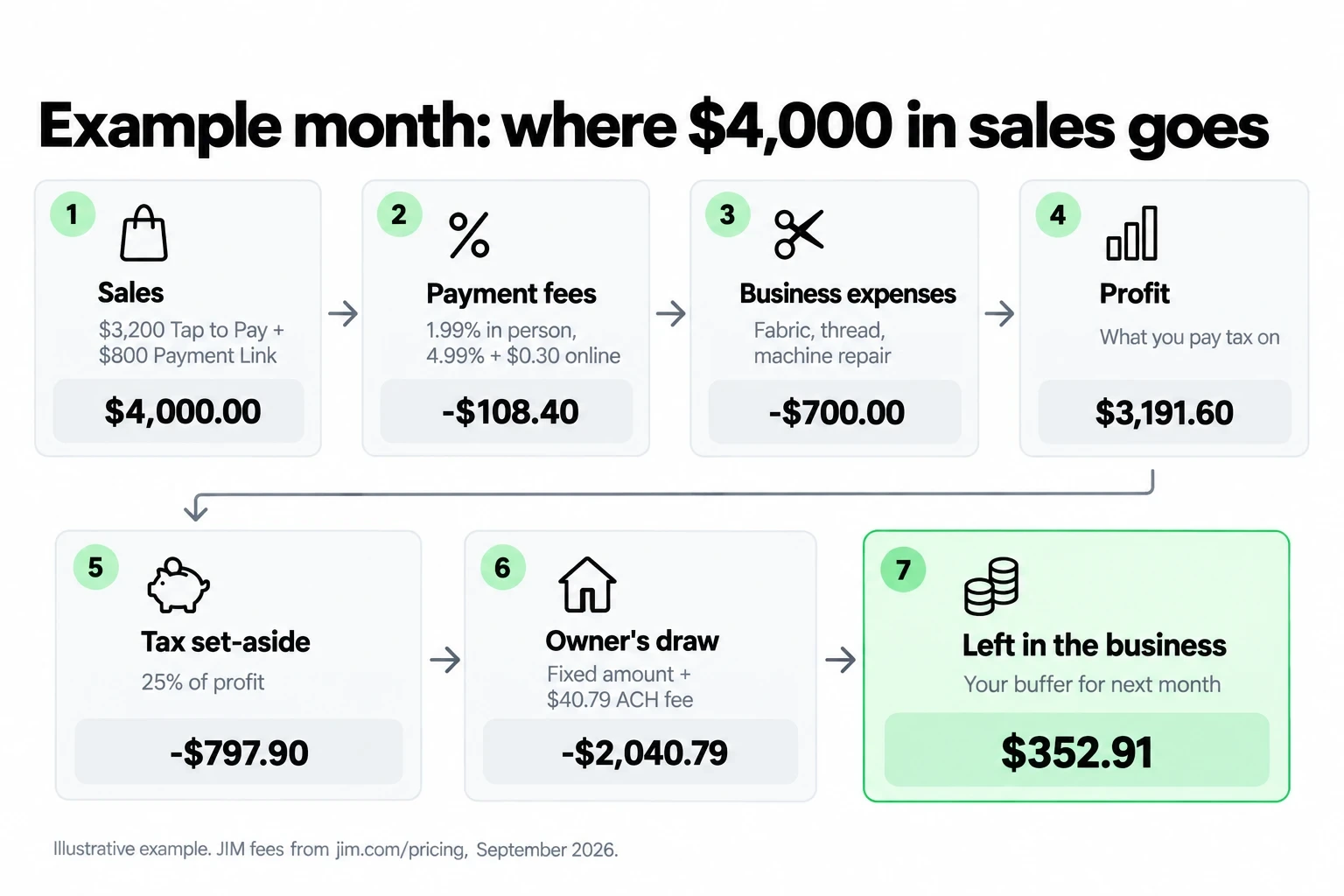
The draw came to about 63% of profit, under the two-thirds line, and the shop still closed the month with $352.91 in reserve. The $2,000 draw does not reduce the $3,191.60 profit on the tax return.
Which expenses are business and which are personal?
If it helps you earn money in the business, pay it from the business account and keep proof. If it's for you or your household, pay it from personal. The IRS says your records should identify the payee, the amount paid, proof of payment, the date, and a description that shows the business purpose.
| Expense | Business or personal | What to keep as proof |
|---|---|---|
| Fabric, thread, zippers | Business | Supplier receipt or invoice |
| Sewing machine repair | Business | Repair invoice and payment record |
| Card and payment link fees | Business | Monthly sales statement |
| Mileage to a supplier | Business | Mileage log with date, place, and purpose |
| Cell phone used for both | Mixed | Bill plus a note of business use; ask your preparer how to split it |
| Groceries, rent, family phone line | Personal | Nothing for the business books |
| Your owner's draw | Personal transfer | Transfer record, not an expense |
| Estimated tax payments | Personal tax | IRS payment confirmation |
Car and travel costs carry stricter proof rules, and the IRS points to Publication 463 for them. Keep records for at least three years from filing in most cases; the IRS lists longer periods, such as 6 years if you left out income worth more than 25% of the gross income on your return. For a system to log each cost, see how to track business expenses, and for the books behind it, bookkeeping for a small business.
How does JIM keep your business money in one place?
JIM puts your sales on your JIM Card, a free virtual Visa prepaid card, within seconds. In-person sales with Tap to Pay cost 1.99% and remote sales with a Payment Link cost 4.99% + $0.30, and both land in the same balance, apart from your personal bank. Instant settlements subject to terms.
JIM Card is a prepaid card, not a checking account, so it does not work at ATMs and you cannot write checks from it. If you deposit checks or pay rent by check, keep a business checking account for that and let JIM handle card and link sales, where every sale lands in seconds and costs nothing to spend on the card. Digital banking for small business covers how the two fit together. You don't need a bank account to sign up: the seller profile asks for a photo ID, date of birth, address, and business category.
JIM is a financial technology company, not a bank. Banking services are provided by Lead Bank, Member FDIC, and JIM Card is issued by Lead Bank pursuant to a license from Visa U.S.A. Inc.
Go back to the example: $4,000 in sales, $3,191.60 in profit, a $797.90 tax set-aside, and a $2,000 draw, every dollar traceable because nothing personal touched the account. Take your next sale with JIM Tap to Pay at 1.99% and your business money starts in one place from the first tap. Instant settlements subject to terms. JIM is a financial technology company, not a bank; banking services are provided by Lead Bank, Member FDIC. This article is not tax or legal advice.




Sell and get paid in seconds with Jim