Schedule C: What It Is and How to Fill It Out, Line by Line

Schedule C is the IRS form you attach to your Form 1040 to report the profit or loss of a business you run as a sole proprietor. You list your sales, subtract your costs line by line, and the net profit on line 31 drives both your income tax and your self-employment tax.
If you requested an extension for tax year 2025, your return is due Thursday, October 15, 2026. Net earnings of $400 or more also mean you owe self-employment tax.
This article is updated every year with the latest IRS forms and rates. Last reviewed: October 2026. It explains IRS guidance and is not tax or legal advice.
Who needs to file Schedule C?
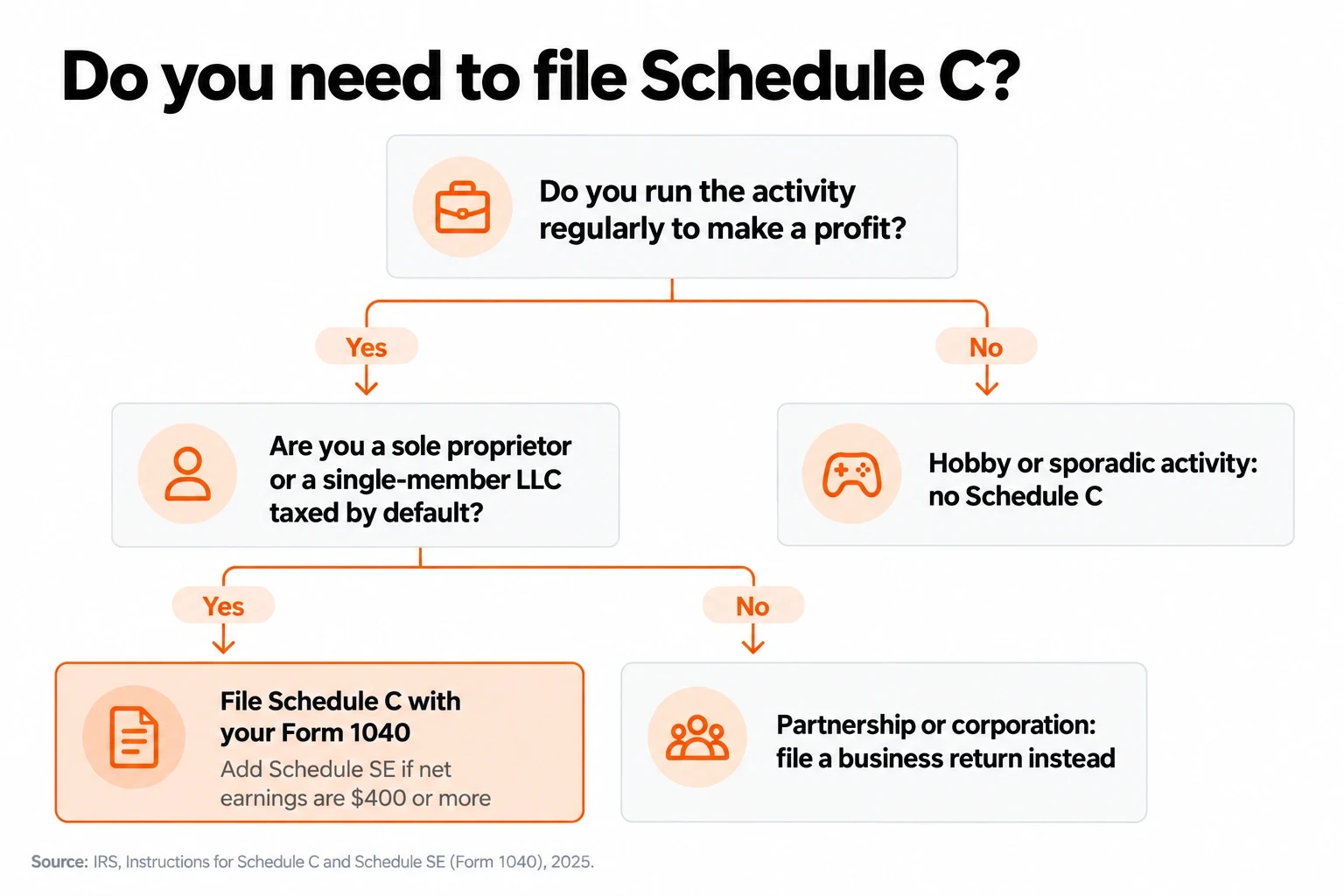
File Schedule C if you run an activity regularly to make a profit and you own it alone, either as a sole proprietor or as a single-member limited liability company (LLC) with default tax treatment. The IRS Schedule C instructions say an activity qualifies as a business when your primary purpose is income or profit and you are involved with continuity and regularity. A hobby or a one-time sale does not qualify.
What does Schedule C look like?
The 2025 Schedule C is a two-page form with five parts. Most small businesses fill in Part I and Part II, and add Part III if they sell products.
| Part | Lines | What you report |
|---|---|---|
| Part I, Income | 1 to 7 | Sales, returns, cost of goods sold and gross income |
| Part II, Expenses | 8 to 32 | Business costs, home office and net profit or loss |
| Part III, Cost of Goods Sold | 33 to 42 | Inventory, materials and labor for products you sold |
| Part IV, Vehicle | 43 to 47 | Miles and records when you claim car expenses without Form 4562 |
| Part V, Other Expenses | 48 | Costs with no line of their own, listed by type |
The top of the form asks for your business name, address, principal business code and accounting method. Pick the code from the list at the end of the instructions that best matches where most of your sales come from.
How do you fill out Schedule C, line by line?
Work from your records, not from memory: total your sales first, then match each cost to the line the IRS names for it. A clean business account makes this a one-hour job, which is why separating business and personal finances pays off at tax time.
- Line 1, gross receipts. Enter every dollar of sales for the year. Check your 1099 forms so nothing is missing.
- Line 2, returns and allowances. Enter refunds and credits you gave customers.
- Part III, cost of goods sold. Fill it in if you sell products. The total flows to line 4.
- Lines 8 to 27b, expenses. Put each cost on its line and list the rest in Part V, which totals on line 27b.
- Line 30, home office. Use the simplified method or Form 8829.
- Line 31, net profit or loss. Carry it to Schedule 1, line 3, and to Schedule SE, line 2.
These are the expense lines most small businesses use:
| Line | Expense | What to know |
|---|---|---|
| 8 | Advertising | Ads, flyers, business cards, sponsored posts |
| 9 | Car and truck | 70 cents per business mile for 2025, or actual costs |
| 10 | Commissions and fees | Card processing and payment app fees |
| 13 | Depreciation and section 179 | Attach Form 4562 for property placed in service in 2025 |
| 15 | Insurance | Business policies, other than health insurance |
| 18 | Office expense | Postage, printer ink, small office items |
| 20 | Rent or lease | Vehicles and equipment on line 20a, space on line 20b |
| 22 | Supplies | Items you use up in the business during the year |
| 24 | Travel and meals | Travel on line 24a, business meals on line 24b |
| 27b | Other expenses | Software, subscriptions and other costs listed in Part V, line 48 |
Two rules save money on equipment. The de minimis safe harbor lets you deduct tangible property up to $2,500 per item or invoice instead of depreciating it, if you make the election. And startup costs qualify for a deduction of up to $5,000 in your first year, reduced once total startup costs pass $50,000.
For the home office, the simplified method gives $5 per square foot for up to 300 square feet, so the deduction tops out at $1,500. For mileage, use the 2025 rate of 70 cents per mile on this return and the 2026 rate of 72.5 cents for miles you drive now.
What does a filled-out Schedule C look like? A worked example
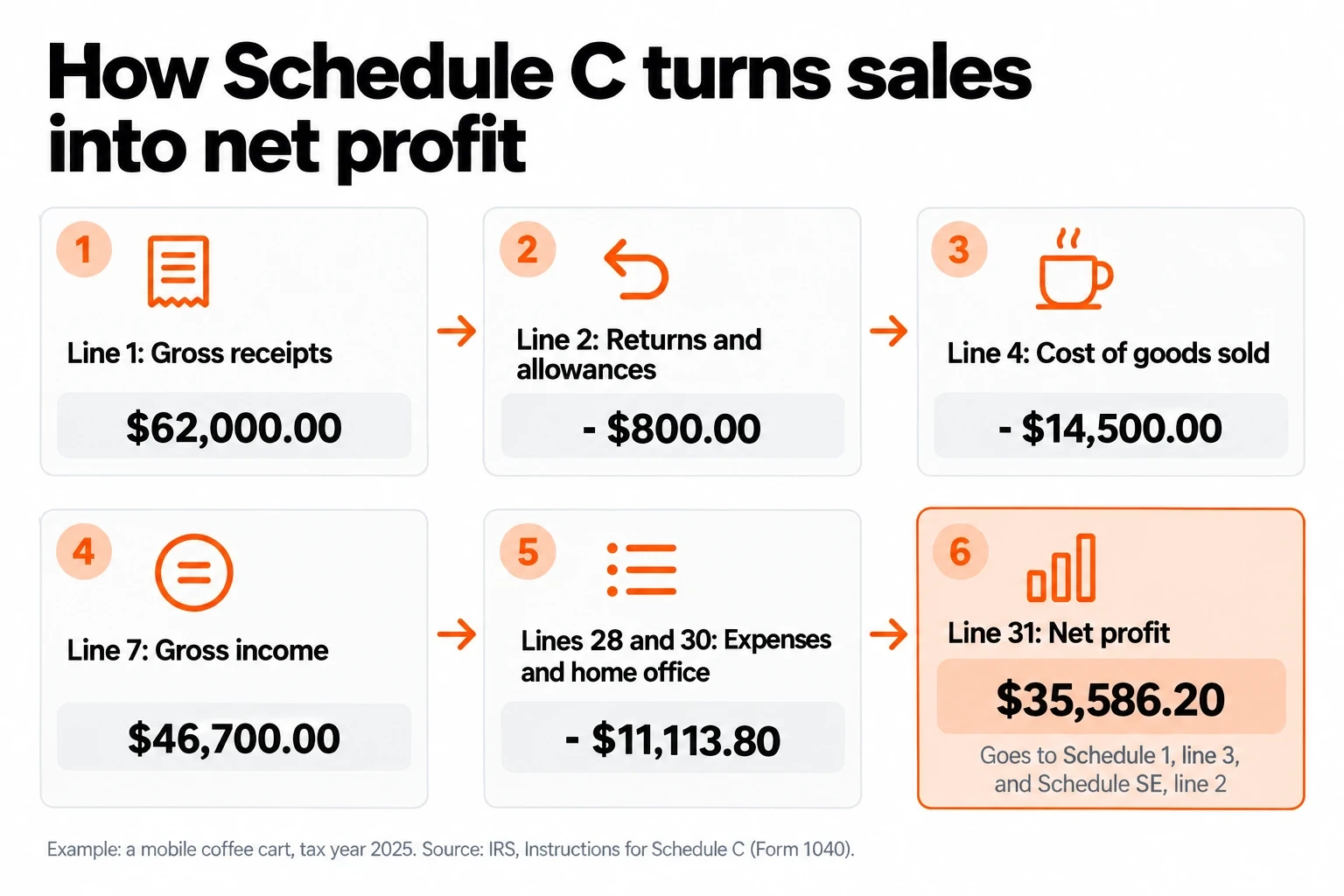
Suppose a mobile coffee cart sold $62,000.00 in 2025, all by card at the 1.99% JIM Tap to Pay rate. The owner refunded $800.00, spent $14,500.00 on beans, milk and cups, drove 6,000 business miles and uses a 150-square-foot home office for ordering and bookkeeping. The numbers are an example.
| Schedule C line | Amount |
|---|---|
| Line 1, gross receipts | $62,000.00 |
| Line 2, returns and allowances | -$800.00 |
| Line 4, cost of goods sold (beans, milk, cups) | -$14,500.00 |
| Line 7, gross income | $46,700.00 |
| Line 8, advertising (flyers, social ads) | -$900.00 |
| Line 9, car and truck (6,000 business miles at 70 cents) | -$4,200.00 |
| Line 10, commissions and fees (card fees at 1.99%) | -$1,233.80 |
| Line 15, insurance (cart liability) | -$1,100.00 |
| Line 18, office expense | -$350.00 |
| Line 22, supplies (cleaning, small tools) | -$2,100.00 |
| Line 27b, other expenses (point of sale software) | -$480.00 |
| Line 28, total expenses | -$10,363.80 |
| Line 30, home office (150 sq ft at $5) | -$750.00 |
| Line 31, net profit | $35,586.20 |
Net profit lands at $35,586.20, or 57.4% of sales. Notice line 10: the card fees of $1,233.80 are deductible, so report the full sales on line 1 and the fees on line 10 rather than netting them out.
How does Schedule C affect self-employment tax?
Your Schedule C profit sets your self-employment tax, which covers Social Security and Medicare for people who work for themselves. The IRS rate is 15.3%, split into 12.4% for Social Security and 2.9% for Medicare, and you owe it once net earnings reach $400.
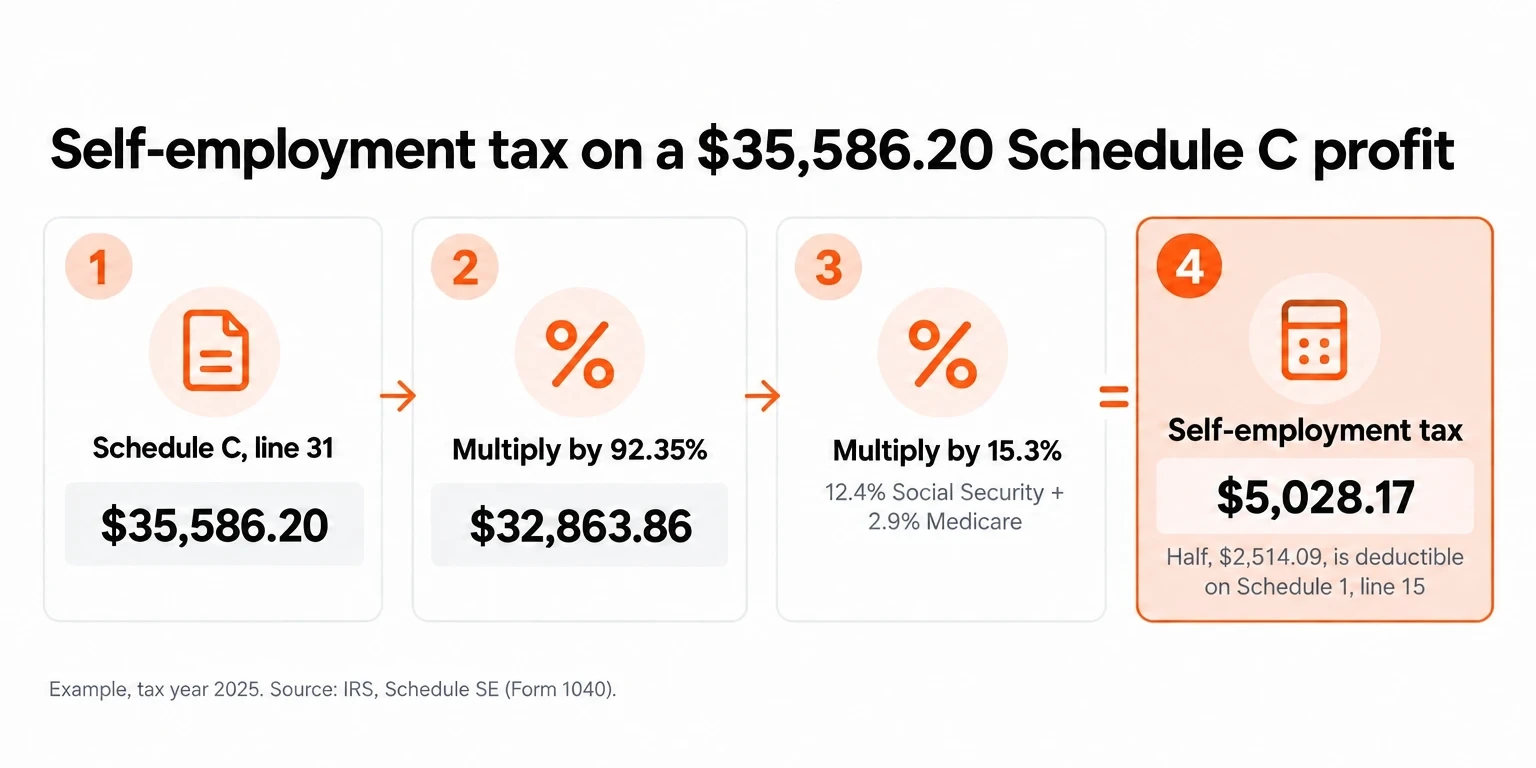
On Schedule SE, you multiply the profit by 92.35% before applying the rate. In the coffee cart example, that turns $35,586.20 into $32,863.86 and a self-employment tax of $5,028.17. You then deduct half, $2,514.09, on Schedule 1, line 15, which lowers your income tax but not the self-employment tax itself.
Two limits matter at higher profits. For 2025, the 12.4% Social Security part applies to the first $176,100 of combined wages and self-employment earnings, according to the Schedule SE instructions. An additional 0.9% Medicare tax starts above $200,000 for single filers and $250,000 for married couples filing jointly.
Where do Form 1099-K and 1099-NEC go on Schedule C?
Both go into line 1 as part of gross receipts, and the line 1 total should be at least what your 1099 forms show. Payment apps and online marketplaces send a Form 1099-K once you pass $20,000 in more than 200 transactions, but the IRS says you must report all business income whether or not a form arrives.
The 1099-K shows gross volume, so it does not subtract refunds or fees. JIM, for example, reports total gross payment volume and does not deduct full or partial refunds from it, according to the JIM tax report help article. Put those refunds on line 2 and the fees on line 10. The full walkthrough lives in 1099-K for payment app sellers.
When is Schedule C due?
Schedule C has no deadline of its own: it goes in with your Form 1040. For tax year 2025, that was April 15, 2026, or October 15, 2026, if you filed Form 4868 for an extension by April 15.
Self-employed people also pay estimated tax during the year, because no employer withholds it. If you expect to owe, Form 1040-ES sets the quarterly payments, and the side hustle guide covers how to set money aside from each sale.
What records do you need for Schedule C?
Keep proof for every line before you file: the IRS can ask for it, and a missing receipt turns a deduction into tax owed. Organize the year by the same lines the form uses.
In the coffee cart example, $1,233.80 in card fees and $800.00 in refunds sit between the 1099-K total and the real income. JIM charges 1.99% per Tap to Pay sale, delivers your annual Form 1099-K by January 31 and lets you export monthly statements from the app, so the numbers for lines 1, 2 and 10 are ready when you sit down to file.




Sell and get paid in seconds with Jim