Self-Employment Tax: How Much You Owe in 2026 and How to Pay It

Self-employment tax is the 15.3% Social Security and Medicare tax you pay on your own business profit, because no employer withholds it for you. You owe it once your net earnings reach $400, according to the IRS, and in 2026 the Social Security part stops at $184,500 of earnings, per the Social Security Administration.
It hits freelancers, gig workers, contractors and side hustlers who get a 1099 instead of a paycheck. Below you get who pays it, the 2026 limits, a calculation worked out in dollars, the deduction most people forget and the dates to pay it.
What is self-employment tax?
It is the self-employed version of the FICA taxes taken from a paycheck. An employee pays 7.65% and the employer pays another 7.65%. When you work for yourself, you are both, so you pay the full 15.3% on your profit.
The Social Security Administration also uses your Schedule SE to credit your earnings record, as IRS Topic 554 explains. Paying this tax is what builds your future benefits.
Who has to pay self-employment tax?
You pay it if you are in business for yourself and net $400 or more in the year. That covers:
- Sole proprietors and independent contractors, including people paid on a 1099-NEC.
- Owners of a single-member LLC that is disregarded for federal tax.
- Partners, including members of a multi-member LLC taxed as a partnership.
- Anyone else running a trade or business, full time or on the side.
Age does not matter. The IRS applies the tax even if you already collect Social Security or Medicare. If you are not sure whether you are self-employed or an employee, check the 1099 vs W2 breakdown first, and see LLC vs sole proprietorship for how your business structure changes the forms.
What is the self-employment tax rate for 2026?
The rate stays at 15.3%, but each part has its own limit. Only the Social Security cap moves each year with the national average wage.
| Part | Rate | 2026 limit | 2027 limit |
|---|---|---|---|
| Social Security | 12.4% | First $184,500 of earnings | First $192,300 of earnings |
| Medicare | 2.9% | No limit | No limit |
| Additional Medicare Tax | 0.9% | Above $200,000 single, $250,000 married filing jointly | Same thresholds |
The 0.9% Additional Medicare Tax applies to married people filing separately above $125,000, according to IRS Topic 554. You figure it on Form 8959.
How do you calculate self-employment tax?
Take your net profit, multiply by 92.35% and apply 15.3%. Here are the four steps on Schedule SE:
- Find your net profit: business income minus business expenses, from Schedule C.
- Multiply it by 92.35% to get your net earnings from self-employment.
- Apply 12.4% to that amount, up to the $184,500 cap for 2026.
- Apply 2.9% to the full amount, then add the two results.

Suppose a mobile dog groomer nets $60,000 in 2026. The numbers work out like this:
| Step | Amount |
|---|---|
| Net profit from Schedule C | $60,000.00 |
| Net earnings, times 92.35% | $55,410.00 |
| Social Security, 12.4% | $6,870.84 |
| Medicare, 2.9% | $1,606.89 |
| Self-employment tax | $8,477.73 |
| Half you deduct for income tax | $4,238.87 |
That is about $2,119 per quarter for self-employment tax alone, before any income tax. The Schedule C guide shows how to get the net profit number right in the first place.
What if you earn more than $184,500?
The Social Security part stops growing. Suppose a single consultant nets $250,000. Net earnings are $230,875. Social Security is capped at $22,878, which is 12.4% of $184,500. Medicare adds $6,695.38, for $29,573.38 in total. The 0.9% Additional Medicare Tax adds $277.88 on the $30,875 above $200,000.
What if you also have a W-2 job?
Your wages count toward the same $184,500 cap, according to the IRS. Suppose you earn $150,000 in wages and net $60,000 from a side business. Only $34,500 of room is left under the cap, so Social Security tax on the side income is $4,278, plus $1,606.89 of Medicare, for $5,884.89. Medicare always applies to the full amount.
How does the self-employment tax deduction work?
You deduct half of your self-employment tax when you figure your adjusted gross income, on Schedule 1 of Form 1040. The IRS calls it the employer-equivalent portion, because an employer would have paid that half for you.
In the dog groomer example, the deduction is $4,238.87. It lowers the income on which you pay income tax. It does not lower the self-employment tax itself, which stays at $8,477.73. Wage earners cannot deduct their share of FICA, so this is one of the few tax breaks that only the self-employed get.
How do you pay self-employment tax?
You report it once a year on Schedule SE with your Form 1040, and you pay it during the year through estimated taxes. The IRS estimated tax page says you generally need to make estimated payments if you expect to owe $1,000 or more when you file.
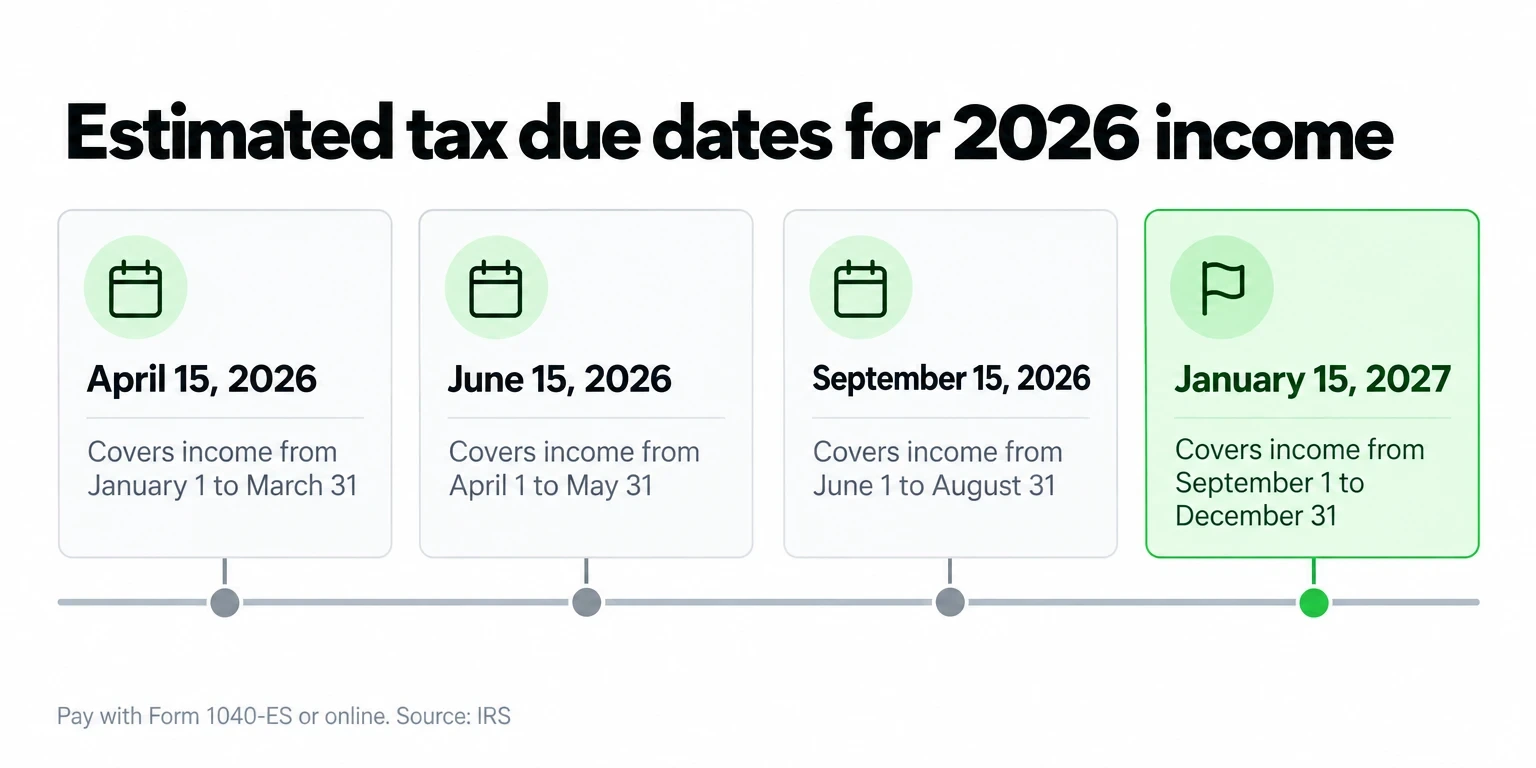
Use the worksheet in Form 1040-ES to size each payment, then pay online, by phone, through the IRS app or by mail. You can also pay weekly or monthly, as long as enough is paid by the end of each period. When a due date falls on a weekend or holiday, you have until the next business day.
To avoid the underpayment penalty, the IRS says most people need to pay at least 90% of this year's tax or 100% of last year's tax, whichever is smaller. Higher-income taxpayers have special rules in Publication 505.
How much should you set aside for self-employment tax?
Set aside at least 14.1% of your profit for self-employment tax, since 15.3% applied to 92.35% equals about 14.1%. Suppose you net $5,000 in a month. Move about $706 to a tax account right away.
Income tax comes on top. A common rule of thumb is to save 25% to 30% of profit to cover both, then adjust once you see last year's return. Keeping a separate account helps, and the guide to separate business and personal finances shows how to set that up.
What mistakes raise your self-employment tax bill?
| Mistake | What to do instead |
|---|---|
| Waiting until April to pay | Pay quarterly with Form 1040-ES to avoid the underpayment penalty |
| Skipping business expenses | Track every expense, because each dollar lowers net profit and both taxes |
| Forgetting the 50% deduction | Claim half of the tax on Schedule 1 of Form 1040 |
| Ignoring income without a 1099 | Report all business income, with or without a form |
| Counting a 1099-K and an invoice twice | Match card and app payments to your records and report each dollar once |
The 1099-K guide covers how card and app payments show up at tax time, and the side hustle guide covers taxes from the first sale.
How can JIM help you stay ahead of self-employment tax?
Saving 14.1% of profit is easier when you can see your sales as they happen. With JIM Tap to Pay, you accept contactless cards on your phone for a flat 1.99% per sale, and the money lands in seconds on your JIM Visa Prepaid Card. Before each estimated payment, ask JIM Agent "How much did I make in Q1?" and set the payment from a real number. In January, the JIM tax report puts every card payment you received on one Form 1099-K, ready for your Schedule C.




Sell and get paid in seconds with Jim