Profit and Loss Statement: Example, Template and Steps

A profit and loss statement, or P&L, shows how much money your business brought in, what it spent to earn that money and what was left as profit over a set period, usually a month, a quarter or a year.
The U.S. Securities and Exchange Commission calls this report the income statement and describes it as a set of stairs: sales at the top, a deduction at each step, and net profit or loss at the bottom. If you are a sole proprietor, the IRS already asks for a yearly version on Schedule C, Profit or Loss From Business.
Last reviewed October 2026. This article explains SEC, SBA and IRS guidance and is not tax or accounting advice.
What is a profit and loss statement?
A profit and loss statement is the report that answers one question: did your business make money in this period? Make one every month, even when sales feel steady, because a monthly P&L shows a rising cost while you still have time to change prices or cut it.
You will see three names for the same report: profit and loss statement, P&L and income statement. You read it, your tax preparer uses it for Schedule C, and a lender or landlord may ask for it before approving a loan or a lease.
What goes on a profit and loss statement?
Every P&L follows the same order, from the top line to the bottom line. Each subtotal tells you something different about the business:
| Line | What it includes | What it tells you |
|---|---|---|
| Gross sales | Every sale in the period, before refunds | How much demand you had |
| Returns and discounts | Refunds, comps and price cuts | How much of that demand you kept |
| Net revenue | Gross sales minus returns and discounts | The real top line |
| Cost of goods sold (COGS) | Ingredients, materials, packaging and inventory you sold | What each sale costs to produce |
| Gross profit | Net revenue minus COGS | Whether your prices cover your product |
| Operating expenses | Rent, payroll, card fees, insurance, marketing, software, depreciation | What it costs to keep the doors open |
| Operating income | Gross profit minus operating expenses | Profit from running the business |
| Other income and expenses | Loan interest, interest earned | The cost of money you borrowed |
| Net profit or loss | Operating income plus other income, minus other expenses | The bottom line |
Two lines trip up most owners. Card processing fees belong in operating expenses, not COGS, as the guide on cost of goods sold explains. Depreciation spreads the cost of a vehicle or equipment over the years you use it, so a $60,000 truck does not wipe out the month you bought it.
How do you make a profit and loss statement?
Make a profit and loss statement in 7 steps, in this order. A first month takes about an hour; after that, it takes minutes if you log expenses as they happen.
- Pick the period and the method. Start with last month and use the same accounting method as your tax return.
- Total your sales. Pull every sale for the period from your payment app, invoices and cash log. In the JIM app, ask JIM Agent "Show my statements" to see every sale with totals.
- Subtract returns and discounts to get net revenue.
- Add up cost of goods sold: what you paid for the products or ingredients you sold that month.
- List operating expenses by category. Use one line each for rent, payroll, fees, insurance, marketing, software and depreciation. The guide on how to track business expenses sets up the categories.
- Add other income and expenses, such as interest on a truck or equipment loan.
- Do the math and compare. Subtract down the page, then put last month in the next column to see what changed.
The job gets easier when business money lives in its own account. If sales and personal spending still share one card, start with separating business and personal finances.
What does a profit and loss statement look like?
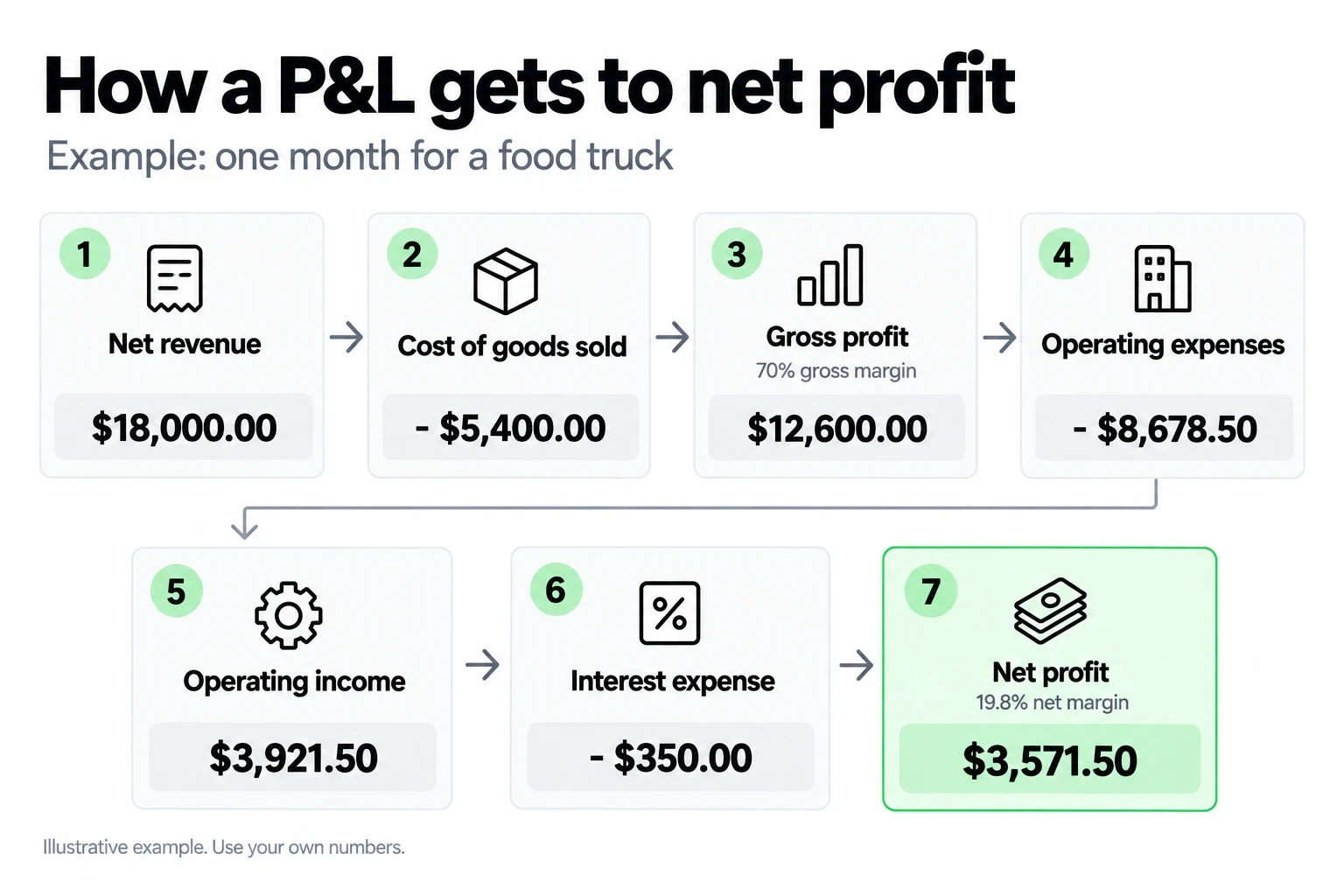
Suppose a food truck closes October with $18,400 in gross sales and $400 in refunds and comps. Here is its P&L for the month. The numbers are illustrative, not industry benchmarks.
| Food truck P&L, October | Amount | % of net revenue |
|---|---|---|
| Gross sales | $18,400.00 | |
| Returns and comps | -$400.00 | |
| Net revenue | $18,000.00 | 100.0% |
| Cost of goods sold (food, cups, packaging) | -$5,400.00 | 30.0% |
| Gross profit | $12,600.00 | 70.0% |
| Payroll (part-time helper) | -$4,800.00 | 26.7% |
| Commissary kitchen rent | -$1,200.00 | 6.7% |
| Depreciation (truck, $60,000 over 5 years) | -$1,000.00 | 5.6% |
| Fuel and propane | -$650.00 | 3.6% |
| Marketing | -$300.00 | 1.7% |
| Card processing (1.99% of $15,000 in card sales) | -$298.50 | 1.7% |
| Insurance | -$250.00 | 1.4% |
| Permits and licenses (monthly share) | -$100.00 | 0.6% |
| Phone and software | -$80.00 | 0.4% |
| Total operating expenses | -$8,678.50 | 48.2% |
| Operating income | $3,921.50 | 21.8% |
| Interest on truck loan | -$350.00 | 1.9% |
| Net profit | $3,571.50 | 19.8% |
Read it from the top. The truck keeps 70 cents of every revenue dollar after food costs, and payroll eats the biggest share of what is left. The owner's own pay is not on the list: in a sole proprietorship, what you take out is a draw, not a business expense.
Is there a simple profit and loss statement template?
Yes. Copy this layout into a spreadsheet, fill one column per month and add a third column for the change. Keep the line names the same every month so the comparison holds.
| Line | This month | Last month | Change |
|---|---|---|---|
| Gross sales | |||
| Returns and discounts | |||
| Net revenue | |||
| Cost of goods sold | |||
| Gross profit | |||
| Payroll | |||
| Rent | |||
| Card processing fees | |||
| Insurance | |||
| Marketing | |||
| Software and phone | |||
| Depreciation | |||
| Other operating expenses | |||
| Operating income | |||
| Interest and other expenses | |||
| Net profit or loss |
A P&L does not show when cash arrives. Pair it with the free cash flow spreadsheet template to track money in and out by date.
Should your P&L use the cash or accrual method?
Use the cash method if you sell services and carry no inventory; it is simpler and matches your bank balance. Switch to accrual when you sell on invoice terms or carry inventory, and keep whatever method your tax return uses.
IRS Publication 538 sets the rule. Under the cash method, you report income when you receive it and deduct expenses when you pay them. Under the accrual method, you report income when you earn it and expenses when you incur them, no matter when money moves.

The Small Business Administration uses a simple example: you make a $200 sale in January and get paid in February. Cash puts it on February's P&L; accrual puts it on January's. Publication 538 adds that a business that buys or sells merchandise generally must keep an inventory and use accrual for those sales and purchases, with exceptions for small business taxpayers. Ask your tax preparer whether that exception covers you.
How is a P&L different from a balance sheet and a cash flow statement?
A P&L tells you whether you made money over a period. A balance sheet shows what you own and owe on one date, and a cash flow statement shows whether cash came in. The SEC's guide puts it plainly: an income statement can tell you whether a company made a profit, while a cash flow statement tells you whether it generated cash.

| Report | Covers | Answers | Use it to |
|---|---|---|---|
| Profit and loss statement | A period, like a month | Did you make money? | Set prices and cut costs |
| Balance sheet | One date | What do you own and owe? | Track debt and equity |
| Cash flow statement | A period, like a month | Did cash come in? | Plan payroll and bills |
A business can show a profit and still run short of cash, for example when customers pay late or you prepay a big inventory order. Build the balance sheet next once your P&L is in place.
How do you read a profit and loss statement?
Read three percentages every month and act when one slips two months in a row. Each one divides a subtotal by net revenue:
Gross margin falling means your prices no longer cover your product, so reprice or renegotiate with suppliers. Operating margin falling with a steady gross margin points to overhead, so look at payroll and rent first.
Costs are the line to watch right now. In the Federal Reserve's 2026 Report on Employer Firms, rising costs of goods, services or wages was the most common financial challenge, and 77% of firms reported rising costs, tariff-related costs or both. A monthly P&L shows that pressure in your own numbers before it reaches the bottom line.
In the food truck example, card processing came to $298.50 on $15,000 in card sales, 1.7% of revenue, because Tap to Pay on JIM charges a flat 1.99% per sale with no monthly fee and no reader to buy. And when you build next month's P&L, ask JIM Agent "How much did I make in Q1?" to get the sales line from your real transactions in seconds.




Sell and get paid in seconds with Jim