Gross Revenue: What It Is, How to Calculate It and Gross vs. Net

Gross revenue is everything customers paid you for goods and services in a period, before returns, discounts, fees or costs come out. The IRS asks for it on line 1 of Schedule C, labeled gross receipts or sales.
Net revenue, gross profit and taxable profit all start from this line, so an error here spreads to every number below it.
What is gross revenue?
Gross revenue is your top line. It counts every sale at the price the customer paid, whether the money came in as cash, card, a payment link or a check. Nothing comes out yet: not the refund you gave on Tuesday, not the card fee, not the supplies you bought to make the product.
You will see it under other names. Accountants say gross sales, the IRS says gross receipts, and lenders write top line or gross annual revenue. All of them point to the same number.
How do you calculate gross revenue?
Add up every sale in the period. If you sell several products or services, multiply the units sold by the price of each one and add the results.
Gross revenue = units sold x price, for each product, added together
Suppose a home candle maker closes March with these sales (illustrative numbers): 180 candles at $28, 40 gift sets at $45 and 25 packs of wax melts at $8.
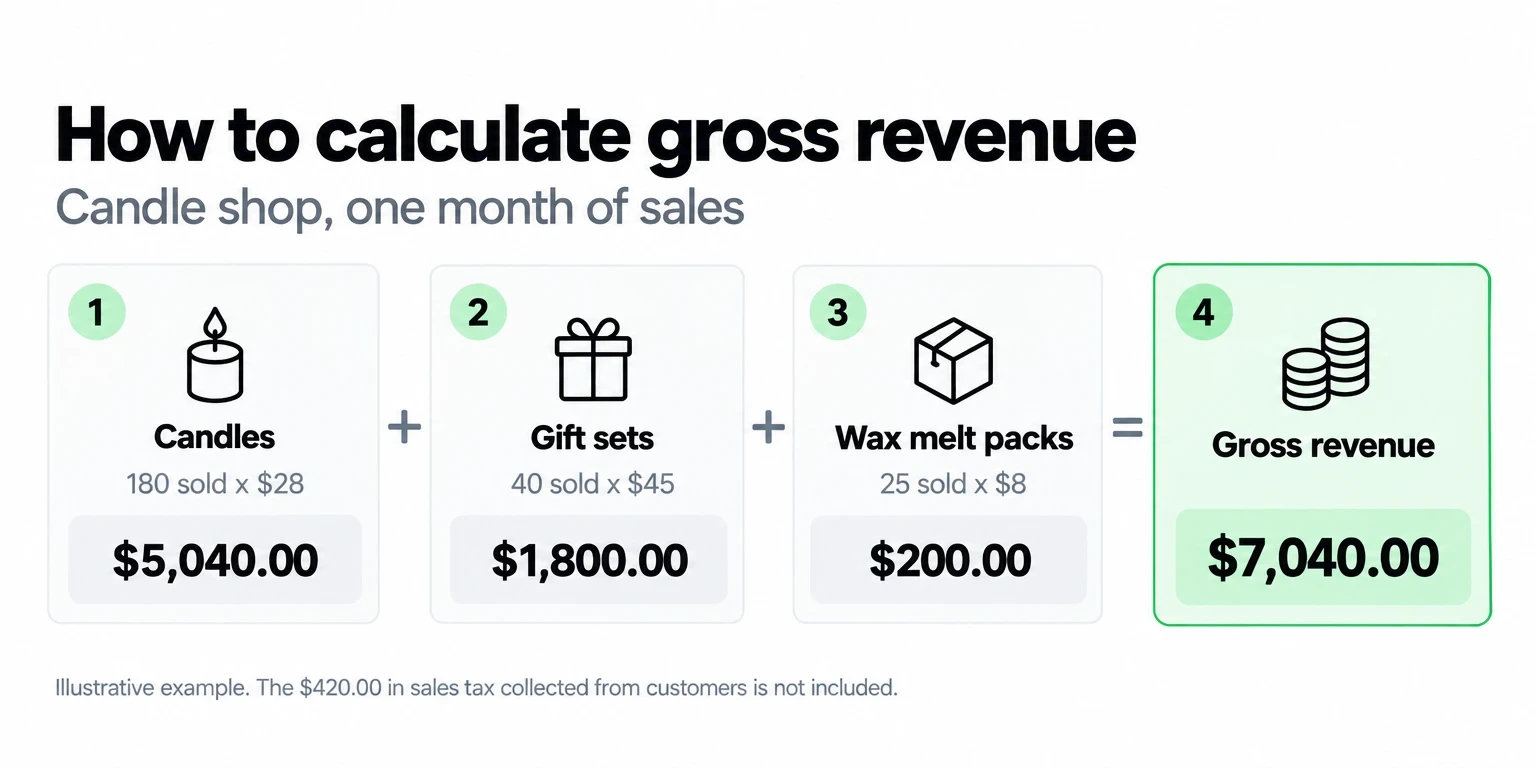
That makes $5,040 plus $1,800 plus $200, or $7,040 in gross revenue. Customers also paid $420 in sales tax at checkout, but that money belongs to the state, so it stays out of the total.
You don't need to rebuild this from receipts every month. If you sell with JIM, ask JIM Agent "Show my statements" to see every sale with totals, or ask "How much did I make this month?" for the figure itself. Add cash sales on top.
What counts as gross revenue and what doesn't?
Most mistakes come from mixing sales with other money that passes through your account. Run this list before you total a month.
| Money in | In gross revenue? | Why |
|---|---|---|
| Sales paid by cash, card, payment link or check | Yes | You earned it by selling goods or services. |
| Sales tax charged to the buyer and paid to the state | No | The IRS excludes it from gross receipts. |
| Sales tax the law places on you as the seller | Yes | Include it on line 1, then deduct it as a tax expense. |
| Refunds and discounts you gave | Not subtracted yet | They come out in the next step, net revenue. |
| Card processing fees | Not subtracted | They are an operating expense. |
| Loans and money you add from savings | No | Borrowed or invested money is not a sale. |
Both sales tax rules come from the IRS Instructions for Schedule C. Which one applies depends on your state law, so check whether your state taxes the buyer or the seller before you file.
What is the difference between gross revenue and net revenue?
Net revenue is gross revenue minus returns, allowances and discounts. It is the money customers kept paying for after refunds and price cuts.
Schedule C follows the same order. Line 1 holds gross receipts, line 2 holds returns and allowances, and line 3 is the difference. The IRS defines a sales allowance as a cut in the selling price given instead of a refund.
Back to the candle maker: four broken candles came back for $112 in refunds, and a discount code cost $168. Net revenue is $7,040 minus $280, or $6,760.
Track both, but run the business on net revenue. If refunds and discounts pass 5% of gross revenue in a month, fix product quality or your discount codes before you chase more sales. The candle maker sits at 4%, inside the line.
Is gross revenue the same as gross profit?
No. Gross profit is net revenue minus the cost of goods sold, the direct cost of what you sold. For the candle maker, wax, wicks, jars and fragrance for March cost $1,930, so gross profit is $6,760 minus $1,930, or $4,830.

Operating expenses come out next: $360 in market booth fees, $240 in packaging, $200 in ads, $45 in website and software, and $91.54 in card fees on $4,600 of Tap to Pay sales at a flat 1.99%. Net profit lands at $3,893.46.
Each measure answers a different question, so pick the one that fits the decision in front of you.
Where does gross revenue show up on your taxes?
If you are a sole proprietor or a single-member LLC, gross revenue goes on line 1 of Schedule C. The IRS instructions tell you to check every Form 1099 you received so line 1 includes the business income they report.
Form 1099-K is the one that trips sellers up. It reports the gross amount of your payment transactions, and the IRS 1099-K FAQ says that figure does not include adjustments for fees, credits, refunds, shipping, cash equivalents or discounts. You subtract those on your return, not on the form.
So start line 1 from the 1099-K total, add cash and any other sales it missed, and keep records for anything on it that was not a sale, like a friend paying you back for dinner.
JIM provides a Form 1099-K with all the payments you received during the year, available in your account by January 31. For the filing details, read the 1099-K guide for payment app sellers and the Schedule C walkthrough.
Why do lenders and the SBA ask for gross revenue?
Gross revenue is the fastest read on your size. The Small Business Administration, or SBA, uses average annual receipts to decide which businesses count as small, and most non-manufacturing businesses under $7.5 million in average annual receipts qualify, with exceptions by industry.
SBA receipts are not your raw top line. Federal rules (13 CFR 121.104) define receipts as all revenue reduced by returns and allowances, and they leave out sales taxes collected for and paid to a taxing authority.
Keep a 12-month table of gross revenue, returns and net revenue by month. Lenders, landlords and grant forms ask for gross annual revenue, and a monthly table answers in two minutes. Pair it with the free cash flow spreadsheet template to see when that money arrived.
How can you grow gross revenue without losing profit?
Gross revenue moves with three levers: how many customers buy, how often they come back and how much they spend each time. Pull the one with the best margin first.
In the candle example, $7,040 of gross revenue became $3,893.46 of net profit, and card fees took $91.54 of it at a flat 1.99% on Tap to Pay with JIM. Pull your own month from your statements, write the gross figure at the top and work down the same four lines.




Sell and get paid in seconds with Jim