Resale Certificate: What It Is and How to Get One

A resale certificate is a form you give your supplier so you can buy inventory you plan to resell without paying sales tax on it. The tax doesn't disappear. You collect it from your customer at the final sale and send it to the state.
Forty-five states charge a statewide sales tax, according to the Tax Foundation, and each one writes its own resale rules. Get the certificate right and your cash stays in inventory instead of prepaid tax.
What is a resale certificate?
Treat a resale certificate as proof, not a license. You fill it out, sign it and hand it to each supplier. The supplier files it to show the state why it didn't charge you tax, and the Texas Comptroller calls it "the seller's evidence" for that sale.
Any document can work as a certificate in California if it carries four elements set by Regulation 1668:
Is a resale certificate the same as a seller's permit?
No. The state issues the seller's permit, and you issue the resale certificate. Get the permit first, because its number goes on every certificate you send.
| Document | Who issues it | What it does |
|---|---|---|
| Seller's permit (sales tax permit) | Your state tax agency | Lets you sell taxable goods and requires you to collect sales tax |
| Resale certificate | You, on your state's form | Lets you buy inventory from suppliers without paying sales tax |
| Exemption certificate | A buyer with a non-resale reason | Covers exempt buyers such as nonprofits, government agencies or manufacturers |
Some states call the permit a "resale license" or "reseller's permit," which is where the mix-up starts. Texas is blunt about it: a copy of your permit is not a substitute for a resale certificate. If you're still setting up the business, the permit step is covered in how to start a retail business.
How does a resale certificate work?
A resale certificate moves sales tax from your purchase to your customer's purchase. The state still collects once, at the final sale.
Suppose a gift shop in a Texas city at the state's maximum combined rate of 8.25% buys $4,000 of mugs from a wholesaler. With a certificate on file, it pays no tax on the order and keeps $330 in cash. It prices with keystone, doubling the cost as shown in how to price a product, sells the mugs for $8,000 and collects $660 in tax from customers.
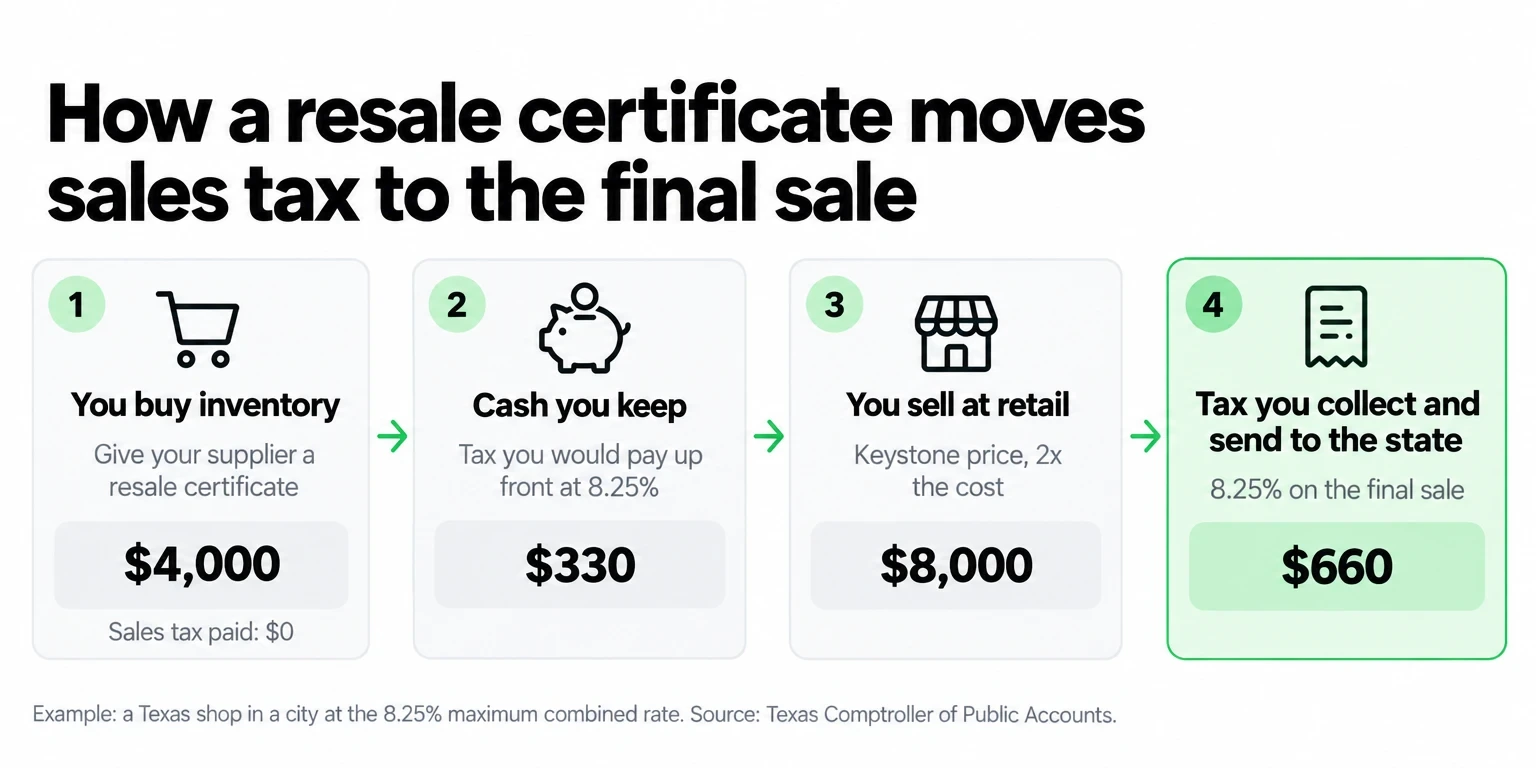
Skip the certificate and you prepay that $330, then claim it back later. California handles this with a deduction for tax-paid purchases resold before use, one more line to track on every return.
How do you get a resale certificate?
Register for a sales tax permit, then fill out your state's resale form for each supplier. Five steps cover it:
Which resale certificate form does your state use?
Use your state's own form with in-state suppliers and a multistate form when you buy across state lines. These are local examples, not nationwide rules, so confirm the current form with the tax agency for your address.
| State or system | Form | What to know |
|---|---|---|
| Texas | Form 01-339 | A blanket certificate works if you buy only for resale |
| California | CDTFA-230 | Stays in effect until you revoke it in writing |
| Florida | Form DR-13 | Issued when you register and expires every December 31 |
| Multistate | MTC Uniform Resale Certificate | Lists 38 states, latest revision October 14, 2022 |
| Streamlined states | SSTGB Form F0003 | Accepted by all 24 member states |
Alaska, Delaware, Montana, New Hampshire and Oregon have no statewide sales tax. Alaska is the exception that still allows local sales taxes, so a shop there checks with its city before buying tax-free.
What can you buy with a resale certificate?
Buy only items you will resell, or that become part of a product you sell. Everything you use to run the business stays taxable.
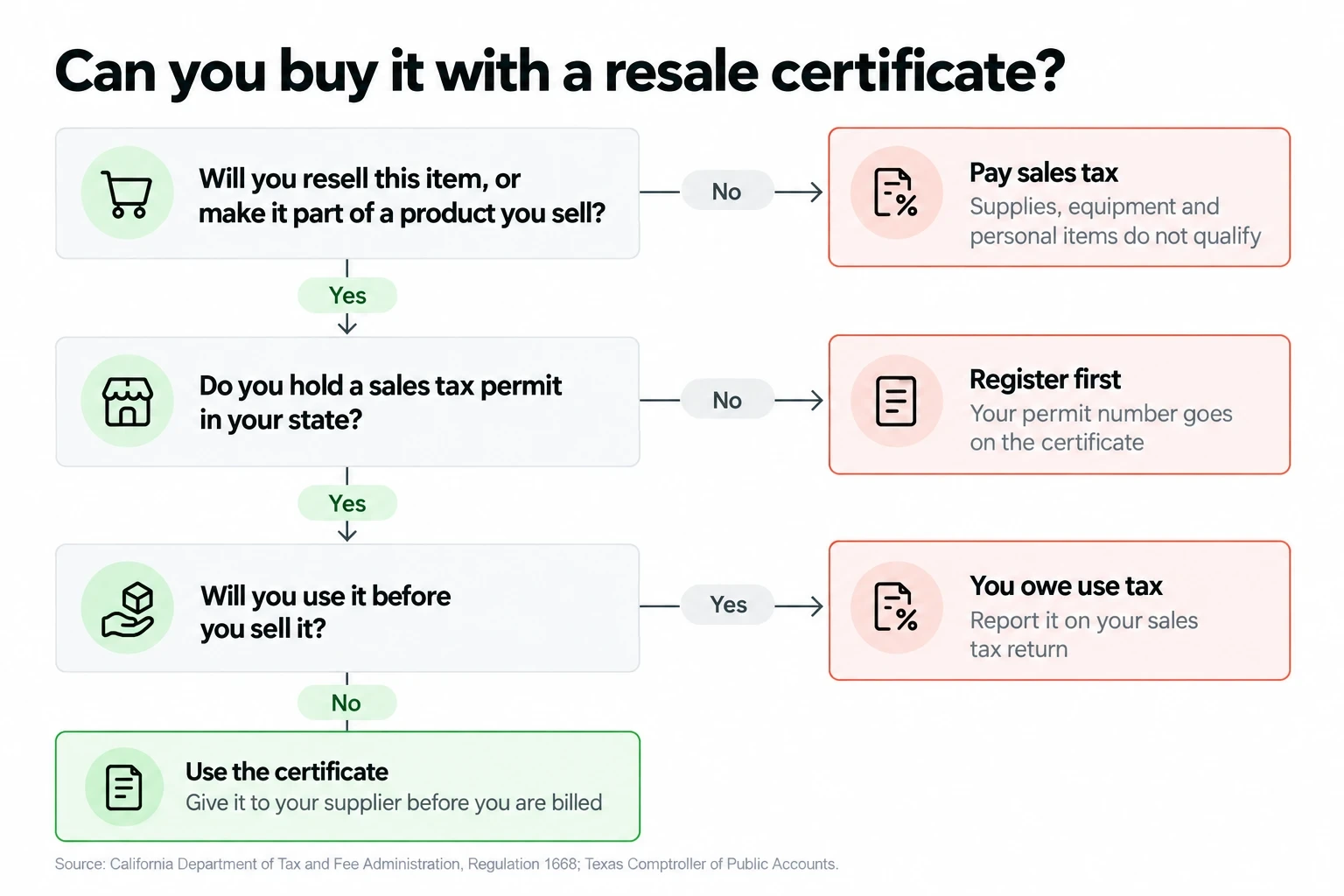
Sourcing from more than one channel? The clothing resale guide compares thrift, estate sales and wholesale pallets. Send your certificate to every wholesale supplier before the first order.
Does a resale certificate expire?
Some do and some don't, so refresh every supplier's certificate each January. That one habit covers the strictest rules below.
What happens if you misuse a resale certificate?
You pay the tax you skipped plus penalties, and in some states misuse is a crime. Suppose you use a California certificate to buy a $1,200 laptop for your office. At the 7.25% statewide rate you owe $87 in tax plus a penalty of 10% of the tax or $500, whichever is greater, per Regulation 1668. That single purchase costs $587.
Texas treats misuse as a criminal offense at every amount, scaled to the tax evaded:
| Tax evaded | Offense in Texas |
|---|---|
| Less than $20 | Class C misdemeanor |
| $20 to less than $200 | Class B misdemeanor |
| $200 to less than $750 | Class A misdemeanor |
| $750 to less than $20,000 | Third-degree felony |
| $20,000 or more | Second-degree felony |
Source: Texas Comptroller of Public Accounts, Resale Certificates FAQ.
What should you check when a customer gives you a resale certificate?
If you sell wholesale, check every certificate before you drop the tax. In California, a seller who takes a valid certificate in good faith and on time doesn't owe tax on that sale.
Selling at markets as well? The street vendor license guide lists the local permits that sit alongside your sales tax registration.
How do you charge sales tax when you resell?
Add sales tax to every taxable sale at checkout, because that's the moment the certificate pays off. In the gift shop example, $330 that stayed in the bank turns into $660 you collect from customers and send to the state.
In JIM, tap Add sales tax on the Current sale and confirm the new total before you charge. Tap to Pay costs 1.99% per sale with no monthly fee, and the money lands in your JIM balance in seconds, so the tax you owe is there when your return is due.




Sell and get paid in seconds with Jim