Freelancer Payment Methods: Get Paid Faster in 2026

See article summary
- Bank transfer (ACH), digital platforms, invoicing software, marketplaces, in-person tap-to-pay, and checks are the six main freelancer payment methods.
- On a $3,000 invoice, ACH costs $0 to $3, digital platforms cost $87.30, and JIM Tap to Pay costs $59.70.
- Request a 25% to 50% deposit upfront and use contracts with clear payment terms and due dates to reduce nonpayment risk.
- Set aside 25% to 30% of income for taxes, covering 15.3% self-employment tax plus federal and state income tax.
- Quarterly estimated taxes are due April 15, June 15, September 15, and January 15.
Your rent is due next week, but the $3,000 invoice you sent two weeks ago sits unpaid. The client promised to "get to it soon." Getting paid as a freelancer is the lifeblood of your solo business, and late payments create real consequences: missed bills, mounting stress, and hours spent chasing money instead of earning it.
The right freelancer payment setup protects your income and gets money into your bank account faster. With one in four U.S. knowledge workers now freelancing and contributing $1.5 trillion to the economy in 2024, getting paid reliably is the lifeblood of your solo business. Getting this right means predictable income; getting it wrong means chasing clients and stressing over rent.
How Do Freelancers Get Paid?
Freelancers collect payment through six main methods: bank transfer (ACH), digital payment platforms, invoicing software with built-in gateways, freelance marketplaces, in-person tap-to-pay, and paper checks. The right mix depends on your work type and client relationship. A common freelance payment structure pairs each method with a pricing model that protects your income and matches client expectations.
| Payment Structure | How It Works | Best For |
|---|---|---|
| Hourly rate | Charge per hour worked | Projects with undefined scope |
| Project fee | Fixed price for deliverable | Clear scope, one-time projects |
| Retainer | Monthly fee for set availability | Recurring client relationships |
| Milestone payments | Paid in stages as work progresses | Large, multi-phase projects |
| Per-word/per-page | Rate based on output volume | Writers, editors, translators |
Project fees work well for a clear scope. Retainers suit recurring client relationships. Milestone payments reduce risk on larger projects by collecting at agreed checkpoints. On a $3,000 project, milestone payments split into three $1,000 stages mean you never carry more than a third of the risk at once, compared to billing the full amount at delivery.
Request a 25% to 50% deposit upfront to reduce nonpayment risk. When you send an invoice, include clear payment terms and due dates.
Freelancer Payment Methods
The payment method you choose affects how quickly you access funds, what transaction fees you pay, and how convenient payment processing is for your clients. Most freelancers use a mix of two or three methods to cover different client types and project sizes.
Here is how the most common freelancer payment methods compare on fees and settlement time. On a $3,000 invoice, the cost difference between the cheapest and priciest method can exceed $600.
| Method | Typical Fees | Settlement Time |
|---|---|---|
| Bank transfer (ACH) | $0-$3 | 1-3 business days |
| Digital platforms | 2.9% + $0.30 | 1-3 business days |
| Tap to Pay (JIM) | 1.99% | Instant |
| Freelance marketplace | 5-20% | Varies |
| Check | $0 | 5-7 days to clear |
Bank transfers (ACH/wire)
Bank transfers remain the most straightforward option for direct deposits to your bank account. With ACH transfers, clients send money directly from their bank to yours using your routing and account numbers. Wire transfers work similarly but process faster for urgent or large payments. Both methods keep fees minimal compared to card-based options.
- Direct deposit to your local bank account via ACH or wire transfers
- Low fees with slower processing time (1-3 business days)
- Best for: domestic clients, large payments where you share bank details directly
Digital wallets and payment platforms
Digital platforms simplify remote and international payments through online transfers, offering a streamlined payment solution for freelance work. These services handle currency conversion automatically when working with international clients paying in foreign currency. Most digital wallets and payment platforms also provide invoicing features and transaction records that simplify your accounting at tax time.
For international work, the FX markup matters as much as the transfer fee. Mainstream payment platforms add a 3% to 4% markup on currency conversion, while specialist transfer services charge closer to 0.5% above the mid-market rate. On a $2,000 international payment, that difference is roughly $70 in hidden FX cost.
- Popular options for online transfers and international transactions
- Fees typically 2.9% + fixed fee; handle multi-currency and currency conversion
- Best for: remote clients, international payments with USD or foreign currency
Invoicing software with payment gateways
Invoicing tools with built-in payment processing let clients pay directly from your invoice using their credit card or debit card. When a client receives your invoice, they click a payment link and complete the transaction without leaving the document. Many of these tools integrate with accounting software to automate bookkeeping and send payment reminders automatically.
- Send invoice, client pays directly via integrated payment gateway
- Streamlines billing through accounting software integrations
- Best for: volume invoicing, automating payment collection for your small business
Freelance marketplaces
Platform-based freelance work comes with built-in payment handling through an escrow system. The client deposits funds before work begins, and the platform releases payment once you deliver. This protects both parties from nonpayment and scope disputes, though the convenience comes with platform fees that cut into your earnings.
- Platform handles payment through escrow system
- Takes platform fee (5-20%); protects both parties
- Best for: new freelancers building reputation, finding new clients
In-person payments
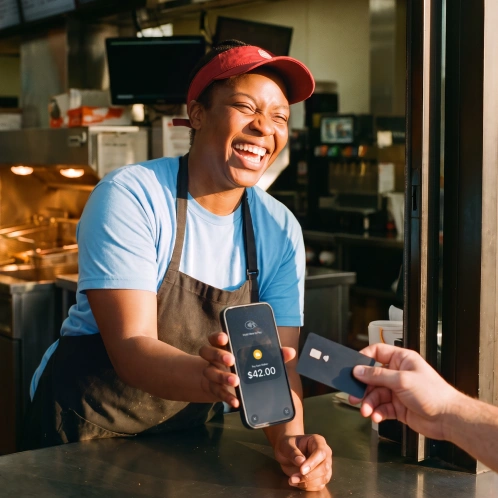
Face-to-face freelance work lets you collect payment immediately at the point of service. Whether you tutor students, photograph events, or consult on-site, accepting in-person payment options eliminates the invoice-and-wait cycle entirely. Mobile payment options now make it easy to accept credit card and debit card payments anywhere without carrying cash.
- Collect at client sites via tap to pay, card readers, or cash
- Immediate payment with no waiting
- Best for: tutors, photographers, consultants, independent contractors
Checks
Some corporate clients still prefer paper checks through their existing payment system. Large companies often have established accounts payable processes that default to check payments on set schedules. While checks are declining in popularity, refusing them could mean losing corporate clients with rigid accounting policies.
- Still used by corporate clients with legacy accounting
- Slow to clear (5 to 7 days); declining in popularity
- Best for: clients who require it for their payment system
How Do You Choose the Right Payment Method as a Freelancer?
Your best payment method depends on your client base, project size, and cash flow needs. Consider these factors when deciding which payment options to offer for your freelance business.
- Client location: Domestic clients can pay via ACH with minimal fees. International payments often require payment platforms that handle currency conversion and exchange rates for international transactions.
- Payment size: A 2.9% fee on a $5,000 project is $145. For larger payments, bank transfers or wire transfers with lower fees make more sense as a cost-effective payment solution.
- Payment frequency: Recurring clients may prefer automatic billing through payment gateways or invoicing software with APIs. One-time fixed-price projects might not justify the setup.
- Speed needs: If you need money immediately, an instant settlement beats waiting three business days of processing time.
- Client preferences: Some corporate clients only pay via ACH or check through their accounting system. Accommodating their payment service, even if slower, keeps the relationship smooth.
- Your small business type: Service providers who meet clients in person can accept credit card payments directly on their iPhone with JIM, collecting credit card and debit card payments at a flat 1.99% fee with instant payouts and access to funds.
If your project is over $3,000 and domestic, use ACH. If you are working in person with the client present, use Tap to Pay. If the client is international, use a specialist transfer service with low FX markup rather than a mainstream payment platform.
How to Get Paid Faster as a Freelancer
Late payments drain your energy and disrupt planning. These practices help you collect on time and protect your freelance business from cash flow problems.
- Start with a contract that spells out payment terms, due dates, and late fees before any work begins. Request a deposit of 25% to 50% upfront so you're protected if the client disappears mid-project.
- Once you deliver, invoice immediately while the work is fresh in the client's mind. Set specific due dates like Net 15 or Net 30 rather than vague terms like "due upon receipt," which clients tend to interpret loosely.
- Make payment as easy as possible by accepting multiple methods: bank transfers, card payments, and digital wallets. When invoices go overdue, let your invoicing tools send automated reminders so you don't have to chase clients manually.
Tip: Charge late fees of 1.5% to 2% monthly on overdue invoices, but check your state's usury cap first. State interest rate limits vary widely, from 6% annually in states like Maryland to 18% or higher in states like Texas and Florida. Include the late fee clause in your contract so clients understand the consequences. Tracking business expenses alongside income helps you see the full financial picture.
What to Do When a Client Will Not Pay
When reminders fail, escalate in this order. Send a formal demand letter citing your contract, invoice, and late fee terms. If the amount is under your state's small claims limit, typically $5,000 to $10,000, file in small claims court without a lawyer. For larger unpaid balances, a collections agency can pursue payment, usually for 25% to 50% of the recovered amount. Document every step, since written records strengthen your case.
What Taxes Do Freelancers Pay?
Freelancers handle their own taxes, setting aside money throughout the year. The IRS treats freelance income as self-employment.
You pay self-employment tax at 15.3%, covering Social Security (12.4%) and Medicare (2.9%). This is in addition to regular federal income tax on your net earnings.
Quarterly estimated tax payments are due April 15, June 15, September 15, and January 15. Missing these deadlines triggers penalties and interest. Source: IRS estimated tax due dates.
| Tax Type | Rate |
|---|---|
| Self-employment tax | 15.3% |
| Federal income tax | 10-37% (varies by bracket) |
| State income tax | Varies by state |
Track all business expenses to reduce taxable income. Equipment, software, home office costs, and professional development all count. Set aside 25% to 30% of income for taxes to cover the 15.3% self-employment tax plus your effective federal bracket and any state income tax. Consult a tax professional for guidance specific to your situation.
1099-NEC and 1099-K: What Freelancers Need to Know
Clients who pay you $600 or more in a calendar year send you Form 1099-NEC by January 31. Payment platforms and marketplaces send Form 1099-K when your transactions exceed the IRS reporting threshold. Under the One Big Beautiful Bill, the 1099-K threshold reverted to $20,000 in gross payments and 200 transactions for the 2025 tax year. Source: IRS Form 1099-K. You report all freelance income on your tax return regardless of whether you receive a form.
Take Control of Your Freelancer Payments
Getting paid reliably requires the right payment methods, clear terms, and prompt invoicing. Protect yourself with contracts and deposits, and follow up consistently on overdue invoices.
If you work with clients in person, JIM offers a simple way to accept card payments, just tap and collect. At 1.99% with instant payouts to your JIM Visa® Prepaid Card, you skip the settlement delays that slow down your cash flow. On a $3,000 payment, that means funds in your balance immediately rather than waiting three business days for an ACH transfer.
Frequently Asked Questions
What is the fastest way to get paid as a freelancer?
Do I get a 1099-K for freelance payments?
How do I handle clients who will not pay?
What are the cheapest freelancer payment methods?
How do international payment fees work?



Sell and get paid in seconds with Jim