Payment Links for Business: A Small Business Guide

See article summary
- A payment link is a shareable URL that sends customers to a secure payment page to complete a transaction.
- Create a link in your provider's app, share it by text or email, and the customer pays online in minutes.
- Payment links work without a website, card reader, or POS system, making them ideal for mobile and service businesses.
- Compare providers on transaction fees, payout speed, and integrations with your existing tools before choosing.
- JIM offers Payment Link at 4.99% plus $0.30 per sale with instant payouts and no monthly fees.
A payment link is a shareable URL that sends customers to a secure payment page where they complete a transaction with a card or digital wallet. No shopping cart, no checkout page integration, no physical terminal required.
You finished a landscaping consultation across town, and the homeowner asks, "Can you just send me a link to pay?" They don't want to write a check. They don't want to wait for an invoice to arrive in their inbox. They want to tap a button on their phone and be done with it.
Every unsent invoice is a delayed payment. Every check in the mail is money you can't use today. Every no-show without a deposit is revenue lost. Payment links solve these problems by letting you accept payments anywhere, anytime, without building an ecommerce site or hauling around card readers.
What Is a Payment Link for Business?
A payment link is a shareable URL that directs customers to a secure payment page where they can complete a transaction. No shopping cart, no checkout page integration, no physical terminal required.
Think of it as a digital "pay here" sign you can send through any channel. A home repair contractor finishes an estimate and texts the client a payment link for the deposit. A food truck owner posts a link on Instagram for customers to pre-order weekend specials. A tutor emails parents a link after each session.
Payment links bridge the gap between in-person sales and full ecommerce setups. You don't need a website with integrated checkout, and you don't need to be standing next to your customer. The link handles everything, and with solutions like JIM, funds land in your account instantly after the customer pays.
How Do Payment Links Work?
A payment link moves through five steps from creation to payout. The process is straightforward, even if the technology running it is sophisticated.
- Create the link. Open your payment provider's app, enter the amount and description, then generate a unique URL.
- Share the link. Send it via text message, email, WhatsApp, or social media. You can also generate a QR code to embed on printed materials or display at your point of sale.
- Customer pays. Your customer clicks the link, lands on a secure payment page, enters their payment details (credit card, debit card, Apple Pay, or Google Pay), and submits payment.
- Authorization and fraud prevention. The payment gateway handles authorization and fraud checks, including 3D Secure verification for online transactions.
- Payout. Funds move toward your bank account or prepaid card according to your provider's settlement schedule. With instant-payout providers, funds are available immediately.
How Do You Create a Payment Link?
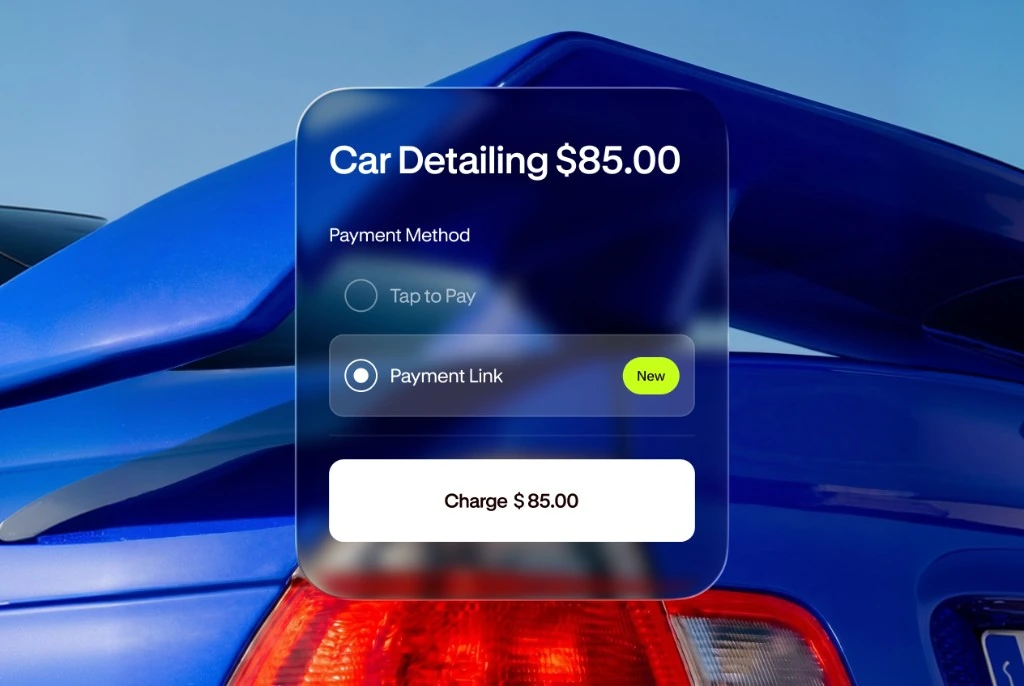
You create a payment link by entering a sale amount in your provider's app and choosing the Payment Link option instead of an in-person sale. The exact steps vary by app, but the flow is consistent. Using JIM as an example:
- Open the app and enter the sale amount in US dollars (minimum $1).
- On the sale review screen, choose Payment Link instead of Tap to Pay.
- Adjust your settings, including who pays the processing fee (you or the customer).
- Review the final amount the customer pays and what you receive.
- Tap Charge to create the link.
- Copy the link or send it directly through SMS, email, or any messaging app.
Your customer opens the link, completes payment on a secure page showing your business name and the sale amount, and both parties receive an email confirmation. No website, no checkout page, no card reader.
Benefits of Using Payment Links for Business
Payment links streamline how you collect payments and improve cash flow. Whether you're working remotely, managing multiple locations, or running a mobile business, payment links give you flexibility that traditional payment methods can't match.
Here's how payment links make running your business easier:
- Get paid faster. Customers can pay within minutes of receiving your link, compared to days or weeks waiting for mailed checks or unpaid invoices. PYMNTS reports that 57% of invoices are paid late and 33% take over 90 days to settle, so offering a fast payment route directly protects your cash flow.
- Reduce no-shows. Require deposits through payment links when customers book appointments. Salons, gyms, consultants, and service businesses use this tactic to protect their time and revenue.
- Accept payments anywhere. Whether you're at a job site, traveling, or simply not near your POS system, payment links let you close the sale from any location.
- Skip the website build. You don't need an ecommerce platform or checkout page to start accepting online payments. Payment links work independently.
- Automate your workflow. Most payment link providers offer real-time notifications and dashboards to track transactions, send payment requests, and monitor your business activity from smartphones or computers.
Common Use Cases for Payment Links
Service providers, appointment-based businesses, social sellers, event organizers, pop-up shops, and subscription businesses all use payment links to collect money without standing next to the customer.
Here are the most common ways businesses use payment links, with practical examples:
- Service providers and freelancers send links after completing work or when requesting deposits for upcoming projects. A freelance designer might email a link for the final 50% of a project balance the day they deliver files.
- Appointment-based businesses like salons, gyms, and medical offices secure bookings and reduce no-shows with upfront payment collection. A salon could require a $25 deposit link at booking to hold a Saturday appointment.
- Social sellers share pay links directly in DMs on Instagram, Facebook, and other platforms without redirecting customers to external sites.
- Event organizers sell tickets and collect registrations without building dedicated checkout pages or event management platforms.
- Pop-up shops and market vendors accept payments before customers arrive for pickup, streamlining busy service windows.
- Subscription-based businesses use reusable links that customers can save for recurring payments each billing cycle.
What Types of Payment Link Solutions Exist?
Payment link solutions fall into five main categories, from standalone apps to all-in-one business platforms. Some focus exclusively on links, while others bundle them into broader payment platforms. Understanding the differences helps you choose the right fit for your business.
Here are the main types of payment link solutions:
- Standalone payment link apps focus specifically on creating and sharing pay links with minimal setup and streamlined interfaces.
- Full-service payment processors include payment link features within broader payment gateway services that handle multiple payment methods.
- Bank-provided payment links let customers pay directly to your bank account through bank transfers, though these often lack flexibility and customization options.
- All-in-one business apps combine payment links with POS functionality, invoicing, and mobile payment acceptance in a single platform. JIM falls into this category, offering both Payment Link for remote sales and Tap to Pay for in-person acceptance.
- Free payment link options exist, though they typically come with higher per-transaction fees or limited features compared to paid solutions.
Evaluate total cost based on your expected transaction volume and how the solution fits your complete payment workflow. The cheapest upfront option isn't always the most cost-effective once you factor in transaction fees and feature limitations.
Are There Free Payment Link Options?
"Free" payment link tools rarely stay free once you process a transaction. Most providers that advertise no monthly fee still charge a percentage plus a fixed fee per sale. The real question is whether the per-transaction cost fits your volume.
For low-volume businesses, a flat-rate provider with no monthly fee usually delivers the best value. You avoid setup costs, monthly minimums, and PCI compliance charges, and you only pay when you make a sale. As your volume grows, compare your effective rate against interchange-plus pricing to see if a different model saves money.
The deciding criterion is simple: if you process fewer than about $5,000 per month in card sales, a flat-rate payment link app with no monthly fee keeps your costs predictable. Above that, interchange-plus pricing may deliver a lower effective rate.
Understanding Payment Link Fees
When customers pay through a payment link, someone pays the cost of payment processing. Understanding what you actually pay helps you protect margins without confusing buyers.
Payment processors charge fees in different ways. Flat rate pricing bundles all fees into one simple percentage, like 2.9% plus 30 cents. This model offers complete transparency because you know exactly what each online transaction costs. Percentage plus fixed fee pricing is common with mobile payment providers. Interchange-plus pricing separates the card network's base cost from the processor's markup, which can offer lower rates for high-volume businesses.
Small businesses in the U.S. typically pay between 2.9% and 4.2% per transaction when processing credit cards. A 3% fee sits near the middle of what most small businesses pay. The average credit card processing fee across Visa and Mastercard transactions was 2.35% in 2024, according to the Merchants Payments Coalition.
The advertised transaction rate rarely tells the full story. Traditional merchant account setups often layer on monthly account fees, setup fees, PCI compliance fees, batch settlement fees, chargeback fees, early termination fees, and payout delays before you process a single transaction. Flat-rate providers eliminate most of those hidden costs.
To estimate your true cost, add up one month of processing statements, including all credit card processing fees, then divide that total by your gross card sales for the month. The result is your effective rate, the number that matters when comparing pricing across providers.
Can I Charge a Processing Fee to a Customer?
Passing processing fees to customers through surcharging is legal in most states, but comes with strict rules. As of 2025, credit card surcharging is prohibited in Connecticut, Maine, and Massachusetts.
California banned surcharges as separate line items starting July 2024 under SB 478, though restaurants are exempt. Colorado caps surcharges at 2%. New York requires displaying the total price, including any surcharge, upfront. Most other states permit surcharging as long as the fee is clearly disclosed and does not exceed 4%. Source: California Attorney General.
Visa and Mastercard require merchants to notify the card network and their acquirer in writing at least 30 days before surcharging, disclose fees clearly to customers, cap surcharges at 3% (Visa) or 4% (Mastercard), and itemize them separately on receipts. Surcharges cannot be applied to debit card transactions. Source: Mastercard merchant surcharge rules.
Because these laws change frequently, consult your state attorney general's office before implementing surcharges. Many businesses prefer building fees into their pricing rather than adding a line item at checkout, which creates a cleaner payment experience and avoids compliance complexity.
How Secure Are Payment Links?
Legitimate payment link providers protect customer data through encryption, tokenization, and PCI DSS compliance. According to the PCI Security Standards Council, businesses that accept card payments must maintain secure environments to protect cardholder data across transmission, processing, and storage.
When customers click your payment link, they land on a secure checkout page hosted by the payment processor. Many providers add 3D Secure verification, which asks the customer's bank to confirm identity through a one-time code or biometric check before the payment goes through. Build trust by using consistent branding with your business name, writing clear payment descriptions, and sending automatic receipts after each transaction.
How Do Payment Links Compare to Other Payment Methods?
Payment links complement rather than replace other payment options. The right method depends on what you're selling and how your customer wants to pay.
| Method | Best for | Setup | Speed | Typical fees |
|---|---|---|---|---|
| Payment links | One-off remote sales, deposits, service invoices | No website or hardware needed | Customer pays in minutes; instant payout with some providers | Flat rate per transaction |
| Invoices | Detailed line items, formal B2B documentation | Invoicing software or template | Days to weeks unless paid by card | Flat rate or monthly software fee |
| Full ecommerce checkout | Multiple products through an online store | Website with integrated checkout | Customer pays online; 1 to 3 day settlement | Flat rate plus monthly platform fee |
| In-person POS | Counter sales, high-volume retail | Terminal or card reader | Seconds at checkout | Flat rate or interchange-plus |
For businesses that need both payment links and in-person flexibility, understanding how to accept credit card payments across all channels helps you build a complete payment strategy. Modern payment solutions let you optimize your payment collection by combining custom payment links with in-person terminals and mobile POS systems.
How Should You Share Payment Links?
How you share payment links affects conversion rates. SMS works well for quick invoices and appointments. Email feels more professional for larger amounts and B2B transactions. Social media DMs suit social selling. QR codes work for printed materials and signage. WhatsApp serves international customers and provides mobile-first communication.
Consider creating custom payment links for different customer segments or transaction types. Some providers let you embed payment links in email signatures, websites, or automated payment requests to streamline your workflow.
What Are the Risks of Payment Links?
Payment links carry the same risks as any card payment method. Chargebacks can occur if customers dispute transactions. Shared links could theoretically be used by unintended recipients. Some customers may hesitate to click on unfamiliar links.
The good news is that most of these risks are manageable with basic precautions. Here's how to protect your business:
- Use expiring links that automatically deactivate after first use or within set timeframes to prevent unauthorized reuse.
- Send through verified channels like direct text messages or email rather than posting links publicly on social media or websites.
- Include clear descriptions with your business name on every payment page so customers recognize the transaction and trust the link.
- Monitor transactions in real-time with fraud alerts enabled to catch suspicious activity as it happens.
- Maintain detailed records of when links were sent, to whom, and for what purpose to resolve disputes quickly.
How Do You Choose the Best Payment Link for Your Business?
The right payment link solution depends on how you actually operate, not just what looks good on a features list. Match the tool to your business model and daily workflow.
Here's what to evaluate when comparing payment link providers:
- Transaction volume and average sale size determine which fee structure saves you the most money over time.
- Payout speed requirements matter if you need immediate access to funds versus waiting several business days for settlement.
- Advanced payment features like recurring payments, subscriptions, ACH payments, bank transfers, or API access for custom integrations may be essential depending on your business model.
- Integration with existing tools such as accounting software, CRM systems, and inventory management can automate workflows and reduce manual data entry.
- Simplicity and mobility often outweigh complex feature sets for small businesses that prioritize ease of use and on-the-go payment acceptance.
For small businesses prioritizing simplicity and mobility, app-based solutions with flat-rate pricing often make the most sense. You avoid surprise fees and can predict costs accurately as your business grows.
Streamline How You Get Paid
Payment links remove friction between completing work and collecting money. They give your customers flexible payment options while helping you automate payment collection and improve cash flow.
Whether you're a contractor texting deposit requests, a consultant following up after sessions, or a food vendor taking pre-orders, payment links make getting paid simpler for everyone involved.
Ready to explore payment solutions that fit your business? JIM offers Payment Link at 4.99% plus $0.30 per sale with instant payouts, alongside Tap to Pay at 1.99% for in-person transactions. Both include PCI DSS compliance and 3D Secure verification, with no monthly fees or hardware to buy. See how JIM's flat-rate pricing works for your business.
Frequently Asked Questions
Are Payment Links Safe?
How Much Do Payment Links Cost?
Do Payment Links Expire?
Can I Use a Payment Link Without a Website?
How Long Does It Take to Get Paid After a Customer Clicks a Payment Link?



Sell and get paid in seconds with Jim