Payment Acceptance in 2026: Fees, Cash Flow, and Fixes

Last updated: August 2026
Payment acceptance can mean your ability to take a payment or your authorization rate, the share of attempted payments a bank approves. This guide distinguishes both meanings and shows how to compare costs across channels.
Match each channel to where your customer pays, then compare the all-in cost and when you can use the proceeds.
The Federal Reserve's 2025 consumer payments diary found 63% of payments made in person and 37% remotely. That split supports offering both routes when the business serves both moments.
Payment Acceptance Rate: The KPI Behind Approved Sales
Used as a metric, payment acceptance is your authorization rate. It measures how well a working setup performs, not whether you can take payment at all.
How to Calculate the Rate
Divide approved payments by attempted payments over the same period. As an illustration, if 92 of every 100 attempts clear, eight sales fall through. Track this per channel, because a single blended number can hide the one that needs attention.
Why Card-Present and Online Results Differ
JIM's in-person authorization rate runs near 97% across its U.S. Tap to Pay transaction data, while online sales typically run closer to 80-90%. Remote payments carry more fraud checks and data-entry errors, which drives the gap. For a home-services owner, that means measuring remote deposit requests separately from job-site taps.
Card-present transactions approve more often because the physical card adds a verification layer the bank can trust. Use these ranges as a starting point, then track your own per-channel rate to find the channel that needs attention.
A rate that slips usually points to a checkout or authorization problem, not a verdict on your provider. For tactics to reduce declined payments, see JIM's guide to accepting credit card payments. The next step is choosing the payment moments and channels that produce the rate.
Payment Acceptance Solutions Start With Where Customers Pay
The right solution starts with one question: where does your customer pay? Match the channel to that moment, and the methods, security, and setup follow.
| Customer setting | Suitable methods | Security check | Setup need |
|---|---|---|---|
| In person, counter or job site | Contactless tap, chip, mobile wallet | Card read on a phone or terminal | Compatible phone or reader |
| Remote or online | Payment link, hosted checkout, wallet | 3D Secure bank verification | A link or checkout page |
| Recurring | Saved card, automatic billing | Stored-card protection | Billing schedule and consent |
| Business-to-business | Invoice paid by transfer or card | Varies by method | Invoicing and approval workflow |
When comparing solutions, weigh four criteria: the per-sale fee and whether it is flat or tiered, how fast funds become usable, the security layer for card-not-present sales, and whether the setup needs hardware or just a phone. A flat rate with instant payout and no hardware rental beats a tiered rate with a 1-to-3-day settlement window for most small businesses.
In-Person and Mobile Payment Acceptance
For counter and job-site sales, mobile acceptance runs on the phone you carry. JIM Tap to Pay turns a compatible phone into the terminal and accepts Visa, Mastercard, American Express, Discover, JCB, plus Apple Pay, Google Pay, and Samsung Pay, the payment methods for small businesses customers already carry.
Online, Recurring, and B2B Payment Acceptance
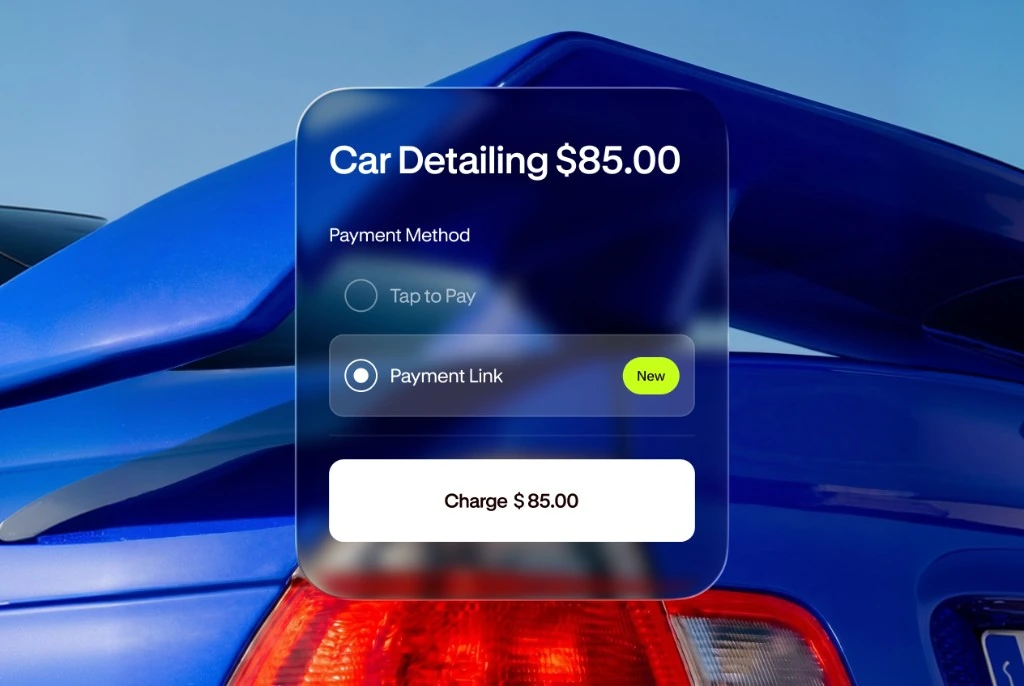
For remote sales, online payment acceptance uses a payment link or checkout. JIM Payment Link collects card-not-present payments with built-in 3D Secure. Recurring billing saves a card for repeat charges.
Business-to-business acceptance collects from another business, usually by invoice. Some invoices settle by Automated Clearing House, or ACH, transfers, a bank-to-bank route that costs less but clears slower. JIM ACH Transfer moves your balance to a bank account; it is not a way to accept ACH payments.
ACH vs Card for B2B
B2B payments split into two paths: card or bank transfer. Card payments settle instantly to your JIM Card at the Tap to Pay rate, which fits deposits and small balances. ACH transfers move your existing balance to a U.S. bank account you own at 1.99% plus $0.99 with a $15 minimum, arriving the same business day. Use the card path when speed matters and the ACH path when the customer or vendor prefers a bank-to-bank transfer.
How Payment Acceptance Works From Tap to Settlement
Every card sale follows the same five-step path from the customer's tap or link to money you can spend. The steps show where a payment stalls and when cash lands.
The customer starts the payment. They tap a card or wallet at your counter, or open your Payment Link for a remote sale.
The details are secured and routed. The system encrypts the card data and sends it to the customer's bank. On a Payment Link, 3D Secure adds a bank verification step.
The bank approves or declines. It checks funds and fraud signals, then returns a yes or no. Each decision feeds your authorization rate.
Confirmation returns to you. An approval posts the sale; a decline sends a reason code you can act on before the customer walks.
Settlement releases the proceeds. With JIM, funds land instantly on your JIM Visa Prepaid Card. Moving that balance to a U.S. bank account you own uses JIM ACH Transfer at 1.99% plus $0.99, with a $15 minimum, arriving the same business day. Traditional credit card processing takes 1 to 3 business days.
Approval and settlement are separate events. Judge a provider's security at step two and its payout promise at step five.
Compare Fees, Security, and Cash Access Before You Enroll
Before you enroll, compare each channel on the same sale amount and check how quickly the money becomes usable. A headline percentage hides the fixed cents, security step, and payout route.
| Compare on | In-person Tap to Pay | Remote Payment Link |
|---|---|---|
| Fee per sale | Flat 1.99%, no monthly or hidden fees | 4.99% plus $0.30 |
| On a $50 sale | About $1.00 in fees, roughly $49 kept | About $2.80 in fees, roughly $47.20 kept |
| Hardware | None; a compatible phone is the terminal | None; you send a link |
| Security | Certified card-data security infrastructure | Built-in 3D Secure bank check |
| Cash access | Instant to the JIM Visa Prepaid Card | Instant to the JIM Visa Prepaid Card |
Source: JIM pricing, accessed August 2026.
Run the Fee on a Representative Sale
Suppose a plumber in Austin with a $75 service call. She texts a $40 deposit through Payment Link, costing about $2.30 and leaving $37.70. She taps the remaining $35 on site through Tap to Pay, costing about $0.70 and leaving $34.30. Run your own numbers through the "what you keep" calculator on the pricing page.
Verify Methods and Protection by Channel
Both channels run on infrastructure certified to the Payment Card Industry Data Security Standard, or PCI DSS, version 4.0.1, the rules that protect cardholder information. Source: PCI Security Standards Council. Payment Link adds a 3D Secure step where the bank verifies a remote sale. Confirm the exact cards and wallets each channel accepts, because protection and methods are set per channel.
Before you sell, confirm the eligibility conditions:
- A full approved seller registration.
- Tap to Pay processed within U.S. territory.
- Each contactless sale is at least $1.
Improve Payment Acceptance With a Three-Step Check
Improve payment acceptance by testing each channel against your real payment moments before you enroll, then watching approvals once sales start. The check protects your authorization rate and cash flow.
List every payment moment. Note where customers pay you, in person and remotely, so no channel gets an afterthought setup.
Run the fee and payout path on a representative sale. Work out what you keep and when the money lands, not the advertised percentage alone.
Confirm accepted methods and the security control. Check the cards and wallets each channel takes and the step that verifies a remote sale.
A few habits then increase acceptance once you are live:
- Keep checkout clear, showing the contactless or link option first.
- Offer the methods your customers use, not one card network.
- Monitor declines by channel to catch a slipping payment approval workflow early.
- Keep card details accurate, since typos and expired cards cause avoidable declines.
Common Decline Codes and Fixes
Decline codes tell you why a bank rejected a card. The most common ones:
| Code | Meaning | Fix |
|---|---|---|
| 05 | Do not honor | Ask the customer to call their bank, then retry or use another card |
| 51 | Insufficient funds | Offer another payment method or retry later |
| 54 | Expired card | Ask for a current card |
| 65 | Exceeds withdrawal limit | Split the sale or use another card |
Fee pass-through optimizes payment acceptance without shrinking your margin: choose per sale whether you or the customer covers the JIM fee on Tap to Pay and Payment Link. Surcharging is banned in Connecticut, Massachusetts, and Maine, so check your state's rules before passing the fee to customers. Source: National Conference of State Legislatures.
Take Contactless Payments Without Extra Hardware
If your checklist points to in-person collection, contactless payment on the phone you carry is the fastest next step.
JIM Tap to Pay turns a compatible iPhone XS or later, or an Android with near-field communication, or NFC, the capability that lets a customer tap a card or wallet, into a payment terminal with no extra hardware.
See how the flat 1.99% fee and same-day payouts work before you commit. It charges a flat 1.99% per sale, with full approved registration required before you sell. Run your sale through the pricing comparison, then get started at https://onboarding.jim.com.



Sell and get paid in seconds with Jim